JetBlue Airways has officially announced the launch of BlueFirst, a dedicated domestic first-class product designed to reshape the carrier’s narrowbody short- and medium-haul network. Unveiled on Wednesday, November 11, the new cabin architecture represents a major pivot for an airline that has relied almost exclusively on a single-cabin economy model and its premier transcontinental Mint service throughout its 26-year history. With the debut flight scheduled for December 8, JetBlue is positioning the product to capture a growing demographic of leisure and business travelers seeking elevated comfort on shorter routes where traditional first-class options have historically been inconsistent or unavailable.
The introduction of BlueFirst marks an operational transformation for the carrier. For over two decades, JetBlue carved out a distinct market position as a customer-focused, value-driven alternative to legacy carriers, offering uniform economy seating supplemented by extra-legroom "Even More Space" seats. The sole exception to this single-class configuration has been Mint, a lie-flat business-class product deployed on high
-density transcontinental and transatlantic routes, such as New York (JFK) to Los Angeles (LAX) and London. However, airline executives emphasize that BlueFirst is entirely distinct from Mint. The two products will never coexist on the same aircraft; while Mint remains fitted to widebody and select transcontinental narrowbody aircraft as a lie-flat bed experience, BlueFirst will be retrofitted onto the remainder of the carrier’s fleet as a comfortable, premium recliner seat intended for shorter domestic and near-international leisure corridors.

Design, Engineering, and Cabin Specifications
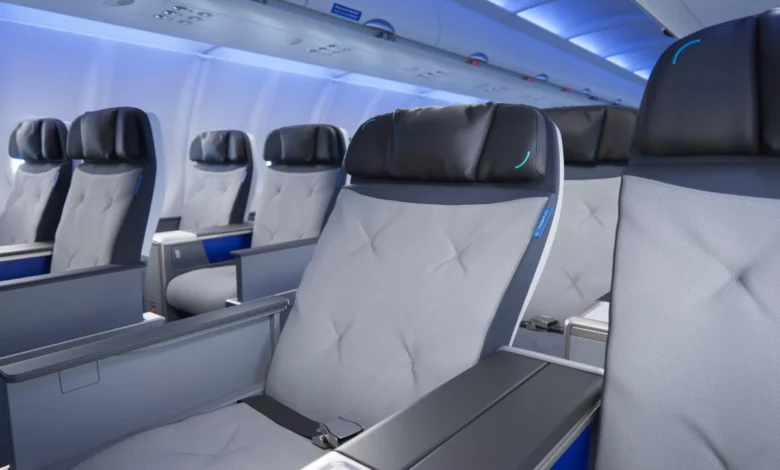
The physical configuration of the BlueFirst cabin has been carefully engineered to maximize passenger comfort without sacrificing the aircraft’s overall economic efficiency. Occupying the first three rows of the aircraft, the cabin features a total of 12 seats arranged in a two-by-two configuration, effectively eliminating middle seats across all rows.
Each BlueFirst seat measures approximately three inches wider than standard economy seating and provides up to seven inches of additional legroom when compared to JetBlue’s regular Main cabin offering. The seats feature a five-inch mechanical recline designed to support various postures during flight. Ergonomics were a primary focus during development; JetBlue partnered with mattress manufacturer Tuft & Needle to incorporate proprietary T&N Flex foam into both the bottom cushions and backrests, ensuring responsive pressure distribution. Additionally, the seats include adjustable headrests equipped with folding side wings to provide stable head support during rest periods.
In alignment with JetBlue’s traditionally unpretentious brand identity, the carrier has opted against installing a physical curtain separating the BlueFirst cabin from the main economy section. Instead, subtle design cues and dedicated overhead bin allocations—reserved exclusively for BlueFirst passengers—delineate the premium space, streamlining the boarding process and mitigating the typical overhead storage scramble.
Comprehensive Onboard Amenities and Technological Integration
Passengers traveling in the BlueFirst cabin will receive an array of enhanced amenities designed to elevate the short-haul flight experience. Each seat is equipped with a 13.3-inch high-definition touchscreen featuring Bluetooth audio connectivity for personal wireless earbuds. Power options are comprehensive, offering USB-A, USB-C, and traditional AC power outlets at every seat, complemented by JetBlue’s signature complimentary high-speed Wi-Fi.

The passenger experience extends to physical comfort items and curated amenity kits. Travelers receive a soft blanket alongside a specialized amenity kit containing sustainably sourced socks, earbuds, mouthwash, and skincare items from OSEA Malibu, including hand cream, lip balm, and the brand’s popular calming pulse point oil.
Dining in BlueFirst varies according to flight duration, utilizing a bento-inspired boxed meal service on routes measuring 899 miles or greater. Menus rotate seasonally and by route, featuring cold or room-temperature items such as pastrami sandwiches with citrus cabbage slaw, tortellini pasta salads, and sesame noodles with Szechuan accompaniments, alongside specialty desserts like moist carrot cake with caramel icing, macarons, and pistachio chocolate cake. Breakfast options include hazelnut-ricotta crêpes, sweet potato and bean bowls with guacamole, and blueberry chia pudding. Dietary accommodations, including vegan, vegetarian, gluten-free, and kosher meals, are available. These selections are supplemented by a curated basket of premium snack offerings, featuring items from Sockerbit, Tosi, Wholesome Bakery, and Cape Cod.
Beverage service introduces a notable technological and experiential innovation: Mixologist Mode. Accessible via the seatback entertainment screen, this feature allows passengers to build custom cocktails or mocktails by selecting a base spirit, mixer, and up to four total components. Flight attendants then deliver the individualized ingredients to a dedicated, pop-out cocktail tray, allowing passengers to mix their drinks directly at their seats. Beverages are served in genuine glassware designed by Fable, resting on handmade watercolor coasters created by New York-based illustrator Danielle Rose Fisher. Non-alcoholic and specialty beverage options include wines curated by Parcelle, drip coffee from Joe Coffee and Cometeer, and teas from Smith Teamaker.
Ground Experience and Pre-Flight Privileges
The BlueFirst journey begins well before departure. Passengers holding BlueFirst tickets receive priority check-in privileges, access to expedited security screening lanes at more than 30 participating airports, and Group 1 priority boarding. Furthermore, fare structures are inclusive of checked baggage allowances; even the entry-level BlueFirst tier includes one complimentary checked bag, while higher-tier configurations include two free checked bags.

Rollout Timeline and Fleet Integration
The commercial rollout of BlueFirst is scheduled to begin in early December. The initial phase will launch with JetBlue’s daily service between Boston Logan International Airport (BOS) and Fort Lauderdale-Hollywood International Airport (FLL), quickly followed by the heavily traveled route between Fort Lauderdale and New York LaGuardia Airport (LGA).
Expansion will continue rapidly throughout 2026. Beginning in January, the product will debut on select flights from New York-JFK to Cancún, Liberia (Costa Rica), and San Juan (Puerto Rico). JetBlue plans to have just over a dozen aircraft retrofitted with the BlueFirst cabin by the conclusion of the year, with the remaining non-Mint fleet scheduled for complete retrofitting through the end of 2027.
Airline leadership has advised travelers that the availability of BlueFirst will depend on equipment scheduling during the multi-year transition period. Because aircraft swaps can occur due to maintenance requirements or operational scheduling adjustments, passengers are encouraged to verify specific aircraft configurations when booking tickets during the rollout phase.
Industry Implications and Competitive Analysis
The introduction of BlueFirst represents a calculated strategic evolution for JetBlue as it responds to shifting domestic travel demands. Historically, ultra-low-cost and low-cost carriers maintained strict single-class configurations to maximize seat density and operational simplicity. However, shifting consumer preferences post-pandemic have driven increased demand for premium domestic leisure products, prompting several low-cost and hybrid carriers to reconsider cabin layouts.

By establishing a standardized domestic first-class product across its Airbus narrowbody fleet, JetBlue bridges a significant operational gap. While Mint successfully captured premium transcontinental and transatlantic traffic, the absence of a mid-tier premium product on shorter domestic and Caribbean routes placed JetBlue at a competitive disadvantage against legacy carriers such as Delta Air Lines, American Airlines, and United Airlines, all of which feature domestic first-class cabins on virtually all mainline domestic routes.
Industry analysts note that the success of BlueFirst will hinge upon JetBlue’s ability to balance the added operational complexity of a multi-class narrowbody fleet with the ancillary revenue gains generated by premium fare classes. By utilizing fixed-configuration recliners rather than complex lie-flat mechanisms on short-haul aircraft, JetBlue aims to minimize weight, maintenance costs, and turnaround times while offering a differentiated product that aligns with its identity as a customer-centric, value-focused alternative in the U.S. aviation market.