Networks Scramble To Report On Reasons Behind Extraordinary Nationwide Ground Stop Of All U.S. Flights

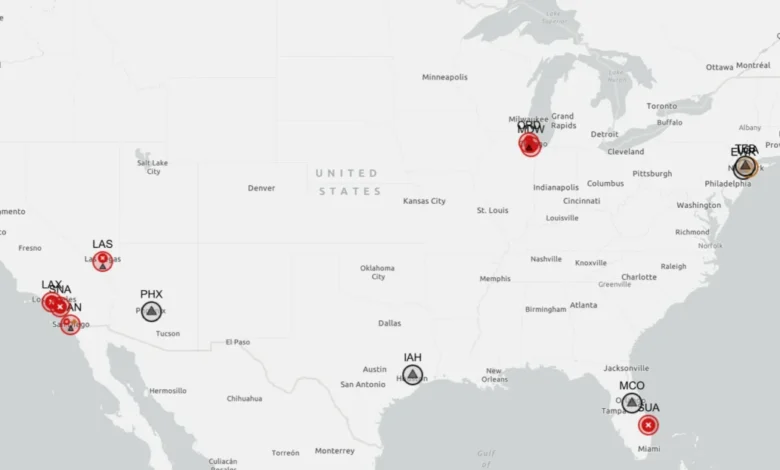
In an unprecedented disruption to the American aviation system, the Federal Aviation Administration (FAA) issued a sweeping nationwide ground stop on Friday, effectively freezing all air traffic across the United States. The directive, which caught travelers, airlines, and federal officials off guard, was characterized by the agency as an emergency measure necessitated by "extraordinary circumstances" and critical "reasons of safety." As news broke, the major broadcast and cable news networks, including CNN, Fox News, and MS NOW, pivoted to rolling coverage to address the cascading implications of the failure.
Transportation Secretary Sean Duffy addressed the nation shortly after the order was disseminated, confirming that the agency was grappling with a systemic failure. "This order follows a communication issue impacting all Air Route Control Centers," Duffy stated. "FAA technicians are currently working to isolate and resolve the technical failure to ensure the safety of the National Airspace System."
A System Under Duress: Chronology of the Crisis
The disruption began in the early morning hours, as Air Route Traffic Control Centers (ARTCCs)—the facilities responsible for managing aircraft in transit between airport terminal areas—began reporting anomalies in their internal communication networks. These centers serve as the backbone of the U.S. airspace, coordinating the high-altitude traffic that forms the grid of national aviation.
By mid-morning, the FAA officially declared a nationwide ground stop for all departing traffic. The directive specified that all flights currently on the ground were prohibited from departing, while aircraft already in the air were permitted to continue to their destinations, albeit under heightened monitoring and restricted routing protocols. Inbound international flights were placed into a "case-by-case" management category, with many being diverted, placed into holding patterns, or held at their points of origin.
The scale of this event is historic. While localized ground stops due to weather or minor equipment failures are relatively common in the aviation industry, a total national cessation of departures is an extreme measure reserved only for catastrophic system failures or national security threats. By noon, the ripple effects were visible across the country, with thousands of passengers stranded in terminals and flight information boards displaying a sea of red "delayed" or "canceled" notifications.
Technical Vulnerabilities and Infrastructure Challenges
Aviation analysts and industry experts have long warned that the aging infrastructure of the National Airspace System is increasingly susceptible to digital bottlenecks. While the FAA has been engaged in a multi-year effort to modernize its flight control systems—a transition commonly referred to as NextGen—the system remains a complex tapestry of legacy hardware and modern software interfaces.

"This is going to be chaos for hours, if not days, to come," remarked CNN aviation correspondent Richard Quest during the network’s live coverage. The complexity of the modern aviation network means that even a momentary pause in flight departures creates a backlog that can take days to fully clear. Because flights are tightly sequenced, a delay in one hub triggers a domino effect that disrupts crew scheduling, aircraft positioning, and slot availability at destination airports.
The communication issue, according to early reports from internal FAA memos, appears to have centered on the failure of the data links that transmit flight plans and real-time positioning updates between regional control centers and the primary FAA command center. When these data streams become corrupted or interrupted, air traffic controllers lose the ability to safely sequence aircraft, leaving the system effectively blind to the high-volume traffic patterns required for safe operations.
Economic and Operational Implications
The financial impact of a nationwide ground stop of this magnitude is staggering. Major carriers, including American Airlines, Delta, United, and Southwest, were forced to immediately suspend operations across their entire domestic networks. Analysts at aviation consultancy firms estimate that a full-day shutdown of the U.S. aviation system costs the economy roughly $300 million to $500 million in lost productivity, passenger rebooking costs, and logistical disruptions.
Beyond the immediate fiscal loss, the incident raises significant questions regarding the resilience of the nation’s transportation infrastructure. With the holiday travel season approaching, the timing of this outage has intensified calls from lawmakers for an immediate, transparent accounting of the failure.
"We need to know not just what happened, but why our primary aviation infrastructure was capable of failing at a national level," said a member of the House Committee on Transportation and Infrastructure in a preliminary statement. "The traveling public deserves a system that is redundant, robust, and capable of withstanding technical glitches without grinding the entire country to a halt."
FAA Response and Recovery Efforts
Throughout the afternoon, the FAA deployed teams of engineers to re-establish the integrity of the communication networks. The process of bringing the system back online is inherently cautious; the agency must verify the accuracy of the data being transmitted through the centers before clearing individual sectors for resumed traffic.
The FAA’s Office of Public Affairs released intermittent updates throughout the day, emphasizing that the primary objective remained the safety of the flying public. "We are working around the clock to restore full functionality to the Air Route Control Centers," the statement read. "Ground stops will be lifted incrementally as we verify the stability of our communications infrastructure."

For the thousands of passengers affected, the experience has been one of uncertainty. Terminal areas in major hubs like Hartsfield-Jackson Atlanta International, Chicago O’Hare, and Los Angeles International were reported to be at capacity as airlines scrambled to provide updates. The Department of Transportation has reminded airlines of their obligations to provide timely communication, rebooking options, and, where applicable, compensation for the significant delays.
Broader Context: Cybersecurity and System Resilience
While the FAA has attributed the incident to a "communication issue," the nature of the outage has inevitably led to discussions regarding cybersecurity. In an era where critical infrastructure is increasingly digitized, the threat of cyber-interference or ransomware attacks remains a primary concern for the Department of Homeland Security and the Cybersecurity and Infrastructure Security Agency (CISA).
As of late Friday, there has been no official indication that the ground stop was the result of a malicious cyberattack. However, the sensitivity of the aviation control system means that any failure—regardless of origin—will be subject to a rigorous forensic investigation. The investigation will likely involve the National Transportation Safety Board (NTSB) and, should evidence suggest a security breach, federal law enforcement agencies.
Looking Ahead
The coming days will be defined by the "recovery phase." Even after the FAA clears the airspace for normal operations, airlines will face the gargantuan task of repositioning crews who have timed out of their duty shifts, managing the backlog of thousands of grounded aircraft, and navigating the logistical nightmare of thousands of displaced passengers.
For the FAA, the incident serves as a stark reminder of the challenges inherent in maintaining a 21st-century aviation network. As the agency pivots toward long-term recovery, the focus will shift from the immediate cause of the failure to the structural changes required to prevent a repeat of this historic disruption. The aviation community remains on high alert, awaiting further instructions as the nation attempts to resume its regular rhythm of travel.
As Secretary Duffy and other officials continue their oversight of the restoration process, the transparency of the FAA’s final report on the incident will be critical in restoring public confidence in the safety and reliability of American air travel. For now, the airspace remains under strict control, a quiet testament to the fragility of the systems that move millions of people across the country every single day.