President Donald Trump Announces Removal of 10 Percent Tariff on Irish Whiskey During Irish Open Ceremony

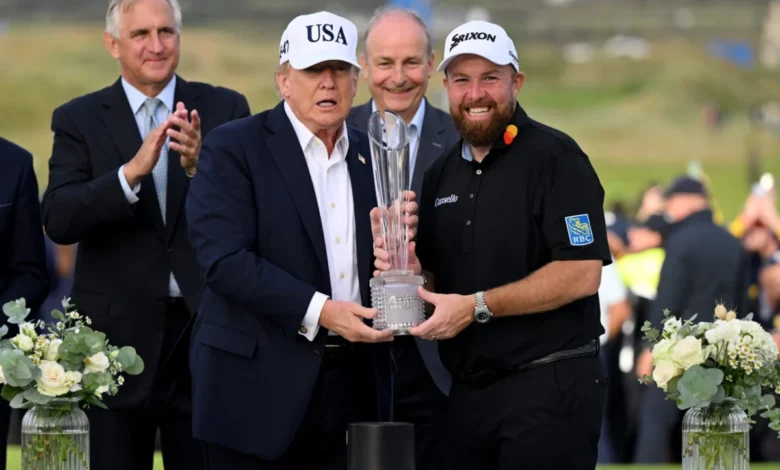
In a move that caught many observers by surprise, U.S. President Donald Trump announced on Sunday at the conclusion of the Irish Open golf tournament that his administration intends to eliminate the 10 percent tariff currently imposed on Irish whiskey. The announcement, delivered during the trophy ceremony, marked a significant policy pivot that promises to reshape trade dynamics between the United States and the Republic of Ireland. While the president offered little in the way of specific timelines, the declaration was met with immediate approval from the sporting crowd and is expected to provide a much-needed boost to the Irish spirits industry, which has navigated a complex landscape of international trade barriers for several years.
The decision to lift the levy follows a period of intense lobbying by industry groups and follows a broader pattern of Trump’s administration recalibrating its tariff approach toward European alcohol imports. The current 10 percent rate was the result of a previous adjustment in July, which saw the tariff reduced from its former level of 15 percent. By signaling the total removal of this tax, the administration appears to be pivoting toward a more conciliatory stance regarding specific luxury goods and spirits imported from the European Union.
A Diplomatic Gesture on the Greens
The setting for the announcement was deliberate, occurring against the backdrop of the Irish Open, an event of immense cultural and economic significance to Ireland. President Trump, an avid golfer and proprietor of high-end golf courses in the region, noted that the topic of trade had become a recurring theme during his interactions with attendees and professional golfers throughout the tournament.
"Everybody has been bugging me to do it," Trump remarked to the crowd. "And I said, ‘On behalf of the United States of America, I am going to take the tariffs off’ Irish whiskey." The remark drew loud cheers and whistling, underscoring the popularity of the move among the local demographic. For the Irish whiskey sector, which has seen explosive growth in the U.S. market over the last decade, the removal of the tariff is seen as a vital step toward reclaiming price competitiveness and ensuring stable export channels.
The Chronology of Trade Tensions
To understand the weight of this announcement, it is necessary to examine the timeline of trade relations between the U.S., the U.K., and the EU regarding spirits. The friction began as part of a series of tit-for-tat trade disputes involving subsidies for aerospace giants—specifically the long-running Airbus-Boeing conflict—which led to the imposition of tariffs on a wide range of goods, including Scotch and Irish whiskey.
- October 2019: The U.S. imposed a 25 percent tariff on various European goods, including single-malt Scotch and Irish whiskey, as part of a World Trade Organization (WTO) dispute resolution.
- May 2024: In a significant breakthrough, the Trump administration announced the lifting of certain tariffs on U.K.-produced whiskey, including Scotch and spirits distilled in Northern Ireland. This move was widely attributed to successful diplomatic outreach by the British monarchy.
- July 2024: The U.S. reduced the tariff on remaining European Union-origin whiskey from 15 percent to 10 percent, a measure intended to ease the burden on consumers and distributors.
- September 2024: President Trump announces the total removal of the 10 percent tariff on Irish whiskey at the Irish Open, effectively aligning the treatment of Irish spirits with those of the U.K.
The timeline reflects a shift in strategy. While the initial tariffs were intended as leverage in broader trade negotiations, the specific focus on whiskey appears to have evolved into a tool for targeted diplomatic goodwill.
Diplomatic Precedent: The U.K. Whiskey Exemption
The president’s announcement on Sunday bears a striking resemblance to the policy shift regarding U.K. spirits earlier this year. Following a visit to the White House by King Charles III and Queen Camilla, President Trump credited the royal couple with facilitating the change. "The King and Queen got me to do something that nobody else was able to do, without hardly even asking," Trump posted on his social media platform at the time.
This success provided a blueprint for the Irish whiskey industry. The Scotch Whisky Association (SWA) confirmed on July 24 that the zero-tariff policy for their exports had reached full implementation. The success of the SWA’s advocacy likely served as a catalyst for the Irish Whiskey Association (IWA), which had been vocal in its demand for parity. By removing the tariff on Irish whiskey, the U.S. government eliminates a competitive disadvantage that had previously favored U.K. producers over their Irish counterparts in the American retail space.
Economic Implications for the Spirits Industry
The Irish whiskey market is a cornerstone of the Irish economy. According to data from the Irish Whiskey Association, the U.S. is the largest export market for the spirit, accounting for over 40 percent of total global sales. The imposition of tariffs in previous years had forced distillers to either absorb the additional costs—thereby shrinking profit margins—or pass the costs onto consumers, which risked suppressing demand.
The removal of the 10 percent tariff is expected to have several immediate effects:
- Consumer Price Stabilization: Retailers are expected to adjust prices downward, potentially increasing the volume of sales in a highly competitive market.
- Supply Chain Certainty: For U.S.-based companies that hold large portfolios of Irish spirits, the removal of the tariff eliminates the "uncertainty factor" that had complicated long-term inventory planning and marketing strategies.
- Market Expansion: Small and medium-sized craft distilleries, which lacked the capital reserves of larger conglomerates to absorb tariff costs, will likely see the most significant relief.
Industry analysts suggest that the move could lead to a broader harmonization of spirits trade. However, they also caution that the lack of a formal, written agreement or a defined timeline leaves a degree of ambiguity. While the president’s word carries significant weight in executive-led trade policy, businesses are waiting for formal notifications from the Office of the United States Trade Representative (USTR) to confirm the effective date of the removal.
Reaction from Stakeholders
The Irish Whiskey Association has long argued that the tariffs were essentially a "tax on consumers" rather than an effective trade weapon. Their stance was that the products affected were not readily substitutable with domestic American products, meaning the tariff did not protect U.S. distillers but rather acted as an artificial inflation of price for the end user.
While official statements from Irish government officials were pending as of Sunday evening, the sentiment from the industry is one of relief. "This is a welcome development that recognizes the distinct nature of the Irish spirits trade and its importance to the transatlantic economic relationship," a spokesperson for a major Dublin-based distillery suggested informally.
Conversely, some economists warn that such "ad-hoc" tariff removals could signal a more unpredictable trade environment. By relying on personal rapport and public announcements during social events to dictate trade policy, the administration departs from the traditional, institutional approach of structured trade negotiations. While the outcome is beneficial for the whiskey industry in the short term, trade policy experts emphasize the need for a codified framework to prevent future volatility.
Looking Ahead: The Future of Transatlantic Trade
As the global economy faces ongoing inflationary pressures, the decision to remove tariffs on consumer goods is viewed as a pro-growth measure. However, the move also raises questions about what other sectors might be addressed. If the removal of whiskey tariffs is part of a wider trend of "resetting" relations with European partners, it could signal further adjustments in agricultural or manufacturing sectors in the coming months.
For now, the focus remains on the implementation phase. As the USTR prepares the necessary documentation to translate the president’s promise into reality, the spirits industry will be watching closely for the fine print. The removal of the 10 percent tariff is more than just a tax break; it is a symbolic restoration of trade fluidity between the United States and Ireland, ensuring that the storied export remains a fixture on American shelves for years to come. The cheers at the Irish Open were not just for the golfers on the green, but for a resolution that will be toasted in homes and bars across the United States.