Empowering the Next Generation: How TED-Ed Student Talks is Shaping Global Education Standards

In an era defined by rapid technological disruption and the widespread integration of artificial intelligence into the workforce, educators worldwide are re-evaluating the core objectives of the modern classroom. As rote memorization becomes less relevant in a world where information is instantly accessible, school leaders are shifting their focus toward "durable skills"—the human-centric competencies that remain resilient against automation. At the forefront of this pedagogical evolution is the TED-Ed Student Talks program, a global initiative designed to bridge the gap between traditional curriculum and the essential real-world capabilities required for the 21st-century labor market.
The Evolution of Student-Led Learning
The genesis of the TED-Ed Student Talks program lies in the fundamental belief that students, regardless of age, possess unique ideas worthy of a global platform. Since its inception, the program has evolved from a simple extracurricular activity into a structured, scalable framework that serves students aged 6–18. By providing a guided journey—moving from the initial "discovery" of a passion, through the iterative process of script development, to the final "share" phase—the program transforms the abstract concept of "student voice" into a measurable, tangible outcome.
The methodology is rooted in three distinct units: Discover, Develop, and Share. This chronological progression mirrors the cognitive development of students, allowing them to engage with their own ideas through the lens of critical inquiry. By forcing students to condense complex concepts into succinct, engaging presentations, the program facilitates a mastery of rhetoric, research, and empathy that is rarely achieved in traditional test-based environments.
Data-Driven Competency: The Rise of Durable Skills
The urgency behind programs like TED-Ed Student Talks is underscored by the World Economic Forum’s Future of Jobs Report 2025. The report identifies a clear shift in labor market demand, prioritizing cognitive and social skills such as curiosity, lifelong learning, critical thinking, and emotional intelligence. These are categorized as "durable skills," defined as competencies that maintain their value across diverse professional roles regardless of industry-specific technological shifts.
Analysis of student performance data from various participating regions reveals a strong correlation between participation in structured public speaking and academic success. For instance, in Romania, educator Andreea Laurențiu conducted a comparative study of student performance and found that participants in the TED-Ed program outperformed their peers in oral assessment components by a statistically significant margin. Similarly, district-wide implementation in California has seen improvements in reading vocabulary benchmarks and, perhaps more tellingly, a measurable increase in student sentiment scores regarding their sense of belonging within the school community.
A Global Framework for Diverse Curricula
One of the primary challenges in modern education is the disparate nature of national and regional learning standards. A curriculum that works in one country may struggle to find purchase in another. To address this, the TED-Ed Student Talks framework has been meticulously designed to integrate with established global standards, including the Common Core State Standards, the International Baccalaureate (IB) Learner Profile, the ISTE Standards for Students, and the Asia Society’s Global Competence Framework.
In Germany, educators have utilized the program to meet specific IB standards regarding research and advanced speaking requirements. In São Paulo, Brazil, Carolina Batisteli Marques de Mello has adapted the program to meet national mandates concerning the analysis of viewpoints and discourse intent. By incorporating "lateral reading" and advanced fact-checking techniques, she has successfully integrated modern information literacy into the presentation-writing process. This flexibility ensures that the program is not an "add-on" but a vehicle for achieving the academic outcomes schools are already required to meet.
Practitioner Perspectives and Institutional Impact
The impact of the program is best understood through the experiences of the educators on the ground. In diverse settings ranging from New York City public schools to classrooms in Dharamshala, India, the common thread is the transformation of the student’s identity from a passive learner to an active communicator.
Paul Weiss, an educator based in New York, reports a observable uptick in student leadership and self-expression, noting that the program provides a "safe space for the trial-and-error process of building confidence." This is echoed by Neera Channan in India, who emphasizes the shift in interpersonal dynamics: "Students have developed the ability to ask deeper, more purposeful questions, which in turn fosters a culture of constructive peer-to-peer feedback."
The psychological shift in students who were once reticent to speak in class is perhaps the most compelling evidence of the program’s efficacy. Laura El Chami, working in Saudi Arabia, recalls a student whose transformation from a silent observer to an articulate speaker served as a turning point for her entire peer group. For these students, the act of standing on a stage is more than a speech; it is a declaration of personal agency.
The Intersection of AI and Human Cognition
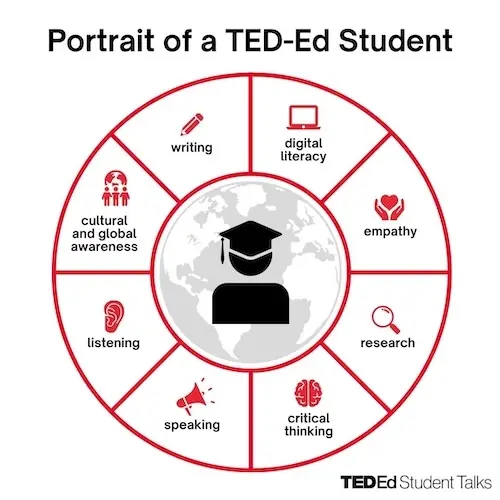
As artificial intelligence begins to handle data synthesis and basic content creation, the human elements of communication—empathy, perspective-taking, and active listening—are becoming the primary differentiators for future success. The TED-Ed approach requires students to engage with their audience’s perspective, a core component of empathy. By learning to structure their ideas for a specific audience, students practice a level of audience awareness that is difficult to replicate through algorithmic tools.
Furthermore, the program fosters digital literacy by mandating that students vet their sources and understand the credibility of the information they present. In an age of misinformation, this training is not merely academic; it is a societal necessity. The emphasis on "thinking for oneself" rather than "what to think" creates a defensive layer against the echo chambers often found in digital media environments.
Challenges and Future Implications
Despite the success of the program, school leaders face the inherent challenge of resource allocation. Implementing a program that requires significant time, mentorship, and logistical support requires institutional buy-in. To secure this, educators are increasingly utilizing a combination of qualitative storytelling and quantitative data. By tracking metrics—such as participation rates, survey-based confidence scores, and standardized test improvements—program leads are better equipped to demonstrate the return on investment to administrators.
The long-term implication of this work is a generation of leaders who view public speaking as a form of leadership. As Moroccan educator Hossam Souhaili notes, "Speaking in front of people is also leading people." This suggests that the impact of the TED-Ed Student Talks is not confined to the duration of the school year; it is an investment in the civic and professional leadership of the next decade.
Conclusion: Preparing for an Uncertain Future
The alignment of TED-Ed Student Talks with global standards and the focus on durable, human-centric skills provides a roadmap for schools attempting to modernize their offerings. By fostering environments where students are encouraged to research, synthesize, and share their ideas, educational institutions are doing more than preparing students for exams—they are preparing them for the world beyond the classroom.
As the program continues to expand, its ability to remain flexible and culturally responsive will be key to its continued success. With the ongoing support of educators and the continued integration into formal curricula, the initiative stands as a testament to the idea that the most effective way to educate a child is to trust them with the platform to share their own thoughts. For school leaders and teachers looking to bridge the gap between current standards and future realities, the framework offered by student-led talks provides a sustainable, measurable, and deeply transformative solution.