Navigating America’s Record-Breaking Housing Market: Why Homes Are So Expensive and What Lies Ahead

The contemporary American housing market is defined by historic pressures, characterized by record-high home values, elevated mortgage rates, and complex economic currents that have fundamentally altered the landscape for buyers, sellers, and renters alike. With national home prices hitting a record median of $409,000 in June 2026—surging nearly 20% over a five-year span—the American dream of homeownership has grown increasingly elusive. Elevated borrowing costs, persistent inflation, escalating property taxes, and soaring homeowners insurance premiums have steadily pushed monthly housing expenses higher, sidelining a vast segment of potential buyers.
This environment has created a slow-moving, expensive market that technically favors buyers who possess strong purchasing power, yet keeps them pinned to the sidelines due to severe affordability hurdles. Consequently, many Americans are priced out of starter homes and are opting to rent instead. Current market analyses indicate that renting has become more affordable than buying in every major U.S. metropolitan area, reshaping how younger generations, particularly Gen Z, approach long-term financial stability and housing. Industry experts argue that resolving these systemic pressures will require a synchronized, multi-tiered effort from federal policymakers, local zoning boards, and private housing developers to bridge the gap between supply and demand.
A Chronology of Crisis: How the Housing Market Reached This Tipping Point
To understand why residential real estate has reached its current valuation, it is necessary to examine the historical trajectory of American homebuilding and economic policy over the past two decades. The roots of today’s severe housing shortage trace back to the Great Recession of 2007–2009. During this period, housing prices experienced a catastrophic freefall, triggering widespread foreclosures and bankruptcies across the residential construction industry. Countless developers went out of business, and the skilled labor force dispersed.
In the decade following the financial crisis, the U.S. homebuilding sector never fully recovered its pre-recession momentum. Construction rates lagged behind population growth and demographic demand year after year, quietly accumulating a massive deficit in housing stock.
This chronic underbuilding set the stage for the unprecedented whiplash of the COVID-19 pandemic beginning in 2020. Propelled by historic lows in mortgage rates, a massive wave of millennial buyers entering peak homebuying age, and a pandemic-driven desire for more living space, the market erupted into a buying frenzy. This surge rapidly drained the already limited inventory down to record-low levels.
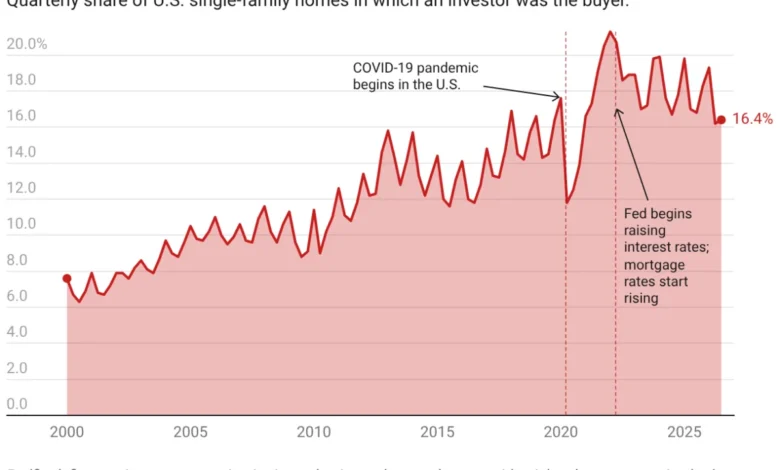
By 2021 and 2022, institutional investors and everyday buyers alike aggressively competed for sparse inventory, driving home prices up at double-digit annual rates. Institutional investors captured a record share of the market, purchasing tens of billions of dollars worth of residential properties—peeking at roughly 21% of total home purchases by 2022.
As inflation surged in the wake of pandemic stimulus and supply chain disruptions, the Federal Reserve responded by aggressively hiking interest rates. Mortgage rates doubled from historic lows near 3% to well over 6% and 7%. While these higher rates were intended to cool inflation, they inadvertently locked existing homeowners into their low-rate mortgages, deterring them from selling and further paralyzing inventory growth. By 2025 and 2026, the market entered a prolonged period of stagnation: home price appreciation slowed to a more modest annual pace of around 2%, but cumulative historical gains combined with high borrowing costs left overall affordability near historic lows.
The Three Pillars of High Housing Costs
Industry analysts and economists point to three primary structural factors driving today’s record-high housing prices: a severe nationwide housing shortage, restrictive local zoning laws, and a significant market footprint left by residential real estate investors.
First, the U.S. faces a profound inventory deficit. Depending on the methodology used, estimates place the national housing shortage anywhere from 1.5 million to 7 million units. This supply-and-demand imbalance means too many buyers compete for too few properties. The shortage is acutely felt in the starter-home segment, as developers have historically favored constructing larger, higher-margin homes, and older homeowners are aging in place significantly longer than previous generations, holding onto properties for an average of 12 years or more.
Second, legacy zoning laws continue to throttle new construction. In many metropolitan regions across the United States, single-family zoning regulations established decades ago prohibit developers from building multifamily or higher-density housing at scale. For instance, in California—a state grappling with one of the most severe housing deficits in the nation—approximately 96% of residentially zoned land is restricted exclusively to single-family detached homes. These regulatory walls prevent efficient land use and drive up land acquisition costs per unit. Furthermore, a persistent rise in construction materials costs, driven in part by trade policies and tariffs, has further disincentivized private homebuilding.
Third, the proliferation of real estate investors has altered market dynamics. While large institutional investors account for only a small fraction (around 1%) of total home purchases, broader business and corporate entities have collectively held a much larger share of residential real estate since the pandemic. Many of these acquired properties are converted into rental units or integrated into build-to-rent communities. While this injects much-needed inventory into the rental market, it directly reduces the pool of existing properties available for traditional, owner-occupied home purchasers.
Official Responses and Legislative Intervention
Recognizing the severity of the affordability crisis, federal and state policymakers have introduced various legislative measures and executive actions aimed at jump-starting construction and easing cost pressures.
At the federal level, executive actions have been deployed to streamline development. Policies focused on reducing federal environmental regulations and exploring opportunities for affordable housing construction on federal land have been enacted to encourage building. Simultaneously, federal lawmakers have pursued legislative remedies, highlighted by the passage of the ROAD to Housing Act, which aims to improve overall housing supply and curb certain predatory practices by large-scale investors competing directly with everyday homebuyers. Proposals have also surfaced to restrict institutional investors from acquiring large portfolios of single-family starter homes, with proponents arguing that such measures will return critical inventory to main street buyers.
However, housing economists urge caution regarding heavy-handed regulatory restrictions on investors. Chen Zhao, Head of Economics Research at Redfin, noted that while limiting investor participation sounds beneficial for prospective homeowners on the surface, it fails to address the root cause of the crisis. Restricting investor purchases can inadvertently diminish the supply of rental housing, subsequently placing additional upward pressure on the broader housing market if displaced renters transition into the pool of desperate buyers.
State legislatures are also stepping up to lead housing and zoning reforms. A growing number of states have begun overriding local zoning restrictions, passing laws that permit accessory dwelling units (ADUs), duplexes, and transit-oriented multifamily developments. These legislative pushes have helped keep multifamily construction relatively robust, which in turn has prevented rental costs from skyrocketing at the same catastrophic pace as for-sale home prices.
Economic Implications and Market Outlook
Looking toward the remainder of 2026 and into 2027, national home prices are widely expected to avoid a severe nationwide crash, instead experiencing slow, modest appreciation or localized stabilization. While year-over-year price growth has cooled significantly compared to the pandemic era—and some overheated regional markets in the South have actually seen minor price corrections—structural deficits ensure that prices remain structurally elevated.
Broader macroeconomic volatility continues to cast a long shadow over the sector. Trade tariffs continue to apply upward pressure on the cost of essential building materials like lumber and steel. Ongoing labor market shifts and immigration enforcement policies threaten to further shrink the construction workforce, amplifying labor shortages that have plagued homebuilders for years. Additionally, geopolitical tensions and their subsequent shocks to global oil prices and bond markets continue to weigh heavily on consumer confidence and builder sentiment.
Daryl Fairweather, Redfin’s Chief Economist, emphasized the scale of the challenge: "It’s normal for house prices to rise gradually over time, but decades of underbuilding, rising economic uncertainty, and the whiplash from the pandemic have left today’s housing market historically slow and expensive. Closing the housing shortage and bringing costs back to more sustainable levels will require a coordinated effort from policymakers and the housing industry. Until then, homeownership will remain out of reach for many Americans."
Navigating the Regional Divide
Real estate market conditions currently vary drastically depending on geography, dividing the country into distinct regional micro-markets. In parts of the Midwest, the Northeast, and high-demand enclaves like the San Francisco Bay Area, robust demand coupled with ultra-low inventory means buyers still heavily outnumber sellers, causing well-priced properties to move rapidly and sustaining upward price pressure. Conversely, across numerous high-growth sunbelt cities in the South, home prices have begun to soften as new construction deliveries catch up with demand and frustrated sellers outnumber active buyers.
For prospective buyers and sellers, understanding these hyper-local dynamics is essential. Buyers are advised to leverage their current negotiating power—stemming from a lack of active market competition—while carefully evaluating their long-term financial readiness in an environment of high borrowing costs. Sellers, meanwhile, must realistically price their properties to meet the expectations of affordability-constrained buyers, acknowledging that the days of rapid, no-inspection bidding wars have largely subsided.
Ultimately, America’s housing affordability crisis is a structural dilemma born of chronic underbuilding, exclusionary zoning, and broader economic headwinds. While legislative frameworks and local zoning reforms offer a pathway toward gradual recovery, a meaningful return to historical affordability will depend entirely on sustained, long-term expansion of the nation’s housing inventory across all price points.