In a significant pivot for the enterprise artificial intelligence landscape, Anthropic has officially moved to consolidate its disparate AI tools into a single, cohesive ecosystem. Beginning in October 2026, the company is merging Claude Chat, Claude Cowork, Artifacts, and Design into one unified interface. This structural evolution is designed to mitigate user friction and streamline the deployment of "Skills"—reusable instruction sets that allow the AI to perform complex, multi-step tasks autonomously. By transitioning from a fragmented suite of applications to an integrated agentic framework, Anthropic is positioning its platform as a central operating system for knowledge workers, effectively blurring the lines between conversational AI and automated task execution.

The evolution of Claude from a text-based chatbot to an autonomous agentic platform reflects a broader industry trend toward "agentic workflows." These workflows move beyond simple prompt-response interactions, enabling AI to access local desktop files, execute multi-stage processes, and coordinate sub-agents. A Claude Skill acts as the bridge between intent and action, serving as a container for instructions, templates, and reference materials that the model loads only when necessary—a process known as "progressive disclosure."
The Chronology of Integration
The push toward a unified interface follows months of rapid iteration. Throughout 2026, users were often required to navigate between different surfaces—Claude Chat for ideation, Cowork for file management, and various design tools for visual output. Industry analysts have long pointed to this "tab-switching fatigue" as a primary barrier to enterprise adoption.

By October 2026, this hurdle was systematically addressed. The rollout prioritizes users on Pro, Max, and Team plans across web, desktop, and mobile platforms. The integration ensures that existing projects, connectors, and saved skills are preserved, allowing for a seamless transition. For organizations that have spent the last year building out custom AI-driven processes, this centralization represents a critical milestone in operational stability.
Understanding the Architecture of a Skill
At its core, a Claude Skill is a specialized, reusable instruction set. Unlike a static prompt that a user might copy and paste into a chat window, a skill is a modular component. It is a folder containing the logic and supporting assets required for a specific workflow. When a user invokes a skill, the model retrieves the relevant instructions, executes the task—such as reading or writing to local folders or generating a complex spreadsheet—and then returns to its baseline state.

This architecture solves the "prompt drift" problem, where instructions lose clarity over long conversations. Because skills are triggered by specific keywords or manual selection, the logic remains consistent regardless of the surrounding context.
Implementation and Operational Efficiency
The "Record a Skill" feature, currently available on Mac desktop versions for Pro and Team users, serves as a bridge for non-technical employees to automate complex tasks. By recording a screen-capture session while narrating the steps of a workflow, users can provide the AI with a visual and auditory roadmap. The model then synthesizes this demonstration into a structured, repeatable script.

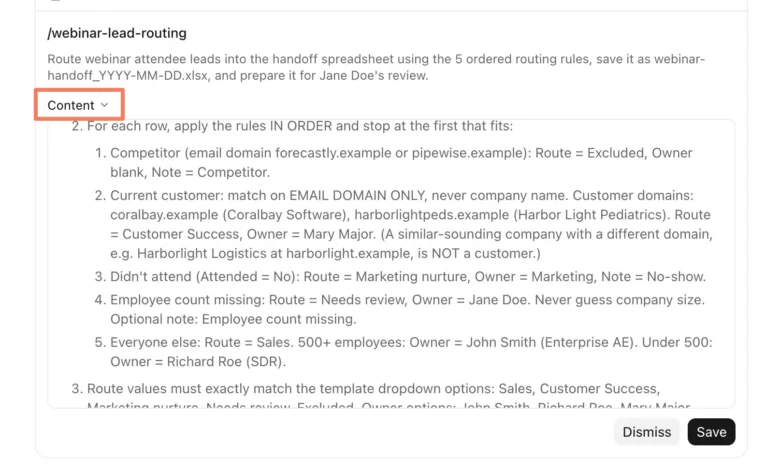
Data from early adopters suggests that this "demonstration-based" learning is significantly more effective than manual prompt engineering. For instance, a revenue operations team can record a weekly lead-routing process in under ten minutes, after which the AI can handle the task autonomously. This shift represents a move toward "low-code" AI development, where the ability to articulate a business process replaces the need for traditional programming knowledge.
Strategic Use Cases for the Enterprise
The impact of this integration is most pronounced in departments that rely on high-volume, repeatable data processing.

Marketing Operations: Marketing teams often struggle with the reconciliation of data from disparate sources like LinkedIn Ads, Google Analytics, and CRM platforms. A "Performance Memo" skill can now ingest multiple raw data exports, synthesize them, and produce a standardized, executive-ready report. By automating the data-wrangling phase, marketing managers can focus on strategic adjustments rather than administrative reporting.
Sales and Legal Triage: The contract review process is frequently cited as a bottleneck in the sales cycle. By utilizing a "Redline Triage" skill, sales teams can scan prospect-initiated contract changes against established organizational playbooks. The AI can highlight deviations, suggest fallback language, and categorize risks before the document ever reaches the legal department. This drastically reduces the time-to-close for enterprise deals.

Customer Service and Technical Support: For support teams, the lag between a product update and internal knowledge distribution can lead to misinformation. A "Release Briefing" skill allows engineering teams to feed raw release notes into the AI, which then reformats them into concise, customer-facing talking points, ensuring that frontline support agents are prepared the moment a feature goes live.
Security and Data Hygiene: A Critical Consideration
As Anthropic grants Claude the capability to read and write files on a user’s desktop, security has become a primary concern. The company emphasizes that "pointing Claude at your desktop is equivalent to letting a new colleague rummage through every file you have."

To mitigate risk, standard security protocols have been established:
- Compartmentalization: Users are advised to create dedicated folders for AI-assisted tasks, ensuring that the model only has access to the files strictly necessary for the job at hand.
- Sanitization: Before recording a screen-based skill, users must ensure that sensitive information—such as internal account numbers, passwords, or PII—is obscured or replaced with dummy data.
- Verification: The "Human-in-the-Loop" requirement remains essential. For high-stakes operations, especially those involving CRM write-access, setting tools to "Needs Approval" ensures that no permanent changes are made to company records without a final human check.
The Role of Model Context Protocol (MCP)
The utility of Claude Cowork is significantly enhanced by its ability to interface with external systems through the Model Context Protocol (MCP). The HubSpot connector for Claude is a prime example of this synergy. By linking a CRM directly to the AI, users can ground their workflows in real-time business data.

This integration allows for context-aware tasks that were previously impossible, such as pulling a comprehensive pre-call brief on a prospect directly into a chat window. By combining the "how" (the skill) with the "what" (the CRM data), users can move from administrative tasks to high-value analysis in seconds. Furthermore, Anthropic has stated that information shared through these connectors is not used to train its base models unless the user specifically opts in, addressing long-standing enterprise concerns regarding data privacy.
Broader Implications and Future Outlook
The shift toward a unified, agentic interface marks a fundamental change in how software is consumed. If the previous decade was defined by the transition from on-premise software to cloud-based SaaS, the current era is defined by the transition from "software as a tool" to "software as a collaborator."

The primary implication for business leaders is the need for a shift in workforce training. As the capability to automate workflows becomes democratized, the competitive advantage will no longer lie in who has the most sophisticated software, but in who has the best-documented internal processes. A company’s "Skills Library" will effectively become a form of intellectual property, capturing the institutional knowledge of its most efficient employees and scaling it across the entire organization.
As this technology continues to mature, the focus will likely shift toward multi-agent coordination. We are already seeing the early stages of this, where a "manager" agent can trigger a "researcher" agent to gather data, followed by a "writer" agent to draft a document. The unification of the Claude interface is the necessary foundation for this more complex, autonomous future. For now, the directive to users is clear: start small, master a single repeatable workflow, and scale only once the reliability of the AI-driven output has been thoroughly vetted.
Related posts: