IHG Hotels & Resorts Prepares for the AI Search Era While Betting That Direct Guest Relationships Will Prevail

The hospitality landscape is undergoing its most profound structural shift since the advent of online travel agencies, driven by the rapid mainstream adoption of artificial intelligence in travel planning. As consumers increasingly turn to generative AI models and digital assistants to curate itineraries, select destinations, and choose accommodations, major hotel brands are rushing to adapt their digital infrastructure. Among them is IHG Hotels & Resorts, which is fundamentally restructuring how its vast portfolio of properties communicates with machines.
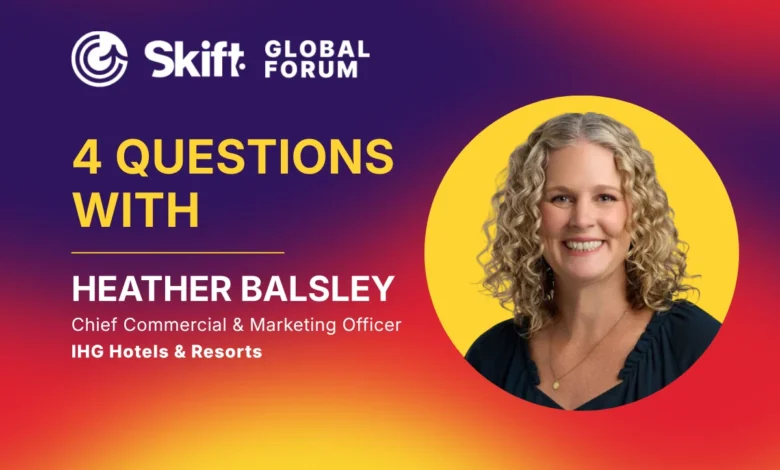
Heather Balsley, Chief Commercial and Marketing Officer at IHG Hotels & Resorts, is leading this charge. Her strategy relies on a dual-pronged approach: ensuring that IHG’s hotels are fully legible to AI search engines while simultaneously maintaining that automated recommendation engines will never replace the foundational, direct relationship a hotel brand builds with its guests. Balsley is scheduled to discuss this evolving digital paradigm live at the upcoming Skift Global Forum, taking place from September 22 to 24, 2026, in New York City. The high-profile event gathers global travel industry leaders—including executives from Booking Holdings and Expedia Group—to debate the intersection of emerging technology, consumer behavior, and commercial strategy.
The Digital Overhaul: Making Hotel Inventory AI-Ready
The core challenge facing hospitality marketers today lies in how artificial intelligence processes information. Traditional search engines relied heavily on keyword matching, metadata, and paid search positioning to surface hotel options. In contrast, generative AI assistants synthesize vast amounts of qualitative and quantitative data to answer highly nuanced, conversational queries from travelers. A user might ask an AI assistant to recommend a boutique hotel in downtown Chicago that offers quiet workspaces, pet-friendly amenities, and proximity to specific cultural landmarks.
If a hotel’s digital footprint lacks the granular content necessary for the AI to parse these specific attributes, the property will effectively become invisible to the modern traveler. Recognizing this reality, IHG is deploying a significant technological overhaul. Later this year, the hospitality group will introduce a brand-new proprietary platform designed to transform how property content is structured, managed, and distributed.
This upcoming platform aims to give individual properties greater flexibility in showcasing their unique offerings while simultaneously strengthening the digital signals required by AI recommendation engines. By moving beyond basic static descriptions and surface-level amenity lists, IHG is working to ensure that its properties provide the rich, contextual, and accurate data that large language models demand. The initiative is engineered to ensure the right property information reaches the right distribution channels at precisely the right moment, reducing friction in the discovery phase and matching travelers with stays tailored to their exact trip purpose—whether corporate, leisure, or a hybrid of both.
The Shifting Landscape of the Customer Journey
The travel planning journey has historically been characterized by fragmentation, with consumers bouncing across dozens of different browser tabs, review sites, booking engines, and comparison portals. However, industry analysts observe that AI-powered interfaces are acting as a powerful consolidation force, serving as a new digital "front door" for travel planning.
Travelers are increasingly consolidating their research, itinerary generation, and initial hotel shortlisting into unified AI-driven dialogues or streamlined mobile experiences. Despite this shift toward conversational planning, fundamental consumer expectations remain unchanged. Modern travelers demand speed, frictionless booking, and absolute confidence that they are making the right economic and experiential choice.
To capture these digitally savvy consumers, IHG has leaned heavily into maintaining a diversified brand portfolio alongside a robust loyalty ecosystem. By integrating these assets with advanced digital experiences, the company aims to eliminate friction at every stage of the funnel. The overarching objective is to deliver personalized, relevant offerings that resonate with consumers, regardless of whether they enter the ecosystem via a traditional search engine, a mobile super-app, or a generative AI assistant.
Evaluating Technology Through a Practical Commercial Lens
As emerging technologies saturate the market, corporate decision-makers face mounting pressure to adopt every new tool or platform. For IHG, filtering out the noise requires a disciplined, pragmatic framework. When evaluating potential technology investments, Balsley applies a straightforward litmus test: Does the innovation genuinely enhance the guest experience while simultaneously delivering concrete financial value for hotel owners?
In the hospitality sector, where individual properties are often operated by independent owners and franchisees, technology must prove its worth on both sides of the ledger. If a digital tool or platform successfully reduces consumer friction, empowers travelers to make more confident booking decisions, strengthens long-term brand loyalty, or directly optimizes hotel operational performance, it justifies deployment. If it fails to meet these core benchmarks, it is categorized as a commercial distraction. This disciplined approach ensures that capital investments are directed toward measurable outcomes rather than chasing fleeting technological trends.
Historical Parallels: Why Discovery Channels Do Not Own the Relationship
The rise of generative AI has sparked anxiety across the travel industry regarding who ultimately controls the consumer relationship. However, IHG views the current AI revolution through a historical lens, noting that the industry has successfully weathered similar technological disruptions in the past.
When online travel agencies (OTAs) first proliferated, industry pundits warned that intermediaries would permanently sever the direct connection between hotel brands and their guests. Similarly, the rapid adoption of mobile booking applications and the dominance of integrated super-apps in Asian markets fundamentally altered how consumers discovered and engaged with travel brands. While these shifts created new distribution dynamics and competitive challenges, they ultimately did not diminish the enduring value of strong brand equity and direct customer relationships.
IHG expects AI-driven discovery platforms to follow a parallel trajectory. While travelers will undoubtedly rely more heavily on conversational AI assistants, social media platforms, and intelligent agents for initial inspiration and destination recommendations, discovery is not synonymous with loyalty. Being present across all modern discovery channels is essential for maintaining brand relevance, but long-term consumer trust is earned through consistent execution.
Ultimately, brand loyalty is forged through personalized recognition, exceptional service, and reliable stays delivered property by property. While artificial intelligence may fundamentally transform the top of the funnel—reshaping how guests find and evaluate hotels—brands that consistently deliver meaningful human experiences and nurture direct relationships will secure long-term commercial success.
Broad Industry Implications and Looking Ahead
The strategic moves being executed by IHG reflect a broader, macro-level transformation sweeping the global hospitality and tourism sectors. As major hotel chains, independent properties, and distribution giants converge on New York City for the Skift Global Forum, the debate over AI readiness and digital sovereignty will take center stage.
The economic implications are substantial. Hotels that successfully optimize their digital content for machine readability stand to capture an outsized share of high-intent digital traffic as conversational search continues to supplant traditional browser-based queries. Conversely, properties that fail to adapt risk obscurity in an automated marketplace where algorithmic curation dictates visibility.
At the same time, the aggressive pursuit of AI-driven visibility highlights a delicate balancing act for hospitality executives. Brands must invest heavily in machine-readable infrastructure without losing sight of the emotional and experiential elements that drive repeat visits. As the industry navigates this complex transitional phase, the leaders who succeed will be those who master the synthesis of advanced digital legibility and uncompromising hospitality standards. The discussions at the Skift Global Forum are expected to provide further clarity on how global hospitality giants plan to navigate these uncharted waters in the years ahead.