Macklemore Champions Human Rights on New Tour Following Controversial Exit from Ed Sheeran’s Global Concert Series

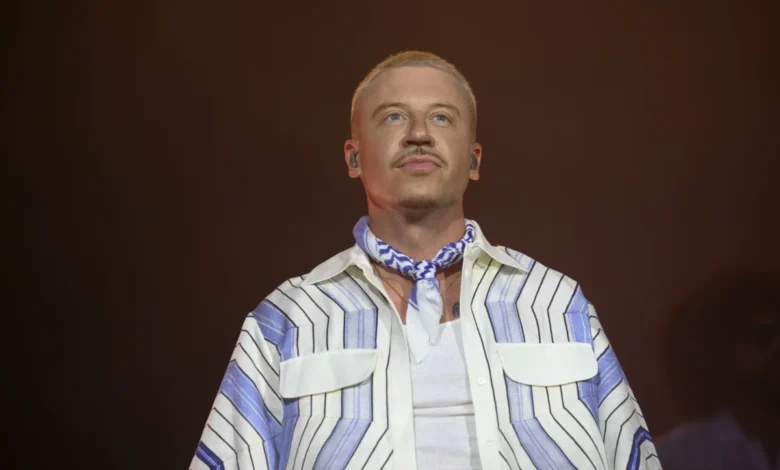
The intersection of celebrity activism and international geopolitical discourse has reached a flashpoint as rapper Macklemore launched a three-city European tour explicitly dedicated to the cause of Palestinian liberation. This artistic pivot follows the artist’s high-profile departure from Ed Sheeran’s "Loop" stadium tour, a separation precipitated by his vocal support for Palestine during live performances in New Jersey. As the rapper brings his message to stages in Dublin, Paris, and London, the music industry continues to grapple with the tension between the expectations of neutral entertainment venues and the increasing demand from artists to utilize their platforms for political advocacy.
A Timeline of Escalation and Severed Ties
The friction that culminated in the current tour began in early September 2026. On September 4 and 5, while serving as a supporting act for Ed Sheeran at the MetLife Stadium in East Rutherford, New Jersey, Macklemore utilized the stage to address the ongoing conflict in the Middle East. Directly addressing the audience, he stated, "A big part of the reason why I wanted to do this tour in the first place is so I could stand up in stadiums like this and say two words that are very near and dear to my heart: Free Palestine."
The reaction was immediate and polarized. The Israeli American Council (IAC) launched a formal petition demanding the rapper’s removal, arguing that stadium tours should serve as non-political spaces for entertainment. By mid-September, the pressure reached a breaking point. Messina Touring Group, the promoter behind the "Loop" tour, informed stakeholders that several venues had signaled they would refuse to host events featuring Macklemore, effectively threatening the viability of the entire tour. On September 12, the decision was finalized: Macklemore would no longer be part of the remaining support dates.
The fallout extended well beyond a single artist. In a show of solidarity, fellow performers including Finneas, Lukas Graham, and Aaron Rowe, alongside the majority of Sheeran’s backing band, exited the tour. The controversy intensified when Macklemore alleged that Robert Kraft, owner of Gillette Stadium, had played a pivotal role in lobbying for his removal. Kraft subsequently countered this narrative by announcing a $2 million donation toward humanitarian aid in the region, an effort joined by Sheeran himself.
The Dublin Kickoff: Reclaiming the Narrative
On his first night in Dublin, Macklemore addressed the controversy head-on, framing his rhetoric not as an act of division, but as a moral imperative. Before a crowd that included surprise appearances by Irish artists Hozier and Kneecap, the rapper contextualized his previous comments. "Six weeks ago, it was two words. Two words is all that it took," he told the audience. "Not against anybody, not divisive. Not a call for hatred. But a call to recognize our shared humanity."
The rapper’s current three-show tour is marked by a transparent financial commitment: all proceeds are pledged to charities providing aid to Palestinians. This follows his earlier announcement that he had donated his entire $1 million salary from the Sheeran tour to the same cause. The move underscores a shift in how modern artists are choosing to align their professional earnings with their personal political convictions.
The Industry Debate: Neutrality vs. Advocacy
The controversy surrounding Macklemore has sparked a broader, more nuanced debate within the music industry regarding the responsibility of performers. Ed Sheeran’s initial response—that he avoids politics to protect his audience, which includes children—highlights the common industry preference for "safe" performance spaces. Sheeran stated, "There is a reason I do not use my professional platform for politics—my audience includes young people, often children, of all backgrounds. Those who come to my shows do not expect a political forum."
However, Sheeran’s stance shifted slightly on September 19 in Philadelphia. Facing criticism from all sides, the British pop star issued a more detailed statement acknowledging the complexity of the conflict. "What happened in Israel and at the Nova Music Festival on Oct. 7 was horrific and compounded centuries of Jewish pain. What is happening in Gaza is catastrophic and unjustifiable, and disproportionate," Sheeran noted. This evolution reflects the immense pressure on major artists to address global crises, even if their preferred method of engagement differs from that of their peers.
Contextualizing the Humanitarian Crisis
The debate is fueled by the stark reality of the ongoing humanitarian crisis in Gaza and the West Bank. According to international reports and data from aid organizations, the region has faced unprecedented levels of infrastructure collapse and displacement. For artists like Macklemore, the visibility provided by a stadium-sized platform is viewed as an essential tool for keeping global attention focused on the scale of suffering.
The backlash from groups like the IAC emphasizes the sensitivity of the topic, particularly in the United States, where public opinion remains deeply divided. Critics of the rapper argue that using a musical platform for political slogans alienates portions of the fanbase and disrupts the collective experience of a concert. Proponents, however, point to a long history of music as a vehicle for social change, from the anti-war songs of the 1960s to the civil rights anthems that defined multiple generations.
The Economic and Logistical Implications
The financial and operational consequences of the Macklemore-Sheeran split serve as a case study for future tour management. The decision by venue owners to threaten cancellation underscores the power dynamic in the music industry; stadium owners and major promoters hold significant leverage over the content of performances. When a performer’s political speech threatens the economic interests of a venue, the resulting conflict often leads to a restrictive approach to on-stage speech.
The exit of other musicians from the "Loop" tour also indicates that the "neutrality" requested by promoters may be becoming increasingly difficult to enforce. If support acts and band members feel compelled to take a stand, the standard "non-political" contract clause may become a source of internal instability for major concert tours.
Broader Societal Impact
The "Free Palestine" tour acts as an extension of the viral momentum Macklemore generated in early September. By choosing to perform in high-visibility European cities like Paris and London, he is testing whether a dedicated, politically-themed tour can survive the same pressures that derailed his appearances in the United States.
The incident has also forced a conversation about the nature of "safety" in concert spaces. While Sheeran defines safety as the absence of political conflict, Macklemore argues that true safety for performers requires the freedom to speak out against injustice. This philosophical divide is likely to shape the clauses and expectations in future artist contracts.
Conclusion: A New Era for Concert Stages
As Macklemore prepares for his remaining dates in Paris and London, the music industry is left to evaluate the long-term impact of this fallout. The controversy has not only highlighted the deep divides in public opinion regarding the Israel-Gaza conflict but has also challenged the traditional boundaries of the celebrity platform.
The case of Macklemore vs. the "Loop" tour is more than a dispute between a rapper and a promoter; it is a manifestation of a global struggle over the role of public figures in political discourse. Whether this leads to a new era of "curated" stages where speech is tightly managed, or a more permissive environment where artists feel emboldened to use their influence, remains to be seen. For now, the tour stands as a testament to the rapper’s resolve and a reflection of a generation of fans and artists who refuse to separate their personal values from their professional contributions. The upcoming shows will serve as a bellwether for the viability of this brand of activism, potentially setting a precedent for how future tours handle the intersection of music and international politics.
Related posts: