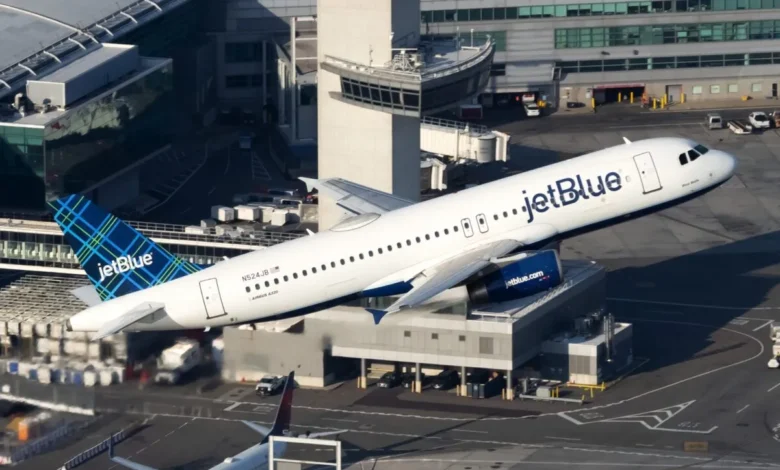
JetBlue Airways startled and eventually reassured financial markets on Monday by releasing its third-quarter financial results a day ahead of schedule. The carrier acknowledged a wider net loss for the quarter and trimmed its financial outlook for 2026, yet its stock surged by more than 10 percent in after-hours trading. This sudden market rebound helped soothe anxieties that had built up over the preceding week, during which swirling rumors and speculative reports regarding a potential Chapter 11 bankruptcy filing had battered the airline’s valuation.
The early earnings drop effectively halted a severe downward trajectory for JetBlue shares. Stock values had plummeted by over 20 percent in just seven days, closing at $2.37 on Monday afternoon. By pushing out its third-quarter performance data ahead of the scheduled Tuesday morning opening bell, executive leadership sought to directly confront and dispel mounting panic among equity holders, analysts, and industry observers. While the macroeconomic and operational realities facing the carrier remain complex, the company’s decisive communication strategy temporarily restored a measure of confidence on Wall Street.
Third-Quarter Financial Realities and Cost Pressures
JetBlue’s latest financial disclosures underscore the persistent headwinds confronting low-cost and low-fare carriers in the post-pandemic aviation landscape. For the third quarter, the airline posted a wider net loss compared to the same period in the previous year, driven by a combination of fluctuating jet fuel expenses, lingering capacity adjustments, and competitive domestic pricing pressures.
However, beneath the headline losses, management emphasized operational improvements tied to its ongoing turnaround strategy, known as the "JetForward" initiative. A critical element of this strategy involves rigorous cost containment and the optimization of the airline’s route network. JetBlue reported that its unit costs, excluding fuel (often referred to as CASM-ex), are on track to experience a significant and measurable "step-down" during the upcoming fourth quarter.
This anticipated reduction in operating expenses forms the bedrock of the airline’s revised multi-year financial roadmap. By trimming overhead, improving aircraft utilization, and focusing on high-performing leisure and visiting-friends-and-relatives (VFR) routes, JetBlue aims to reverse consecutive quarters of unprofitability.
Adjusting the Horizon: The 2026 Outlook and 2027-2028 Targets
In a significant update to its long-term financial guidance, JetBlue officially trimmed its outlook for the year 2026. The downward revision reflects a more conservative macroeconomic forecast, softer demand in specific domestic markets, and the ongoing operational complexities associated with Pratt & Whitney engine inspections that have grounded portions of the carrier’s Airbus fleet.
Despite scaling back expectations for 2026, leadership reaffirmed its ambitious longer-term targets for the end of the decade. JetBlue reiterated its commitment to achieving sustained operating profitability by 2027. Furthermore, the carrier preserved its fiscal goal of generating at least $1 in earnings per share (EPS) and achieving positive free cash flow by 2028.
"Together with continued JetForward execution, this reinforces our confidence in achieving sustained operating profitability in 2027 and delivering at least $1 EPS and positive free cash flow," leadership stated in the financial briefing. This explicit reaffirmation was designed to signal to equity markets that the short-term adjustments to 2026 do not derail the structural foundations of the multi-year recovery plan.
Chronology of a Market Scare: The Week Leading to the Earnings Release
The weeks and days preceding JetBlue’s early earnings report were characterized by heightened volatility and intense market speculation. To fully understand the significance of Monday’s after-hours stock surge, it is necessary to examine the timeline of events that put the airline on the defensive.
Early October 2024: Mounting Industry Pressures
As the peak summer travel season faded, airline analysts began reassessing the financial health of low-cost carriers. JetBlue, still digesting the fallout from its blocked merger with Spirit Airlines and navigating costly aircraft groundings due to supply chain bottlenecks, was frequently singled out in equity research notes as facing structural cash burn challenges.
Mid-October 2024: Speculation and Rumors Intensify
By the middle of the month, anonymous commentary and speculative financial blogs began floating worst-case scenarios, including unverified rumors regarding potential debt restructuring or Chapter 11 bankruptcy filings. While these rumors lacked official substantiation, algorithmic trading patterns and jittery retail investors reacted swiftly, initiating a massive sell-off.
Monday, October 28, 2024: The Sell-Off Deepens and the Pivot
Selling pressure intensified at the start of the week, driving JetBlue shares down to $2.37—a drop exceeding 20 percent over the course of a single week. Recognizing the destructive nature of the unverified bankruptcy rumors, JetBlue executives took the strategic decision to bypass the standard Tuesday morning earnings release schedule. By dropping the third-quarter numbers immediately after Monday’s market close, the carrier sought to replace speculation with hard, verifiable data.
Monday After-Hours: The Relief Rally
The market’s initial reaction to the early data release was overwhelmingly positive. Rather than triggering panic, the transparency regarding both the third-quarter losses and the structural cost reductions reassured investors. Shares bounced back by more than 10 percent in after-hours trading, proving that the market was eager for clarity and willing to reward management for confronting rumors head-on.
The Broader Context: Challenges Facing the Low-Cost Sector
JetBlue’s current predicament is not isolated; it reflects broader structural shifts within the United States domestic aviation market. In recent years, legacy carriers such as Delta Air Lines, United Airlines, and American Airlines have successfully captured a larger share of premium and business travel, while simultaneously expanding their own basic economy offerings to compete directly with low-cost carriers.
Simultaneously, ultra-low-cost carriers and low-cost operators have grappled with surging labor costs following newly negotiated pilot and flight attendant contracts across the industry. When combined with persistent inflation, elevated interest rates, and localized supply chain constraints that delay aircraft deliveries and maintenance turnarounds, profit margins have compressed industry-wide.
For JetBlue specifically, the strategic pivot away from the aborted Northeast Alliance (NEA) with American Airlines and the regulatory block on the Spirit Airlines acquisition forced the company to radically rethink its network architecture. The JetForward plan represents the culmination of this enforced introspection, shifting the airline’s focus away from rapid geographic expansion and toward margin discipline, premium product offerings like its Mint service, and profitability on core legacy routes.
Operational Headwinds: Fleet Constraints and Capacity Discipline
A critical component of JetBlue’s financial recovery involves managing its fleet constraints. Like many operators of Airbus A320neo family aircraft powered by Pratt & Whitney GTF engines, JetBlue has been forced to park several aircraft due to required powder metal inspections. These unscheduled maintenance events reduce daily fleet utilization and drive up unit operating costs.
To mitigate these constraints, JetBlue has instituted strict capacity discipline. Rather than forcing growth into a soft domestic pricing environment, the airline has redeployed aircraft to high-yield leisure routes, enhanced its partnerships with international carriers through codeshare agreements, and optimized its focus cities, particularly in New York, Boston, and Fort Lauderdale.
Industry analysts note that while capacity discipline limits top-line revenue growth in the short term, it is an essential prerequisite for pricing power. By removing unprofitable flying from its schedule, JetBlue can better match supply with actual demand, supporting higher average fares per passenger.
Market Implications and Analyst Reactions
Wall Street analysts have maintained a cautious yet watchful stance following the earnings release. While the after-hours stock rally demonstrates that bankruptcy fears were vastly overblown and detached from the airline’s actual liquidity position, analysts emphasize that execution risk remains high.
JetBlue retains adequate liquidity, including cash reserves and unencumbered assets that can be leveraged if necessary, distinguishing its financial standing from true restructuring scenarios. However, achieving the targeted $1 EPS by 2028 will require flawless execution of the JetForward cost-reduction initiatives, favorable pricing environments during upcoming holiday travel windows, and a stabilization of engine-related maintenance disruptions.
Furthermore, labor costs will continue to play a defining role in the airline’s financial trajectory. With wage rates permanently recalibrated higher across the U.S. airline sector, productivity gains and technological enhancements must offset rising labor expenditures to achieve the anticipated fourth-quarter cost step-down.
Looking Ahead: The Road to 2027
As JetBlue navigates the remainder of the decade, the airline’s leadership faces the delicate task of balancing structural cost-cutting with the preservation of its distinct customer-facing value proposition—known for attributes like free high-speed Wi-Fi, seatback entertainment, and extra legroom.
The positive reception to Monday’s earnings release suggests that investors are willing to grant management time and leeway, provided that communication remains transparent and strategic milestones are consistently met. The upcoming fourth quarter will serve as the first major testing ground for whether the promised cost reductions materialize as projected.
If JetBlue can successfully deliver on its fourth-quarter unit cost reductions and demonstrate sequential operational improvements, the market panic of late October 2024 will likely be viewed in hindsight as an overreaction to transient market rumors. Until then, the carrier remains laser-focused on its long-term rehabilitation, charting a disciplined course toward sustained profitability by 2027.