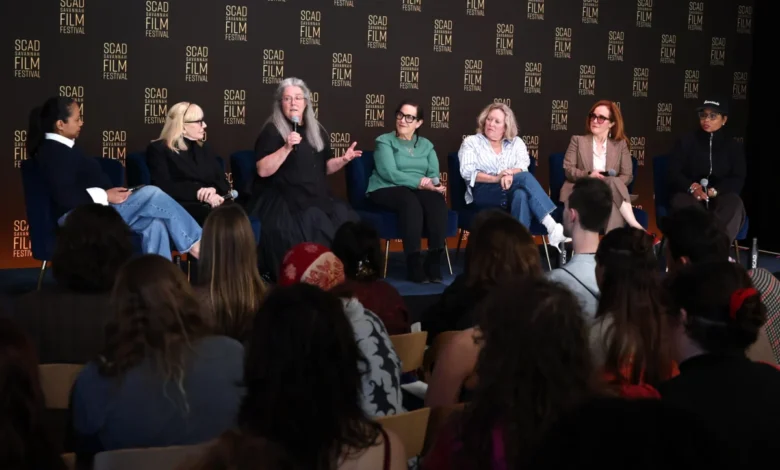
The popular misconception that costume design is merely an exercise in high-end shopping and aesthetic curation was systematically dismantled during the recent Costume Design Roundtable at the SCAD Savannah Film Festival. Moderated by Variety’s Senior Artisans Editor Jazz Tangcay, the panel featured a powerhouse assembly of industry veterans, including Molly Rogers, Ellen Mirojnick, Arianne Phillips, Linda Muir, Amy Roth, and Marci Rodgers. Through their collective experience, the panelists illustrated that costume design functions as a rigorous form of visual storytelling—a discipline that bridges the gap between historical documentation, psychological character building, and the logistical challenges of modern film finance.
The Myth of the Fashionable Shopper
Molly Rogers, a key figure in the legacy of The Devil Wears Prada, offered a stark reality check for aspiring designers who view the profession through a romanticized lens. “When someone comes up to me and says, ‘I really want to learn and work with you. I love to shop,’ that’s an automatic exit,” Rogers stated. Her sentiment resonates across the professional costume community, where the primary objective is character development rather than retail therapy.
The role of a costume designer is inherently collaborative and often defensive. Designers must act as agents for their characters, protecting the visual integrity of a narrative against the intrusion of commercial interests and the sometimes misplaced instincts of actors or executives. Arianne Phillips, whose portfolio includes work on Nocturnal Animals and The Invite, noted that the disconnect often stems from a lack of understanding regarding the designer’s mandate. In high-stakes production environments, where studio executives and directors may be accustomed to personal shoppers and luxury consumption, the designer must navigate these power dynamics to ensure that the character’s clothing serves the script rather than the vanity of the performer or the demands of a brand.
The Historical and Social Context of Contemporary Design
Ellen Mirojnick, whose iconic contributions to films like Wall Street and Basic Instinct helped define the aesthetic of late 20th-century cinema, emphasized that contemporary design is an act of historical preservation. “In the beginning of my career, I did a lot of contemporary costume, and I loved it,” she reflected. “I loved being able to document what New York was like at that period, because yes, it was for film, but it also documented the history of what we were like.”
This dual responsibility—to satisfy the immediate needs of the scene while creating a cultural artifact—is a recurring theme in the work of Marci Rodgers. Recalling her early experience on Spike Lee’s She’s Gotta Have It, Rodgers explained how she leveraged background casting sessions to understand the authentic, lived-in style of New Yorkers. For her characterization of Nola Darling, Rodgers avoided the polished aesthetics of high-end department stores like Saks, opting instead for curated thrift store finds that aligned with the character’s love for Prince and her specific socio-economic reality. This granular attention to detail, she argued, is what anchors a character in reality.
The Logistical Hurdles of Modern Filmmaking
As the film industry evolves, so too do the pressures on costume designers. The rise of integrated brand financing—where luxury labels provide capital in exchange for product placement—has created a new friction point. Phillips, acknowledging this trend, pointed out the difficulty of maintaining creative control when producers dictate which brands must be featured. “We’re told by producers, ‘You have to use that product,’” she said. “You have to choose directors who support staying true to the story, as this is only going to get more complicated with how films are financed.”
The difficulty of the craft is further compounded by the unpredictability of the creative process. Marci Rodgers noted that the vision for a character often shifts significantly after a table read. When working on projects set in specific cultural hubs, such as the Chicago-based Barbershop, the designer must constantly negotiate between the actor’s input, the director’s changing vision, and the necessity of reflecting the community’s authentic fashion.
Case Studies in Technical Precision
The roundtable provided deep insight into the technical demands of recent high-profile projects:
- The Odyssey: Ellen Mirojnick’s work for Christopher Nolan involved the creation of over 5,300 costumes. To maintain visual cohesion, she utilized a specific color palette—burned red—for the House of Ithaca. The design of Queen Penelope’s climactic blue gown was intended as a form of armor, utilizing precise pleating and minimalist gold accessories to convey strength and readiness for conflict.
- The Northman and Werwulf: Linda Muir highlighted the challenges of period-accurate material sourcing. In Viking-era narratives, wool was a primary indicator of wealth and status. The eradication of wolves in the British Isles to protect sheep stock is a historical fact that informs her approach to character class hierarchy. Muir’s primary hurdle was the logistical orchestration of sourcing authentic wool, buttons, and belts, illustrating the "archaeological" side of the profession.
- I Play Rocky: Amy Roth faced the challenge of recreating iconic looks from the original Rocky film, which famously lacked a dedicated costume designer. Without original references, she had to rely on the collective cultural memory of the audience. The meticulous aging of a leather jacket—found on eBay to ensure specific sizing—demonstrates the lengths designers go to for verisimilitude.
- The Devil Wears Prada 2: Returning to a franchise with a massive, pre-existing cultural footprint presents the "sequel curse." Rogers navigated this by recontextualizing the iconic cerulean sweater. By transforming the original garment into a vest, she maintained a sense of character continuity while signaling the passage of time and personal evolution for Anne Hathaway’s character.
- Michael: For the upcoming biopic on Michael Jackson, Marci Rodgers undertook an exhaustive research process, including an 800-page archive. Her work on the “Thriller” sequence required a precise understanding of color theory, such as the discovery that Jackson’s original jeans were dyed red to match the aesthetic requirements of the shoot. Her commitment to detail extended to the background dancers, ensuring that the pearls and accessories of every extra aligned with the historical source material.
Broader Implications for the Industry
The discussion at the SCAD Savannah Film Festival underscores a broader shift in how the industry perceives the role of the costume designer. No longer relegated to the periphery of production, these professionals are increasingly recognized as essential narrative architects. The tension between commercial product placement and authentic storytelling is likely to remain a central conflict in the coming decade, as studios prioritize revenue streams that inherently threaten the visual authenticity of period and contemporary dramas.
Furthermore, the emphasis on research and technical labor—such as dyeing textiles, aging leather, and historical mapping—highlights a skill set that is rarely acknowledged by the casual viewer. The "science" of the costume designer relies on an intersection of psychology, sociology, and engineering. As the panelists demonstrated, their work is not about selecting the most fashionable garment, but about selecting the garment that best articulates the character’s inner life, social standing, and emotional trajectory.
In conclusion, the work of the costume designer is a testament to the discipline required to maintain artistic integrity in a commercial environment. By viewing clothing as a narrative tool, these designers ensure that every stitch and hue serves a specific purpose in the greater tapestry of film history. The challenges they face—from the intrusion of brand interests to the shifting demands of actors—are merely the constraints within which their creative problem-solving thrives. As film production becomes more complex and increasingly global, the necessity for designers who can balance this myriad of pressures with technical expertise and deep research will only continue to grow.