For SEO managers and digital marketing professionals, the landscape of search engine optimization has undergone a fundamental transformation. While volatility is a familiar byproduct of traditional Google core updates, the rise of Answer Engine Optimization (AEO) has introduced a new layer of complexity that renders standard tracking tools insufficient. According to HubSpot’s State of AEO report, a significant 58% of marketers were actively optimizing their content specifically for answer engines by the first quarter of 2026. This shift marks a departure from focusing solely on blue-link rankings to competing for visibility within the conversational, summarized outputs of platforms like ChatGPT, Gemini, and Perplexity.
Unlike traditional search, where a rank tracker provides a definitive position for a specific keyword, AI-generated answers are non-deterministic. A single model update can fundamentally alter the citation patterns of an AI engine, causing a brand to appear in one interaction and vanish in the next. This instability creates a unique challenge for marketing teams: distinguishing between a genuine decline in content performance and the inherent, chaotic nature of large language model (LLM) outputs.
The mechanics of AI search volatility are rooted in the architecture of generative models. Because these systems prioritize synthesis over simple retrieval, they do not provide a fixed SERP (Search Engine Results Page). Research conducted by SparkToro and Gumshoe.ai in late 2025 revealed that when identical recommendation prompts were executed repeatedly, AI models had less than a 1-in-100 chance of returning the same list of brands. Consequently, a sudden dip in AI-referred traffic is not necessarily a reflection of degraded content quality or technical failure; it is often merely a symptom of the engine’s underlying randomness.

Understanding the Mechanics of Market-Wide Shifts
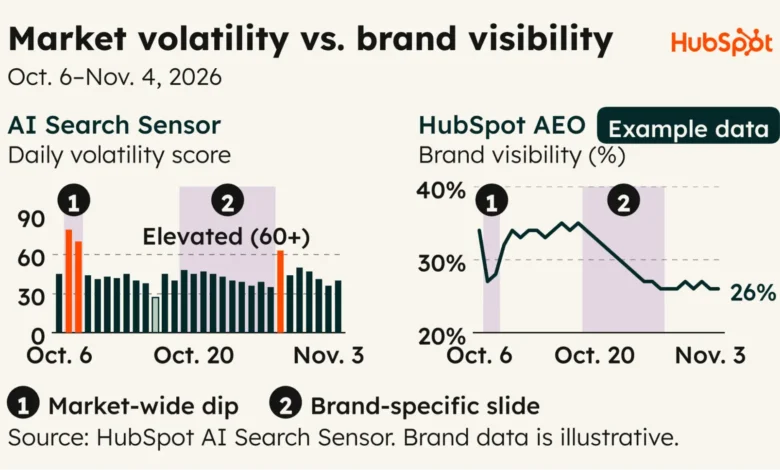
To effectively manage this volatility, organizations must look beyond their own internal metrics. The diagnostic process begins with benchmarking against industry-wide data. If a company experiences a drop in visibility while the broader industry benchmark remains stable, the issue is likely localized to the company’s domain, site architecture, or tracking configuration. Conversely, if the market-wide benchmark shifts in tandem with internal data, the organization is witnessing a systemic change—an answer engine algorithm update that affects the entire competitive landscape.
The AI Search Sensor, a tool designed to track these shifts, provides a daily volatility score based on four critical signals: mention rate, citation rate, citation type, and AI-referred traffic. By monitoring these variables across ChatGPT, Gemini, and Perplexity, marketers can gain the context necessary to report fluctuations to leadership without triggering unnecessary alarms.
Differentiating AI Volatility from Traditional SEO
The divergence between ranking volatility and AI search volatility is profound. In the traditional SEO paradigm, tools like the Semrush Sensor track ranking movements on a 0-10 scale across a static sample of keywords. While this remains useful for monitoring Google’s traditional SERPs, it fails to capture the nuances of generative AI.
However, the two worlds are increasingly interconnected. Data from the 2026 State of AEO report indicates a strong correlation between high Google rankings and frequency of citation in AI Overviews. This suggests that while traditional SEO is not dead, its primary value is shifting from direct click-throughs to serving as the foundational authority that AI models utilize to build their summaries. This is critical because, as Pew Research Center data from March 2025 demonstrated, the presence of an AI summary in search results significantly reduces the likelihood of a user clicking on a traditional link—dropping from a 15% click-through rate to just 8%.

As a result, relying on legacy KPIs like "Google Rank" is increasingly misleading. Marketing leaders must pivot toward tracking share of voice within AI responses and the volume of citations generated by specific content types.
Measuring Performance in a Non-Deterministic Environment
The methodology for measuring AI search volatility requires a structured approach that prioritizes consistency. To generate reliable insights, marketers must:
- Define a standardized set of prompts that reflect high-intent search queries.
- Execute these queries on a fixed schedule (e.g., daily or weekly).
- Utilize a centralized dashboard to track changes in brand mentions and citations.
- Normalize data against industry benchmarks to filter out "noise" from the models’ inherent randomness.
It is important to acknowledge the limitations of these measurements. Because AI responses are non-deterministic, individual data points are inherently noisy. Analysts should focus on rolling averages and multi-week trends rather than reacting to single-day anomalies. Furthermore, when reporting to executive leadership, the focus must shift from vanity metrics to business impact.
Reporting and Strategic Responses to Volatility
When reporting to stakeholders, the narrative must center on the "Why" and the "So What." A robust report should include:

- A high-level overview of lead and pipeline impact linked to AI referrals.
- A visual comparison of the brand’s visibility trend versus the industry benchmark.
- A clear summary of whether the volatility is isolated or market-wide.
- A list of actionable content adjustments if the issue is confirmed to be internal.
When the industry benchmark signals an "Elevated" or "Extreme" volatility period, the best strategic response is often patience. Attempting to overhaul a content strategy in response to a temporary model-driven fluctuation can be counterproductive, potentially leading to further instability. According to industry guidance, organizations should wait until a volatility event passes before making major shifts in their SEO or AEO strategy.
The Evolution of Attribution and Future Outlook
The technical challenge of attribution remains the most significant barrier to widespread adoption of AEO as a primary KPI. As MarketingProfs CCO Ann Handley has noted, while traffic is a measure of reach, it is misleading when viewed in isolation. Many current attribution models are not yet equipped to track the complex, non-linear path from an AI-generated mention to a closed deal.
To solve this, firms are increasingly leveraging custom source rules within their CRM systems. By filtering reports through "AI Referral" values in traffic source properties—and supplementing this with "How did you hear about us?" form fields—marketers can begin to quantify the ROI of AI visibility.
As we move further into 2026 and beyond, the competition for "AI real estate" will likely intensify. The brands that win will be those that treat AI search not as a separate entity, but as a critical, integrated channel. By understanding the distinction between market-wide shifts and site-specific performance, and by adopting a data-driven approach to tracking, marketers can turn the threat of volatility into a competitive advantage. The era of the "fixed rank" is ending; the era of "conversational authority" has arrived. Success will depend on the ability to remain stable while the ground beneath the search industry continues to shift.
Related posts: