Trump administration beef import policy fails to deliver promised relief to American consumers and sparks industry backlash

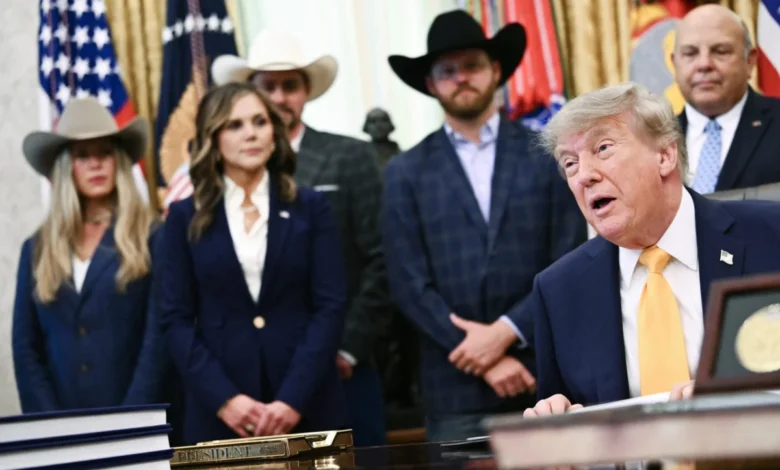
The Trump administration’s high-stakes attempt to curb domestic food inflation through a major trade intervention is currently struggling to gain momentum, leaving both consumers and the agricultural sector in a state of limbo. In August, President Donald Trump signed a formal proclamation intended to stabilize the skyrocketing price of beef, a staple protein that has become a flashpoint for voter frustration ahead of the midterm elections. The initiative authorized the import of 300,000 metric tons of lean beef trimmings over a 90-day window from September through November, specifically targeting reduced tariff rates to lower costs for retail and institutional buyers.
However, as of October 19, federal data from U.S. Customs and Border Protection indicates that only 59,423 metric tons of beef have crossed the border under this program—a mere 20% of the administration’s stated target. This shortfall, combined with persistent market complexities, has cast significant doubt on the efficacy of the policy as a tool for economic relief.
The Anatomy of an Affordability Crisis
The beef market in 2026 has been defined by a stubborn upward trajectory in prices that has outpaced the broader grocery inflation rate. According to data from the Bureau of Labor Statistics, ground beef prices reached an average of $6.79 per pound in September. While this represents a marginal dip from the $6.92 peak observed in August, it remains substantially higher than the $6.32 per pound recorded during the same period in 2025. This 7% year-over-year surge in beef costs stands in stark contrast to the modest 2.5% to 2.9% increase seen across the wider U.S. grocery index.
The administration’s intervention was designed to alleviate this burden, with President Trump positioning the move as a dual-purpose strategy: providing immediate relief to households while simultaneously allowing the domestic "Great American Beef Herd" the time necessary to recover from cyclical lows. Yet, the disconnect between the policy’s intent and the reality on the ground has become a subject of intense scrutiny from agricultural economists, who argue that the market dynamics governing meat production are far too intricate for such a blunt-force legislative tool.
Economic Realities and Market Complexity
The fundamental misunderstanding of the current supply chain lies in the nature of the beef being imported. The product authorized for lower tariffs—lean beef trimmings—is not the type of beef typically destined for the butcher counters of local supermarkets. Instead, these trimmings are predominantly utilized by the food service and fast-food industries, where they are mixed with domestic, higher-fat trimmings to produce ground beef products.
Derrell Peel, a professor of agribusiness at Oklahoma State University, emphasizes that the supply of these trimmings was already largely sufficient to meet market demand, even under the previous tariff structure. "The simple assumption there was that if we can just increase the supply of beef in the U.S., that should lower prices," Peel noted. "Unfortunately, the beef industry is much more complex than that. We were getting as much as we wanted because the industry was already absorbing the costs of tariffs to meet their specific blending needs."
Furthermore, the nations most capable of filling this import gap, namely Brazil and Argentina, are currently grappling with their own inventory constraints. Global demand for protein remains robust, and these exporting nations are balancing their own domestic shortages against international commitments, making it difficult for the U.S. to source the targeted volume of product within the requested 90-day timeframe.
The Role of Consumer Demand
While the administration has frequently pointed to dwindling cattle herd sizes as the primary culprit for high prices, academic experts offer a more nuanced perspective. Glynn Tonsor, an agricultural economics professor at Kansas State University, argues that the current crisis is as much a function of sustained consumer demand as it is of supply-side contraction.
Data shows that domestic beef demand rose by 5.9% during the first six months of 2026. Despite record prices, American consumers have not significantly curtailed their consumption of beef. Tonsor points out that herd sizes have been undergoing a natural, secular decline for approximately 60 years, making the current supply contraction a predictable, albeit painful, long-term trend rather than a sudden market shock.
Tonsor posits that the only way to effectively lower prices through market forces would be a decline in demand. "If you erode beef demand, you will erode beef prices," he explained. However, the political reality is that a sustained reduction in demand is rarely a desirable outcome for a governing administration, as it implies a decrease in the standard of living and purchasing power for the average voter.
Industry Backlash and the Political Fallout
The policy has met with significant resistance from the very constituency the administration aims to support: the American rancher. The American Farm Bureau Federation (AFBF), led by President Zippy Duvall, has been a vocal opponent of the trade maneuver. The AFBF argues that the influx of foreign beef, even if limited in volume, creates a downward pressure on cattle prices that can cost individual ranchers between $300 and $400 per head.
In a formal statement released last month, the organization urged the administration to rescind the order, characterizing it as a policy that "undercut a fragile recovery in the cattle industry while failing to benefit consumers." For many in the agricultural heartland, the intervention is seen as an unwelcome distortion of free-market principles.
Peel notes that the frustration among farmers is driven less by the actual impact of the imports—which have been limited by the market’s inability to absorb them—and more by the president’s willingness to intervene in a sector that prides itself on market-driven independence. The "Great American Beef Herd" that the President references in his communications is, to farmers, a business asset subject to market cycles that are best managed by producers themselves, not through government-mandated shifts in trade volume.
Implications for the Midterm Election Landscape
The political implications of this policy failure are significant. As the midterm elections approach, beef prices have become a shorthand for the broader "affordability crisis" that has dominated the national discourse. President Trump has framed the issue as a critical component of his second-term agenda, telling supporters that failing to manage these costs puts ranchers and farmers in "big trouble."
"It really became unacceptable to the voter," the President remarked during a recent interview. By attempting to force prices down, the administration sought to demonstrate responsiveness to the economic anxiety of the average American household. However, the data suggests that the move has yielded little political capital, as consumer prices at the retail level remain high, and the agricultural lobby continues to voice its displeasure.
Looking forward, the failure to meet the 300,000-metric-ton target raises questions about the administration’s ability to influence food costs through trade policy. If the remaining weeks of the program do not see a significant surge in imports, the policy will likely be viewed as a symbolic gesture that failed to address the systemic causes of food inflation.
A Disconnected Strategy
The situation highlights a widening gap between populist economic rhetoric and the realities of global agricultural trade. For the administration, the goal was to provide a tangible "win" for consumers. For the market, however, the policy failed to account for the specific blending needs of the beef industry, the global competition for protein, and the long-term structural changes in cattle production.
As the program reaches its conclusion in November, analysts expect the focus to shift toward more sustainable, long-term solutions, such as investments in processing capacity and support for herd health. In the interim, the administration remains largely silent on the specific reasons for the import shortfall, and the White House has not yet provided comment on whether it intends to extend or adjust the policy.
Ultimately, the beef price issue serves as a case study in the limitations of executive intervention in the food supply chain. While the administration sought to bridge the divide between affordable groceries and a profitable farming sector, the current result is a policy that has struggled to achieve either objective, leaving both consumers and producers waiting for a more effective solution to the ongoing affordability crisis.