Canada to pursue unprecedented associate membership with European Union as geopolitical shifts reshape transatlantic trade and security policy

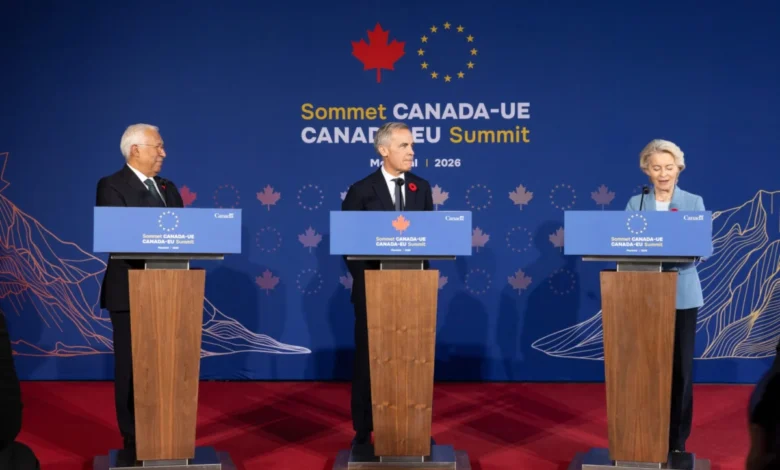
The geopolitical landscape of the North Atlantic is undergoing a tectonic shift as Canadian Prime Minister Mark Carney and leadership from the European Union unveiled an ambitious framework to transform their bilateral relationship into an unprecedented associate membership. This move, announced Friday at the conclusion of a high-level summit in Montreal, marks a significant departure from traditional diplomatic norms, signaling a concerted effort by both Ottawa and Brussels to insulate their economies and security architectures from the volatility of shifting U.S. foreign policy.
The proposed "Alliance for the Future" seeks to create a structural bridge between Canada and the 27-member bloc. While the specific legal designation of "associate member" remains a subject of ongoing negotiation, both sides have committed to formalizing an "ever-closer association" by 2027. This partnership aims to integrate digital trade, critical mineral supply chains, and advanced technological research, effectively diversifying Canada’s economic portfolio away from its heavy reliance on the United States.
A Chronology of the Strategic Pivot
The momentum toward this deepened integration did not emerge in a vacuum; it is the culmination of years of mounting friction within the Western alliance. Following the 2024 U.S. election cycle, trade rhetoric from Washington became increasingly protectionist, with threats of across-the-board tariffs and the questioning of traditional security commitments.
In early 2025, the Canadian government commissioned a national security review, which identified a "concentrated risk" in its trade profile. Statistics from the 2025 fiscal year revealed that the United States accounted for 71.7% of Canada’s total merchandise exports. Prime Minister Carney’s administration subsequently set a target to double exports to non-U.S. markets over the next decade.
The timeline for the current initiative accelerated rapidly:
- January 2026: Informal dialogues between the Prime Minister’s Office and the European Commission began regarding deeper supply chain integration.
- March 2026: Initial working groups were established to address regulatory alignment in digital markets.
- May 2026: The two-day Montreal Summit was convened, bringing together Prime Minister Carney, European Commission President Ursula von der Leyen, and European Council President António Costa.
- June 2026: Both parties are scheduled to meet in Brussels to finalize the foundational framework for the proposed associate membership.
Economic Implications and Digital Integration
The core of this new alliance rests on economic resilience. By concluding negotiations on a comprehensive digital trade agreement, Canada and the EU are effectively creating a single digital market for service providers. This initiative is designed to lower compliance costs for startups and mid-sized enterprises. For a tech firm in Vancouver, the agreement provides a streamlined regulatory pathway to the German or French markets, bypassing the fragmented legal landscape that currently hinders transatlantic commerce.
Beyond digital services, the two sides are leveraging the European Investment Bank (EIB) to inject capital into Canada’s nascent critical minerals sector. Canada holds vast reserves of lithium, cobalt, and rare earth elements—essential components for the European Green Deal and the transition to renewable energy. By aligning these resources with European demand, Canada secures a long-term buyer, while Europe gains a stable, non-adversarial supply chain that is not subject to the whims of geopolitical rivals or sudden American trade barriers.
Furthermore, the decision to join the European supercomputing initiative, specifically the JUPITER project, represents a massive leap in research capabilities. Canadian scientists will gain access to computing power that can complete complex climate and medical simulations in 24 hours, a task that currently requires six months of processing time on domestic infrastructure.
Sovereignty and the U.S. Reaction
The ambition of the "Alliance for the Future" has not gone unnoticed in Washington. U.S. officials have expressed private concerns that such a close integration between an American neighbor and a European bloc could undermine the existing United States-Mexico-Canada Agreement (USMCA). President Donald Trump has publicly categorized the potential associate status as a "hostile act," hinting that the United States might impose retaliatory tariffs on European goods if the partnership is perceived as detrimental to U.S. commercial interests.
Prime Minister Carney, however, has maintained a diplomatic but firm stance. During a press conference in Montreal, he emphasized that the agreement is not exclusionary. "It is about reinforcing sovereignty. Why? So we can live our lives as we choose, our people can live their lives as they choose," Carney stated. He argued that the alliance is not a reaction against any specific nation, but rather a proactive measure to ensure that Canadian and European citizens maintain the "full freedoms" inherent in their respective democratic systems.
The rhetoric from Brussels has been equally deliberate. President Ursula von der Leyen characterized the partnership as a realization that the global "headwinds" are now a permanent feature of international relations. "We see the world through the same eyes," she remarked, emphasizing that shared values form the bedrock of this new, closer-knit structure.
Defense and Security Cooperation
The alliance extends well beyond economics, encompassing a robust security framework. The joint declaration includes provisions for:
- Arctic Security: Increased intelligence sharing and joint monitoring of northern maritime routes, which are becoming increasingly accessible due to climate change.
- Cybersecurity: A formalized mechanism to counter foreign disinformation and state-sponsored cyberattacks, utilizing a joint rapid-response task force.
- Defense Industrial Base: Closer integration of military procurement, allowing Canadian defense contractors to participate in European defense tenders, and vice-versa.
- Border Security: A new arrangement to standardize entry and screening protocols for travelers between Canada and the EU, modeled after the Schengen area’s security features.
The Path to 2027: Defining "Associate Membership"
While both Carney and von der Leyen have championed the term "associate member," the official joint declaration released in Montreal was more cautious, opting for the phrase "ever-closer association." Political analysts suggest this linguistic nuance is designed to manage domestic sensitivities in both Canada and the EU. For Canada, there is a need to ensure that such an association does not imply a loss of domestic legislative autonomy. For the EU, the challenge lies in defining a relationship that provides Canada with the benefits of the single market without granting it the voting rights or the financial obligations of a full member state.
European Council President António Costa noted that the goal is to create something "entirely new"—a tier of cooperation that exists in the space between a standard free-trade agreement and full institutional integration. As the ministers prepare for the March meetings, the specific legal architecture of this association will be the primary focus.
Future Outlook and Regional Expansion
The "Alliance for the Future" is intended to serve as a template for other nations. Both Ottawa and Brussels have indicated that the structure is modular, allowing other "like-minded" democracies to eventually join. This could include partnerships with countries in the Indo-Pacific or other parts of the Americas that seek to align their economic and security policies with the Canada-EU axis.
The feasibility studies into exporting Canadian liquefied natural gas (LNG) to Europe and the development of high-speed undersea cables connecting Canada to European and Asian markets suggest a long-term vision. These projects would physically bind the economies together, creating a degree of interdependency that would be difficult to dismantle.
As the June negotiations approach, the world will be watching to see if Canada and the European Union can successfully navigate the diplomatic and political challenges inherent in such a radical departure from the post-Cold War order. If successful, the move will redefine the Atlantic as a more robust, independent economic powerhouse, capable of exerting influence in an increasingly multipolar world. Whether this leads to a new era of stability or a period of intensified transatlantic friction remains the primary question for global markets and policymakers alike.