Italy in Turmoil as Nationwide Protests and Supply Chain Blockades Expose Deep Economic Fractures

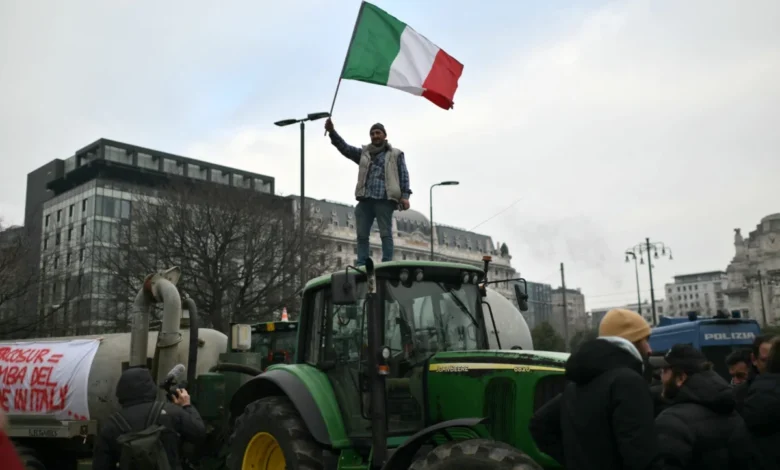
The streets of Turin became the focal point of national unrest on Friday morning as a coalition of farmers, laborers, and activists converged on the city center to voice growing despair over the escalating cost of living and the nation’s increasing military expenditures. In a visceral display of frustration, farmers deployed two bins of manure in front of the city hall, a symbolic gesture directed at what speakers characterized as the government’s pivot toward an economy defined by arms manufacturing rather than essential production. This demonstration was not an isolated incident but rather the climax of a coordinated, country-wide general strike organized by the grassroots union USB, which saw protests erupt in more than 50 Italian cities.
As inflation hit a three-year peak of 5.4% in October, the social fabric of Italy is showing signs of severe strain. The economic volatility is underscored by a 31.4% year-on-year surge in energy prices, a burden so crushing that it has forced a return to archaic modes of transport, with citizens in Naples documented riding horses through urban thoroughfares to bypass prohibitively expensive fuel costs. The convergence of these factors has transformed localized agricultural grievances into a national crisis of confidence.
A Chronology of Escalation
The current unrest is the result of a compounding series of economic shocks that began in mid-October. The timeline of the crisis reveals a rapid deterioration of the supply chain:
- Mid-October: Truckers and agricultural workers initiated a series of blockade operations targeting major transport arteries, ports, and fuel depots, primarily in southern Italy. These actions were prompted by the expiration of a critical diesel tax discount and a surge in fuel prices, which have climbed by roughly one-third since the onset of the war in Iran.
- October 20-22: The blockades reached critical mass, effectively severing the distribution of staple goods. Producers in Campania and Puglia—the engines of Italy’s food supply—reported massive losses as perishable goods rotted in transit.
- October 22: The government of Prime Minister Giorgia Meloni announced a €175.2 million relief package, bringing total tax credit support to €540 million. While this led to the removal of the most significant southern pickets, local leaders maintained that the aid was insufficient, describing it as a belated repayment of existing obligations rather than a solution to structural inequality.
- October 30: The general strike took hold, culminating in the widespread demonstrations seen in Turin, Milan, and Bologna, met with a firm response from the Interior Ministry and law enforcement, including the use of water cannons against protesters near the Turin prefecture.
The Collapse of the Supply Chain
The logistical paralysis caused by the protests has had immediate and tangible consequences for the Italian consumer. The dairy and pasta sectors, which are fundamental to the Italian economy and cultural identity, have been among the hardest hit. Pier Maria Saccani, director of the consortium overseeing Mozzarella di Bufala Campana DOP, confirmed that roughly one million liters of milk went unprocessed in a single day due to transport stoppages. Because the production of authentic buffalo mozzarella requires processing within 60 hours of milking, the blockade caused an estimated €3 million in losses within a 24-hour window.
Similarly, the pasta industry, a cornerstone of Italy’s export market, faced a near-total shutdown. Major producers, including Rummo and La Molisana, were forced to suspend operations as they ran out of essential raw materials. In the southern regions, which cultivate nearly 25% of Italy’s durum wheat, the impact was profound. Supermarkets across Naples and Sicily faced empty shelves, with retailers posting apologies to customers as fresh meat, cheese, and pasta disappeared from the supply chain. Federdistribuzione, the national retail group, confirmed that the burden of these losses fell disproportionately on the south, leading to widespread food spoilage in warehouses across Campania, Puglia, and Calabria.
Economic Context and the North-South Divide
The unrest has highlighted a widening chasm between Italy’s industrial north and its agricultural south. While major protests in cities like Milan and Bologna captured the attention of national media, the initial, more disruptive blockades in the south were largely ignored in the early stages of the crisis. This perceived neglect has fueled resentment among southern workers, who feel their contributions to the national economy are undervalued while their costs of production remain unsustainable.
Data provided by Istat reveals that this is not merely a short-term volatility issue but a long-term trend. Between 2000 and 2025, consumer prices in Italy rose by approximately 63%. However, the cost of food has outpaced general inflation, rising by roughly 90% in the same period. This discrepancy has placed small-scale agricultural businesses in a precarious position, as they are often unable to pass the full extent of these rising costs onto consumers without losing their market share.
The frustration is also historical. In February 2024, farmers launched tractor convoys into Rome to protest against European Union green mandates and the influx of low-cost imports. The current administration has adopted a more adversarial stance than previous governments. By implementing preventive arrests and threatening sanctions against transport workers, the government has signaled its intent to maintain order, yet this approach has arguably served only to harden the resolve of the protest movement.
Analysis of Implications
The intersection of military spending, energy costs, and food security poses a complex challenge for the Meloni administration. The decision to prioritize "arms company" investments—as cited by protesters in Turin—is seen by critics as a misallocation of resources during a period of record-high inflation.
Economists point to several critical implications of this ongoing tension:
- Inflationary Pressure: The disruption of the food supply chain is likely to cause further price spikes in the coming months. When production halts and supply lines are fractured, the resulting scarcity typically drives retail prices higher, further eroding household purchasing power.
- Political Stability: The mobilization of a diverse coalition—including farmers, taxi drivers, students, and truck drivers—suggests that the dissatisfaction transcends traditional political party lines. This cross-sectoral solidarity makes the protests harder to appease with sector-specific tax credits.
- Governance Challenges: The government’s reliance on a "hard line" approach, while effective in the short term, risks alienating a significant portion of the electorate in the south. If the government fails to address the underlying structural costs—specifically the dependence on imported fuel and the lack of subsidies for local agricultural infrastructure—the cycle of protest is likely to continue.
Official Responses and the Road Ahead
The government has defended its fiscal policies, emphasizing that the €540 million in tax credits represents a significant effort to stabilize the economy under extreme external pressure. However, labor leaders argue that this is a temporary bandage on a systemic wound.
As the country moves forward, the primary concern remains the sustainability of the agricultural sector. If small and medium-sized farms continue to shutter due to the inability to cover operational costs, Italy risks a permanent decline in its food sovereignty. For now, the streets remain volatile, and the silence from the halls of power regarding a long-term strategy for energy independence and cost-of-living relief continues to serve as a catalyst for further civil disobedience.
The events of this week have demonstrated that the Italian populace is reaching a breaking point. With inflation outpacing that of both the United States and China, and with the essential supply chain for national staples now proven to be vulnerable to collapse, the administration faces a critical juncture. Whether through comprehensive policy reform or further social friction, the path ahead for Italy will be defined by its ability to balance the needs of its agricultural heartland with the harsh realities of the current global economic landscape.