The major equity indices experienced a sharp downward correction during Friday’s trading session, as a wave of risk aversion swept through Wall Street on All Hallows Eve. The accelerated rotation out of technology and artificial intelligence (AI) infrastructure signaled a profound shift in market sentiment, with capital flowing rapidly toward defensive sectors including energy, consumer staples, and healthcare. Investors, increasingly wary of the sustainability of current capital expenditure (capex) models and the long-term return on investment for AI, sought shelter in the relative safety of Treasury bonds.
By the closing bell, the Nasdaq Composite plummeted 2.9% to finish at 25,437. This marks the tech-heavy index’s most severe single-day decline since March 2025, effectively erasing the week’s modest gains and leaving the index with a 2% deficit for the period. The broader S&P 500 followed suit, shedding 1.8% to close at 7,580, resulting in a 0.6% weekly loss. Meanwhile, the Dow Jones Industrial Average fell 1.1% to 51,770, capping a week that saw the blue-chip index slide 0.9%.
The Erosion of Magnificent Seven Dominance
The current market volatility is fundamentally rooted in the performance of the so-called "Magnificent Seven," a group of mega-cap stocks that have served as the primary engine for equity growth throughout the year. However, technical indicators and fundamental earnings reports suggest that the rally may be nearing an exhaustion point.
Adam Turnquist, Chief Cross-Asset Strategist at LPL Financial, noted that mega-cap stocks have faced mounting selling pressure over the past two weeks. "Elevated AI-related spending combined with rising financing costs has raised legitimate concerns over the path to profitability," Turnquist stated. "Recent earnings reports have added to these anxieties, revealing slowing growth in select hyperscalers’ core businesses."
The evidence of this cooling was apparent in the latest round of corporate disclosures. Alphabet reported its weakest advertising revenue growth in five quarters, while Amazon’s e-commerce segment saw sales growth decelerate to a three-year low. While Microsoft managed to deliver a positive surprise with stronger-than-expected Azure cloud revenue, the broader sector sentiment remained fragile.
From a technical standpoint, the Magnificent Seven Index has broken below support levels established at its May highs. Turnquist warns that the relative strength of these market leaders is at a "critical inflection point." Further deterioration in these metrics would likely confirm a sustained rotation of capital away from mega-cap growth stocks and into more traditional, value-oriented assets.
Semiconductor Sector Under Pressure
The broader technology complex faced additional headwinds on Friday beyond internal earnings concerns. Reports of a $6.3 billion cryptocurrency heist targeting the Binance exchange, allegedly orchestrated by state-sponsored actors linked to North Korea, injected a layer of geopolitical anxiety into the digital infrastructure market.
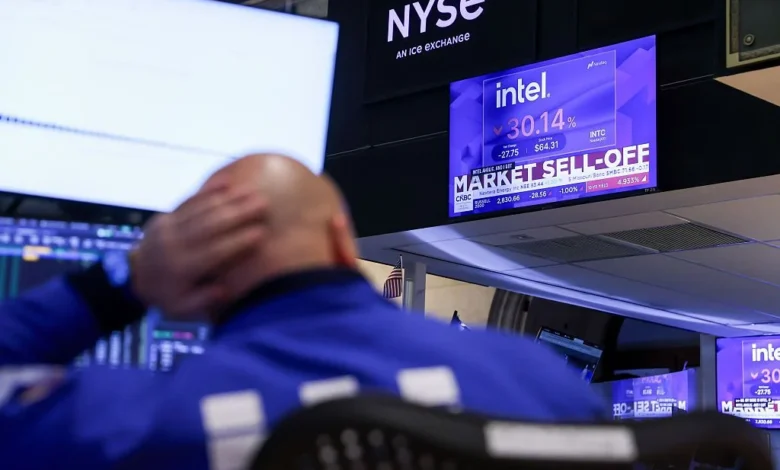
The most acute damage, however, was felt in the semiconductor industry. Intel became the focal point of the market’s ire, with its shares plummeting 28.6%—the worst performance among S&P 500 stocks on Friday. The company’s quarterly update was marred by a combination of mixed financial results and weak forward guidance. Management cited a more rapid-than-anticipated contraction in the core PC market as a primary driver for the downward revision. Intel now expects to report earnings of 25 cents per share for the fourth quarter on revenue between $15 billion and $16 billion, falling significantly short of Wall Street’s consensus estimate of 45 cents per share on $17.3 billion in revenue.
This collapse in Intel’s valuation had a contagion effect across the chip sector. Advanced Micro Devices (AMD) fell 10.9% ahead of its own third-quarter earnings report scheduled for the following Tuesday. Nvidia, the current face of the AI boom, declined 4.2%, ranking as the poorest performer among the Dow Jones components. While Meta Platforms and Tesla saw more moderate declines, the collective sentiment indicated a retreat from high-multiple tech valuations.
Macroeconomic Factors and Safe-Haven Assets
While equity markets struggled, other asset classes reflected the ongoing "flight to quality." Crude oil prices saw a significant uptick as geopolitical tensions in the Middle East threatened to disrupt supply chains. Front-month West Texas Intermediate (WTI) crude futures climbed 2.4% to $104.45 per barrel, while Brent crude rose 1.5% to $112.44. Market participants appear to be positioning for an escalation in regional conflict following the upcoming U.S. midterm elections.
The bond market served as the primary beneficiary of the day’s volatility. Yields on Treasury notes fell across the curve as investors bid up prices in a search for stability. The 2-year Treasury yield dropped 6.4 basis points to 4.592%, while the 10-year yield declined 5.8 basis points to 4.931%. The 30-year yield saw a more modest decline of 1.9 basis points, ending at 5.31%.
This move into fixed income was further encouraged by the U.S. Treasury Department’s announcement of a 5.51% I-bond rate, which will remain fixed for the six-month period ending April 30, 2027. This offering provides a compelling alternative for risk-averse investors navigating the current economic climate.
Federal Reserve Policy and Future Outlook
The Federal Open Market Committee (FOMC) remains firmly focused on the persistent challenge of inflation, despite the cooling seen in recent economic data. The September jobs report, which arrived softer than analyst expectations, did little to deter the Fed from its cautious stance.
The division within the central bank was highlighted by Cleveland Fed President Beth Hammack, who dissented from the committee’s decision to maintain interest rates at current levels during the October meeting. Her dissent underscores the ongoing debate regarding the necessity of further tightening to ensure long-term price stability. Markets are currently bracing for the next employment situation update from the Bureau of Labor Statistics, scheduled for release next Friday. Analysts expect the data to demonstrate a continuation of labor market stability, though any sign of significant weakness could reignite recession fears.
The Berkshire Hathaway Anomaly
Amid the broad market decline, Berkshire Hathaway stood out as a point of stability, posting a 0.3% gain. As the largest financial stock within the S&P 500, the conglomerate has increasingly functioned as an equity index fund, mirroring the diversified nature of the broader market.
The company’s portfolio, overseen by Warren Buffett and Greg Abel, provides a hedge against sector-specific volatility. Its holdings include significant positions in financial stalwarts like American Express and Bank of America, as well as technology giants such as Apple and Alphabet. However, the inclusion of consumer staples like Coca-Cola and energy producers like Chevron has provided a buffer against the tech-led downturn.
As the market approaches the next earnings cycle, attention is shifting to Berkshire’s upcoming report next Saturday. This will be the first quarterly release since Buffett officially retired as chairman of the board in September, marking a new chapter for the firm under Greg Abel’s leadership. The company’s ability to outperform in a bearish environment highlights the enduring appeal of value-oriented, cash-rich business models during periods of market uncertainty.
Implications for Investors
The events of this past week suggest that the market is currently in a state of recalibration. The transition from a growth-at-any-cost mindset to a more disciplined focus on fundamental performance and profitability is gaining momentum. As the "Magnificent Seven" face increased scrutiny regarding their high capital expenditures and their ability to translate AI investment into tangible earnings, the broader market is likely to see continued volatility.
For investors, the current environment necessitates a re-evaluation of portfolio concentration. The outperformance of sectors that historically provide safety—such as energy and consumer staples—suggests that the market is no longer willing to reward technology stocks indiscriminately. As the investment community waits for further signals from the Federal Reserve and additional corporate earnings reports, the theme of "quality over growth" is expected to remain the dominant narrative for the remainder of the quarter. Investors are advised to monitor the upcoming jobs data and the Federal Reserve’s future commentary as the primary catalysts that will dictate the market’s direction into the year-end.