Naomi Watts Dedicates Prestigious San Sebastián Donostia Award to David Lynch While Defying Ageism in Hollywood

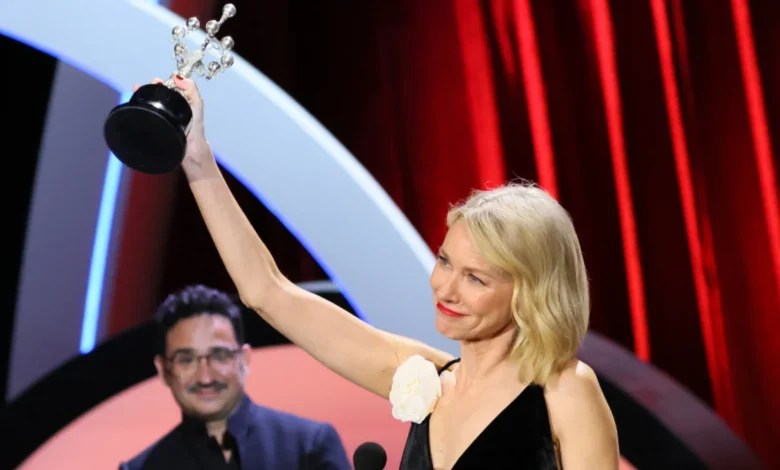
The historic coastal city of San Sebastián played host to a poignant evening of cinematic celebration as British actress Naomi Watts accepted the festival’s highest accolade, the Donostia Award, during the 2026 San Sebastián International Film Festival. The honor, which recognizes lifetime achievement and contributions to the cinematic arts, was presented to Watts on Saturday night ahead of a gala screening of her latest dramatic feature, The Housewife. Amid the glitz and emotional speeches that typically accompany career-retrospective honors, Watts utilized her platform to spotlight the pivotal figures who shaped her trajectory, pay tribute to the late, visionary director David Lynch, and deliver a resounding critique of Hollywood’s historically rigid approach to aging actresses.
The evening bridged decades of cinematic history, underscored by a heartfelt introduction from Spanish filmmaker J.A. Bayona. Bayona, who directed Watts in the harrowing 2012 disaster drama The Impossible—a role that secured the second Academy Award nomination of her career—recalled the formative experience of working with the seasoned actress as a relatively green director. Speaking to an attentive audience, Bayona praised Watts not merely for her formidable professional talents, but for her unwavering support during a physically and emotionally grueling production schedule.
Main Facts and the San Sebastián Tribute
The presentation of the Donostia Award to Naomi Watts marks another high point in the celebrated autumn film festival circuit. The San Sebastián International Film Festival, renowned globally for its discerning audiences and prestigious programming, runs from September 18 to September 26, 2026. The festival’s opening weekend set a high-profile tone, having kicked off with a Donostia Award presentation to legendary German auteur Werner Herzog on Friday night, followed by screenings of works by prominent international filmmakers such as Fatih Akin.
For Watts, the receipt of the award underscores a career defined by artistic fearlessness, oscillating seamlessly between gritty independent features and massive commercial studio projects across both film and television. Festival organizers lauded the 57-year-old actress for her versatility, noting her ability to anchor complex character studies just as effectively as high-concept blockbusters.
When Watts took the stage to accept the award from Bayona, the emotional weight of the moment was palpable. Reflecting on their grueling shoot for The Impossible—which chronicled a family’s harrowing ordeal during the catastrophic 2004 Indian Ocean tsunami—Watts shared anecdotes that balanced the intense physical demands of the production with deep fondness.
"Shooting in Spain with incredible crews, getting to know the Thai community, so many full, brilliant memories, and I loved it all, the whole experience, even the hard stuff," Watts told the audience, eliciting laughter when she recalled the sheer endurance required for water-tank sequences. She humorously acknowledged her young co-star, Tom Holland—who made his live-action feature film debut in the movie at just 15 years of age—noting how Holland enthusiastically characterized the punishing aquatic stunt work as "the best water park he ever went to," contrasted with her own characterization of the shoot as "pure pain." The Impossible went on to become a massive global commercial success, grossing over $198 million worldwide and cementing Watts’ status as a bankable dramatic lead capable of carrying high-stakes narratives.
The Chronology of Perseverance: Overcoming Early Rejection
While Watts currently commands respect as one of the preeminent dramatic actresses of her generation, her path to international stardom was neither immediate nor straightforward. During her acceptance speech, the British-born star offered a candid reflection on the decade of hardship that preceded her breakout role, detailing an unrelenting cycle of rejection that nearly prompted her to abandon her cinematic ambitions.
"It wasn’t an easy trajectory making a name for myself in Hollywood. There was so much rejection. A lot of people telling me I wasn’t going to make it," Watts recounted to the rapt audience. For roughly ten consecutive years, the young actress faced closed doors, casting offices that failed to see her potential, and industry voices suggesting her career had plateaued before it truly began.
Everything shifted dramatically at the turn of the millennium when she crossed paths with avant-garde auteur David Lynch. Auditioning for what would become a seminal psychological thriller, Watts caught the eye of a director willing to look past conventional casting metrics. Lynch cast her in the 2001 masterwork Mulholland Drive, a role that transformed her overnight from a struggling jobbing actress into an international art-house icon.
"[He] saw me, and all those wounds from all that rejection now appeared as growth," Watts said, her voice thick with emotion as she remembered Lynch. "He gave me the role that you couldn’t even dream for. He really just changed my life. He gave me a different understanding of what it meant to act, to trust instinct, to embrace uncertainty, and to not be afraid of the strange or the unexplained. But more than that, he believed in something in me before I fully believed in myself, and that is a gift that you never forget. So tonight, I do really feel like this award is very much about David."
The tribute took on added resonance given Lynch’s recent passing, prompting the actress to hold her Donostia statuette aloft during the closing moments of her speech and declare to the auditorium, "And David Lynch, I miss you!"
Shattering Hollywood Ageism and Shaping New Narratives
Beyond honoring her mentors, Watts used her time at the microphone to address systemic issues within the entertainment industry, specifically confronting the pervasive ageism that historically curtailed the careers of women past a certain demographic threshold. Reflecting on the timeline of her career, Watts noted the disheartening predictions she received when Mulholland Drive first premiered.
"As a woman of my age, despite what I was told at 31 when I was launching Mulholland Drive — that it’d be all dried up and finished at the age of 40 — I’m grateful beyond words to be part of shifting that narrative," Watts stated to thunderous applause.
The commentary strikes at the heart of a long-standing critique regarding gender equity and longevity in Hollywood. For decades, traditional studio systems relegated actresses over forty to marginal supporting roles—often cast merely as matriarchs or love interests to younger male leads—or forced them out of the industry entirely due to a drought of substantive material. Watts’ sustained career trajectory, which has expanded into producing and television work well into her late fifties, serves as a testament to shifting industry paradigms.
"We need to see ourselves," Watts emphasized, issuing a rallying cry for inclusive storytelling. "Women are consumers of films and storytelling too. We want to see ourselves reflected on screen."
Underscoring her commitment to sustaining this momentum, Watts assured the festival audience that her creative journey is far from over. "I still have lots more in me and I’m still reaching for the stars. So thank you for giving me the privilege of doing what I love to do," she declared.
Contextualizing The Housewife and an Illustrious Filmography
The evening’s festivities culminated in the screening of Watts’ newest cinematic venture, The Housewife. Directed by Ben Shirinian and featuring an ensemble cast that includes Tye Sheridan, Michael Imperioli, and Luke Evans, the film transports viewers to 1964 New York. Based on true historical events, the narrative follows a young journalist who uncovers evidence suggesting a potential Nazi officer is living quietly and anonymously in Queens. As the reporter attempts to infiltrate the suspect’s life by befriending his charming wife—portrayed by Watts—the investigation spirals into dark, morally complex territory, testing the psychological boundaries of all involved.
The project fits neatly into a career defined by fearless choices across a staggering array of genres and formats. Watts’ filmography is characterized by collaborations with many of modern cinema’s most demanding auteurs. Following her international breakout in David Lynch’s Mulholland Drive, she quickly secured her first Academy Award nomination for Alejandro González Iñárritu’s devastating 2003 drama 21 Grams.
Her subsequent work reads as a masterclass in diverse filmmaking. She has stepped into blockbuster territory with Peter Jackson’s 2005 remake of King Kong, explored visceral crime drama with David Cronenberg in Eastern Promises, navigated biographical drama with Clint Eastwood in J. Edgar, pushed psychological boundaries with Michael Haneke in the English-language remake of Funny Games, and collaborated with contemporary indie mainstays such as Noah Baumbach on While We’re Young and Audrey Diwan on Emmanuelle. Furthermore, her relationship with the San Sebastián Film Festival is longstanding; she previously attended the event in 2009 alongside director Rodrigo García to close the official selection out of competition with Mother & Child.
Broader Industry Implications and Legacy
As the 2026 San Sebastián International Film Festival moves past its opening weekend—highlighted by extensive industry panels, tributes to living legends like Herzog, and rigorous journalistic retrospectives led by outgoing festival director José Luis Rebordinos—Watts’ recognition serves as a timely reminder of the evolving metrics of cinematic achievement.
The convergence of her lifetime achievement honor with the premiere of The Housewife illustrates an ongoing industry shift: veteran actresses are no longer passive participants in a youth-obsessed ecosystem, but active creative forces dictating the terms of their longevity. By explicitly calling out the institutional skepticism she faced in her early thirties, Watts highlights how resilience, combined with uncompromising artistic collaborations with directors like David Lynch, can fundamentally rewrite the cultural script for women in media.
As the applause faded in the Basque Country auditorium, Watts’ message remained clear: the narratives told on screen are expanding to reflect the full spectrum of human experience, and the artists who champion those stories are refusing to yield to arbitrary expiration dates. With a slate of complex new projects and a freshly minted Donostia Award in hand, Naomi Watts stands firmly at the forefront of that ongoing cinematic evolution.