President Donald Trump Addresses White House Correspondents’ Association Dinner with Scathing Remarks and Unconventional Claims

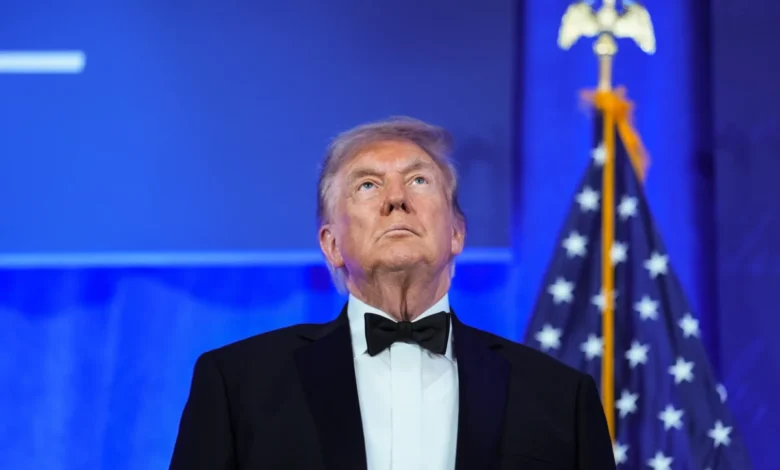
President Donald Trump made his inaugural appearance at the White House Correspondents’ Association Dinner, a rescheduled gala held Friday evening in Washington, D.C. His address, spanning just over an hour, was characterized by a rambling, often confrontational style, as he delivered pointed remarks directed at a wide array of journalists, politicians, and celebrities with whom he has publicly sparred. The event, typically a more lighthearted affair aimed at fostering civil discourse between the press and the executive branch, took on a distinctly adversarial tone under Trump’s presidency.
A Rescheduled Gala Amidst Security Concerns
This year’s White House Correspondents’ Association Dinner, typically held in late April, was postponed following a security incident on April 25th. During the initial scheduled date, an individual armed with a firearm reportedly breached security at the Washington Hilton, leading to an evacuation and the apprehension of the suspect. The event’s rescheduling to a later date in the year underscored the heightened security concerns surrounding presidential appearances, particularly for an event that historically brings together a large gathering of prominent figures. Trump, in his remarks, acknowledged the incident, expressing gratitude to law enforcement personnel who subdued the suspect, highlighting the gravity of the security threat that had necessitated the postponement.
An Unpredictable Opening
Upon taking the podium, Trump initially seemed to gauge the room’s reception, expressing a mixed sentiment towards the assembled journalists. "I am delighted to be here at the White House Correspondents’ Dinner," he stated. "Amazing people, a lot of people that I like. Some I don’t like at all, but I respect most of them." He then alluded to the disruption of the original dinner, suggesting he was tempering his usual approach. "What do we do here? Is this supposed to be fun? Am I supposed to be serious? Am I supposed to be a comedian? So I guess you said, maybe a little bit of everything," he mused, hinting at a prepared, more aggressive set of remarks that were either curtailed or modified due to the circumstances.
Targeting the "Fake News Media"
The initial ambiguity quickly dissolved as Trump launched into a direct assault on the press, labeling much of the media as "fake news." He drew a parallel between the news industry and the Academy Awards, criticizing both for perceived bias and declining viewership. "This evening it’s really all about the fake news media and your handling of prizes – writing and producing and performing made-up stories like the Academy Awards," Trump declared. He elaborated on the perceived decline of the Oscars, attributing it to their alleged engagement with political commentary that alienated audiences. "The Academy Awards used to be the the epitome of ratings outside of the Super Bowl… Now it’s down in the dumps. Nobody wants to watch it anymore because they took on Trump. They hit me all night long."
This critique of entertainment awards extended to his view of the press’s business model. Trump posited that his absence from the political spotlight would cripple the media industry. "When I’m gone. You’re all going to be broke. Your business model is going to be finished. No, it’s true. When I’m not around, you’re going to be broke. There’s not going to be anybody to report on. Nobody gives a damn about anybody else," he asserted, projecting a direct correlation between his public persona and the financial viability of news organizations.
Shifting Platforms and Past Grievances
Trump also highlighted his perceived departure from traditional media, referencing his presence on platforms like TikTok. "Mostly, I’ve given up on you and the media, so that now I just gave up on you, and I’m number one on TikTok. Did you see that?… I gave up on you, people. I gave up on traditional press, and it obviously worked because we did win in a landline" (a clear misstatement for "landslide," referencing his 2016 election victory). He boasted about his alleged role in facilitating the sale of TikTok to American investors, a claim that requires further factual verification regarding the specifics of the transactions and his direct involvement.
His decision to abstain from previous WHCA dinners, he explained, stemmed from what he viewed as consistently unfair treatment by the press. "I thought the press treated me very, very unfairly, and I don’t know. I think I made the right decision because they need to go where maybe you’re not wanted, but they did want me. They wanted me for ratings, and they wanted me for other reasons, but not for love. And I said, ‘You know, I’m not going to go.’ First time that ever happened… And I didn’t go for four years because I got treated terribly by the press." This statement directly contradicts his presence at this year’s event, suggesting a shift in his strategy or a calculated decision to engage directly with the press corps.
Critique of Comedians and Media Personalities
This year’s WHCA dinner eschewed a traditional comedian in favor of a mentalist, Oz Pearlman. Trump seized upon this decision to criticize prominent late-night hosts, including Jimmy Kimmel, Jimmy Fallon, and Stephen Colbert. "They considered using Jimmy Kimmel, Jimmy Fallon… These guys – they’re terrible. They’re terrible. Stephen Colbert. These are people without talent… They have no talent, but they are not comedians. They’re not funny people. They’re angry people. They’re sick people," he stated, dismissing their comedic abilities and characterizing them as ideologically driven and emotionally unstable.
A Proposed Name Change and An Awkward Encounter
In a move that evoked his past attempts to associate his name with prominent institutions, Trump recounted a supposed conversation with Paramount CEO David Ellison. Ellison, whose company oversees CBS News, allegedly suggested renaming the dinner the "Trump White House Correspondents’ Dinner" in the future. "He told me that, and I like that very much. We’re going to change the name of it, OK?" Trump announced, drawing a parallel to his unsuccessful bid to have his name affixed to the Kennedy Center. This statement appears to be a projection of his desires rather than a confirmed plan.
An unusual moment occurred when Trump offered praise for Bari Weiss, a commentator associated with CBS News. "I, for one, wish Bari Weiss all the best at CBS News. She’s a wonderful woman," he said, prompting an audible reaction from the audience, suggesting Weiss’s viewpoints or affiliations might be a point of contention or surprise among the attendees.
White House Press Secretary Karoline Leavitt also received a mention, with Trump acknowledging the difficulty of her role. "May have one of the hardest jobs in the White House because she has to deal with all of you all the time, and you can be very difficult. You can be very, very difficult people. But I’m probably being a little bit oversensitive. Sometimes I really do think that some of you don’t like me," he conceded, framing her position as a challenge due to the perceived adversarial nature of the press corps.
"Trump Derangement Syndrome" and Personal Attacks
Trump characterized the assembled attendees as embodying "Trump derangement syndrome," a term he has frequently used to describe perceived irrational opposition to his policies and person. "This place is the really the largest group of Trump derangement syndrome people ever put together at one time, I suspect," he quipped, eliciting a mixed response of laughter and murmurs. The concept of "Trump derangement syndrome" has been widely debated and is not recognized as a medical condition by mainstream psychiatric organizations.
His remarks then devolved into personal attacks on several figures. He singled out Don Lemon, formerly of CNN, as having "the lowest IQ on television" and being "the dumbest man on television." Trump dismissed the possibility of Lemon’s professional comeback, stating, "when you say some things, you never make a comeback. It’s not like, ‘Oh gee, hey Don, let’s have dinner some night.’"
CNN anchor Kaitlan Collins, who received a WHCA award for her coverage of a confrontation between Trump and Ukrainian President Volodymyr Zelensky, also became a target. While congratulating her on the award, Trump immediately dismissed the merit of her reporting. "I want to personally congratulate CNN’s Kaitlan Collins on receiving her award… It was all about me. It’s a fake. She shouldn’t get the award. It was a fake, but I didn’t mind." CNN Worldwide Chairman and CEO Mark Thompson issued a swift response, stating, "We stand by our journalists and the integrity and fair mindedness with which the CNN team reports the news. Honest, accurate journalism may sometimes irritate politicians, but our right to report and present that reporting to the public without government interference is fully protected by the U.S. Constitution. CNN will continue to exercise this right."
Trump’s commentary on Collins took a peculiar turn as he described her as a "young, active woman" who "never smiles." He recounted an alleged personal interaction where he urged her to smile, suggesting it would be fitting for someone at a "fake news" organization. He then veered into a bizarre tangent involving a supposed sponsorship opportunity for Collins, which he claimed was a mistake, confusing her with transgender influencer Dylan Mulvaney, who was involved in a controversial Bud Light campaign in 2023. Trump referenced the financial fallout for Bud Light due to the Mulvaney partnership, calling it "the worst commercial ever made" and stating he "wouldn’t want to hire Dylan anytime soon." This commentary reflects a broader pattern of Trump engaging with cultural issues and celebrity controversies.
Anderson Cooper, another CNN anchor, received a more nuanced critique. Trump acknowledged a past rapport, stating, "I like Anderson actually because he’s covered me well for many years, and he went bad as soon as I went for politics. But for years, he loved interviews. I did so many interviews with him, and he was great. But you know, he’s got a little different persuasion than me, in many ways actually." This suggests a recognition of Cooper’s past journalistic approach, contrasting it with his current perceived stance.
A Broad Sweep of Criticisms
The president’s verbal volleys extended to a wide range of political figures and cultural icons. California Governor Gavin Newsom, U.S. Representative Ilhan Omar, Senators Elizabeth Warren and Chuck Schumer, Rosie O’Donnell (whom he described as a "sick older woman"), and CNN’s Jake Tapper were all subjected to criticism. Bruce Springsteen also faced Trump’s ire, with the president remarking on his appearance and perceived political messaging during concerts. "What the hell happened to that guy? He looks like hell… I’m sure he doesn’t like the way I look, but I don’t look so bad." Trump quipped that Springsteen’s tour had been effectively renamed "Bored in the USA" due to the perceived political nature of his performances.
Legal Battles and an Award-Winning Controversy
Trump’s contentious relationship with the press is well-documented, marked by frequent accusations of "fake news" and lawsuits against various media outlets, including The New York Times, The Wall Street Journal, CNN, ABC News, and CBS News’s "60 Minutes."
At the WHCA dinner, the reporters from The Wall Street Journal who investigated a story about a birthday letter allegedly written by Trump to Jeffrey Epstein were awarded the Katharine Graham Award for Courage and Accountability. Trump has vehemently denied authoring such a letter and had previously filed a $20 billion defamation lawsuit against the Journal over the story, which the Journal’s legal team characterized as "an affront to the First Amendment." While a judge initially dismissed the suit, Trump refiled the complaint in May 2026, and the case remains pending. Trump’s interaction with the award-winning reporters at the dinner was reportedly awkward; he shook their hands before mockingly throwing up his hands and returning to his seat, a gesture that underscored the ongoing legal and personal conflict. "This has not been an easy evening. All these awards… Do I get a say in those awards?" Trump asked rhetorically, highlighting his contentious relationship with the journalistic accolades presented.
Future Ambitions and a Bizarre Anecdote
Towards the conclusion of his extended remarks, Trump donned a "Trump 2028" hat, signaling his intention to run for a fourth term. This move was accompanied by a reiteration of his unsubstantiated claim that he won the 2020 U.S. presidential election, a claim widely debunked by election officials and courts. He also expressed his intent to return to the correspondents’ dinner in 2027.
In a peculiar anecdote, Trump also made a joke at the expense of his Secretary of Health and Human Services, Robert F. Kennedy Jr. He referenced a fictional scenario involving Kennedy and a cow, implying it was brought to the dinner for consumption. "Bobby Kennedy’s right here. He personally ran over the cow in his car… He brought it here for you to eat tonight," Trump stated. He further embellished the story with a suggestion of an appetizer featuring "his favorite cut of male raccoon roadkill," which he claimed was rejected. "But we drew the line at that, Cheryl. We said, no, we’re not going to do that. We’re not doing that. We love Bobby," he concluded, framing the tale as a lighthearted jab at a trusted associate.
The Event’s Context and Leadership
The 2026 White House Correspondents’ Association Dinner was held at the Waldorf Astoria hotel in Washington, D.C. The program featured a performance by mentalist Oz Pearlman, a departure from the traditional inclusion of a comedian. The event’s leadership for the evening was handled by outgoing WHCA President Weijia Jiang, senior White House correspondent for CBS News, and Fox News’s Jacqui Heinrich, who is set to assume the role of WHCA president for the 2026-27 term. Their co-hosting duties reflected the association’s effort to present a unified front in managing the high-profile event.