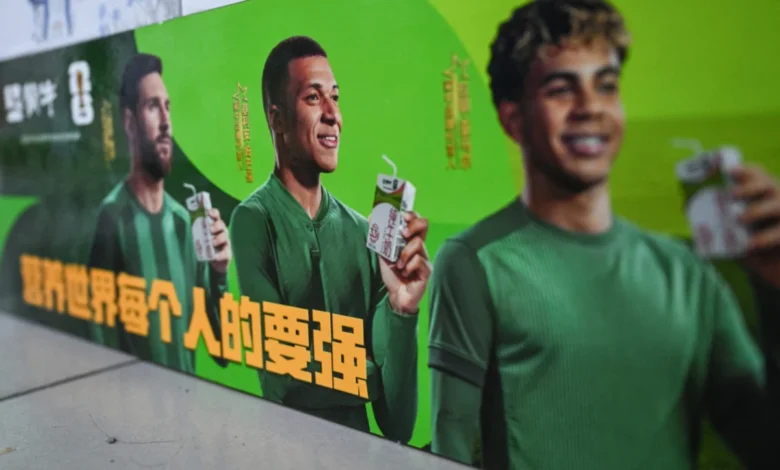
Kylian Mbappé faces unprecedented commercial fallout in China following controversial remarks on a French talk show.

The global sports and entertainment landscape remains a high-stakes arena where cultural sensitivities intersect with massive commercial interests. Kylian Mbappé, arguably the most recognizable footballer of his generation and a key figure for Real Madrid, has found himself at the center of a rapidly escalating diplomatic and commercial firestorm. During a recent appearance on a popular French online talk show, Mbappé made a remark referring to a meme figure as a "Chinese dictator"—a comment widely interpreted by Chinese audiences as a disparaging reference to Mao Zedong. The reaction from the Chinese market, which prides itself on deep reverence for its modern historical figures, was swift, uncompromising, and financially severe.
Within 72 hours of the broadcast, three major Chinese corporations—Dongpeng Beverage, the dairy giant Mengniu, and the cheese producer Milkground—formally severed their sponsorship ties with the athlete. Simultaneously, the state-run China Media Group (CMG) announced an immediate suspension of broadcasts featuring LaLiga, the Spanish premier soccer league where Mbappé currently competes. The move signals a broader systemic response, suggesting that the fallout may extend beyond the individual player to the institutions that house him.
A Chronology of the Crisis
The sequence of events highlights the velocity at which public sentiment can mobilize in the digital age.
- The Incident: During a lighthearted segment on a French media program, Mbappé engaged in a discussion involving internet memes, during which he used the phrase that ignited the controversy.
- The Viral Backlash: Clips of the interview were rapidly circulated on Weibo and Douyin, where the comment was swiftly identified as an insult to Chinese history.
- Corporate Decoupling: By the second day, major sponsors including Mengniu and Dongpeng issued notices terminating their contracts, citing a breach of their internal codes of conduct regarding cultural respect.
- Broadcasting Suspension: CMG, the primary rights holder for soccer broadcasts in China, confirmed that it would pull LaLiga matches from its schedule, effectively blacking out the league for the Chinese audience.
- The Apology: Recognizing the existential threat to his brand equity in the world’s second-largest economy, Mbappé issued a formal apology on the social media platform X, expressing regret for his lack of judgment and confirming his respect for Chinese history.
- Institutional Damage Control: Both Real Madrid and the leadership of LaLiga mobilized their public relations teams, with club statements and high-level diplomatic meetings aimed at de-escalating the situation.
The Anatomy of the Backlash
The decision by major Chinese brands to drop a global icon like Mbappé is not an isolated phenomenon but rather a reflection of a maturing, hyper-sensitive consumer market. In China, corporate branding is inextricably linked to national sentiment. When a celebrity or a global firm deviates from the established social or political consensus, the response is often a collective, bottom-up boycott that forces companies to choose between international talent and domestic market share.
Data from the past decade illustrates that this phenomenon is not limited to sports. In 2019, the "Morey Tweet" controversy saw the NBA lose hundreds of millions of dollars in revenue after the then-General Manager of the Houston Rockets expressed support for protesters in Hong Kong. It took three years for the NBA to regain its full broadcasting footprint in China. Similarly, the 2021 H&M boycott, triggered by the company’s stance on cotton sourcing in Xinjiang, resulted in a sustained cratering of the brand’s revenue in the region. These instances serve as a blueprint for how quickly a global brand can lose its footing in the Chinese market.
Official Responses and Mitigation Efforts
The response from the sporting bodies involved has been characterized by an urgent attempt to distinguish the player’s personal views from the institution’s official stance. Javier Tebas, the President of LaLiga, sought an immediate audience with the Chinese ambassador to Spain. The intent behind this meeting was to frame the comment as an isolated "individual episode" that should not undermine years of cultural and sporting cooperation.
Real Madrid’s official statement, released on Wednesday, was crafted to be conciliatory and diplomatic. By emphasizing a "deep respect for China, its history, its culture, and its citizens," the club attempted to decouple its brand from the controversy. However, in the realm of international public relations, such statements often struggle to gain traction once a nationalist narrative has taken hold on social media platforms.
Broader Implications for Global Brands
The Mbappé incident serves as a stark reminder of the complexities of operating in a globalized economy where local cultural norms can carry global consequences. Several factors contribute to this volatility:
1. The Power of Nationalist Sentiment:
Social media in China acts as a catalyst for collective action. When a perceived slight against the nation occurs, the volume of online discourse can force corporate boards to make reactive decisions to protect their reputation in the domestic market.
2. Cultural Illiteracy in Marketing:
The case of Lululemon in June 2026, where a promotional event on the Great Wall of China caused a stir due to the accidental inclusion of a Japanese instrument instead of a traditional Chinese one, highlights that "cultural sensitivity" is not just about political statements. It is also about the granular understanding of cultural symbols. Brands that fail to vet their content through a local lens often pay a steep price in public perception.
3. The Trademark Trap:
The LVMH-Molly Tea dispute indicates that legal victories can sometimes lead to public relations disasters. While LVMH won a significant court battle regarding intellectual property, the resulting public perception that a global giant was "bullying" a domestic favorite caused a measurable decline in sales. The lesson for multinational corporations is that being legally correct does not necessarily equate to being commercially successful.
4. The Risk of Domestic Backlash:
The experience of Nongfu Spring in 2024 demonstrates that even indigenous Chinese brands are susceptible to the same pressures. When public discourse turned against the company over accusations of "pro-Japanese" packaging, consumers did not hesitate to boycott a homegrown giant. This proves that the environment is one of universal scrutiny rather than just a "foreign vs. local" dynamic.
Analysis of Future Outlook
The financial impact on Mbappé is expected to be significant. The loss of three major sponsorships is merely the immediate cost; the long-term potential for revenue loss, including lost endorsement deals and a diminished capacity for future brand activation in Asia, is immense. For LaLiga, the suspension of broadcast rights represents a massive risk to its international broadcasting rights value, which is a critical pillar of its financial health.
Moving forward, this event will likely lead to more stringent "cultural awareness" training for global athletes and their management teams. Just as professional athletes are now coached on media relations and financial management, they may increasingly require geopolitical and cultural sensitivity training to navigate the minefield of international public relations.
The incident also highlights a growing trend of "de-risking" in international sports marketing. Brands and leagues are beginning to realize that the benefits of massive exposure in the Chinese market come with the implicit requirement for total alignment with local cultural sensibilities. As the global digital ecosystem remains interconnected, the margin for error for international stars is shrinking. Whether this incident leads to a permanent cooling of relations between European football and the Chinese market remains to be seen, but the current situation serves as a definitive case study in the modern cost of cultural missteps.
As the dust settles, the sports industry will be watching closely to see if the apologies from Mbappé and his club are sufficient to restore access to one of the world’s most lucrative and influential markets. If history is any guide, the road to rehabilitation will be long, requiring not just words, but sustained, demonstrative actions of cultural respect over an extended period.