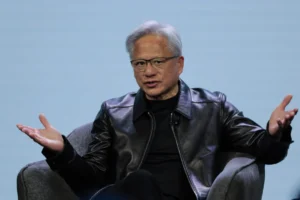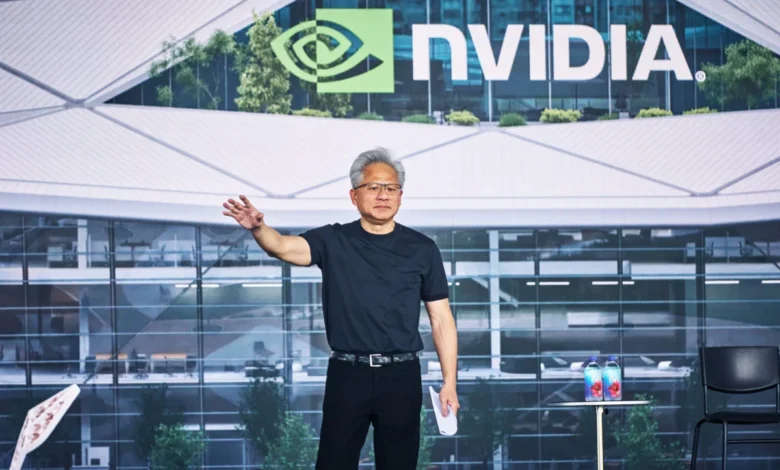
The resignation of Jensen Huang, the visionary architect behind Nvidia’s meteoric rise to the center of the global artificial intelligence economy, has triggered a high-stakes transition period for the Santa Clara-based semiconductor giant. As of Thursday, Nvidia’s board of directors has appointed Colette Kress, who has served as the company’s Chief Financial Officer since 2013, to the role of interim CEO. While Kress maintains her financial oversight, the board has launched a comprehensive search for a permanent successor to navigate the next chapter of a company currently valued at trillions of dollars.
The Interim Transition and Board Strategy
Colette Kress enters this transitional phase with the deep institutional knowledge required to steady the ship. Having navigated Nvidia through its pivot from a gaming-focused hardware manufacturer to the dominant supplier of data-center AI processors, Kress is viewed by analysts as a stabilizing force. Scott W. Simmons, co-managing partner at executive search firm Crist Kolder Associates, emphasized the necessity of her appointment, noting that for a firm of Nvidia’s complexity, internal continuity is paramount during the search process.
However, industry observers suggest that the permanent role requires a specific profile—likely a seasoned technologist capable of maintaining Nvidia’s aggressive innovation roadmap. The board, led by new chair Harvey Jones, is expected to prioritize candidates who possess not only executive acumen but a deep-seated understanding of the intricate, hardware-software ecosystem that Huang spent decades constructing.
Potential Candidates: The External Search
The search for a successor has naturally turned toward other leaders within the semiconductor and broader technology sectors. Analysts have identified a diverse shortlist of high-profile executives, each bringing unique strengths to the table.
Rene Haas, CEO of Arm:
Widely considered a frontrunner by market analysts, Rene Haas offers a compelling intersection of history and modern industry alignment. Having spent seven years at Nvidia before his tenure at Arm, Haas understands the "Nvidia DNA." Furthermore, as the leader of Arm, he oversees the architecture that powers Nvidia’s Grace and Vera CPUs. Supporters of his candidacy, such as Shay Boloor of The Futurum Group, argue that his expertise in CPU architecture makes him uniquely qualified to lead, despite his distance from the specific rise of rack-scale AI and NVLink technologies during his time away.
Lisa Su, CEO of AMD:
The mention of Lisa Su has introduced a fascinating, if complex, narrative to the search. As the architect of AMD’s remarkable resurgence since 2014, Su has demonstrated an unparalleled ability to revitalize a chipmaker’s engineering culture and market positioning. Her credentials in semiconductor physics and executive leadership are arguably unmatched. While she is a distant cousin of Huang, the primary obstacle remains professional: poaching a sitting, highly successful CEO of a direct competitor is a feat of corporate maneuvering that few boards attempt.
Tim Cook, Former CEO of Apple:
Perhaps the most high-profile name in the discussion, the former Apple CEO brings experience in managing a company that functions as both a hardware and software powerhouse. Tim Cook’s tenure at Apple, particularly his mastery of global supply chain logistics and his experience succeeding a legendary founder in Steve Jobs, provides a blueprint for what a "post-founder" era looks like. Although Cook’s recent role as executive chairman at Apple creates potential conflict, his name has gained traction, with high-profile political figures even publicly endorsing his suitability for the role.
Tom Kurian and Nikesh Arora:
Industry analysts have also highlighted the merits of leaders like Google Cloud CEO Tom Kurian and Palo Alto Networks CEO Nikesh Arora. Kurian’s deep integration with Nvidia’s AI infrastructure through his work at Google provides him with a client-side perspective on the company’s core business. Conversely, Arora brings a global, multifaceted background spanning SoftBank and Google, offering a "builder" mentality that could suit a company looking to expand its reach into new enterprise verticals.
The Weight of Legacy: A Chronological Context
To understand the magnitude of this transition, one must look at the timeline of Nvidia’s expansion under Jensen Huang.
- 1993: Nvidia is founded, initially focusing on 3D graphics for personal computers.
- 2006: The introduction of CUDA (Compute Unified Device Architecture) changes the trajectory of the company, allowing GPUs to perform general-purpose computing.
- 2013: Colette Kress joins as CFO, marking the beginning of the era of massive financial expansion.
- 2020-2023: Nvidia solidifies its role as the backbone of the AI boom, with its H100 and Blackwell architectures becoming the industry standard.
- 2026: The search begins for a successor to manage a firm that is no longer just a chipmaker, but the central nervous system of global AI development.
Analytical Implications for the Semiconductor Market
The choice of the next CEO will signal Nvidia’s strategic priorities for the next decade. If the board selects a purely operational leader, it may suggest a focus on supply chain efficiency and margin expansion. If they opt for a technologist, it reinforces the company’s commitment to staying at the bleeding edge of silicon design and parallel computing.
The primary challenge for any successor will be maintaining the company’s "moat." Nvidia’s strength is not just in its hardware, but in the software stack that makes its chips indispensable to developers. Any new leader will have to balance the pressure to deliver record-breaking quarterly results with the long-term R&D investments that define the company’s competitive advantage.
Furthermore, the new CEO will have to navigate a complex geopolitical landscape. As the U.S.-China technology race intensifies, Nvidia’s role in the global supply chain has made it a focal point of trade policy and international relations. Managing these pressures while sustaining double-digit growth will be a task of unprecedented scale.
The Road Ahead
As the search continues, the executive search committee faces the difficulty of finding an individual who can command the respect of Nvidia’s deep bench of engineers while simultaneously satisfying Wall Street’s aggressive growth expectations. There is no simple path forward; the candidate pool is exceptionally small, restricted to a handful of leaders who have successfully managed companies of similar size and complexity.
"There’s such a small pool to fish in when you think about people capable of stepping into this," notes Simmons. The board is expected to conduct an exhaustive process, likely engaging with both internal talent and the external candidates listed above, while keeping the company’s internal morale high during the interim period.
As Nvidia moves past the "Huang era," the market remains in a state of cautious anticipation. The company has evolved from a boutique GPU developer into the most important hardware provider in the world. Whoever eventually occupies the office left vacant by Jensen Huang will not only be inheriting a company—they will be inheriting the responsibility for the hardware that defines the current technological revolution. Whether that individual comes from within the company’s established hierarchy or is brought in from the outside, the decision will undoubtedly be the most significant executive appointment in the history of the semiconductor industry.
Related posts: