The historic 2004 Cassini flyby of Titan revealed the secrets of Saturn’s largest moon for the first time

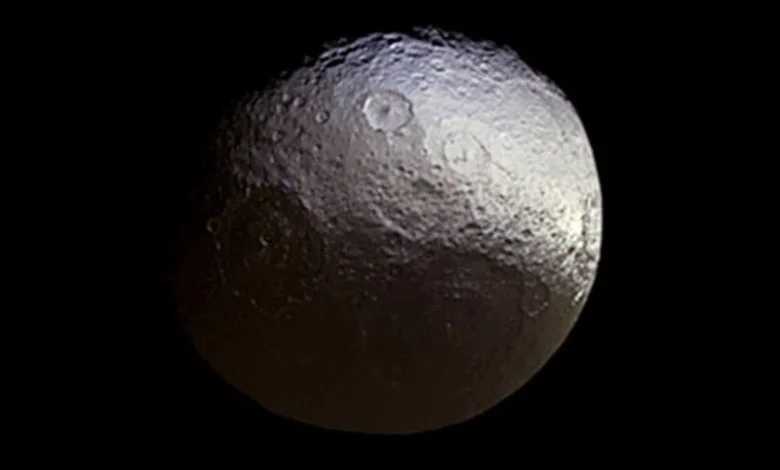
On October 26, 2004, the NASA Cassini spacecraft executed a maneuver that fundamentally altered our understanding of the outer solar system. By passing within 745 miles (1,200 kilometers) of the surface of Titan, Saturn’s largest moon, the robotic explorer pierced the thick, opaque veil of nitrogen-rich haze that had long obscured the satellite from human view. This encounter marked the first time humanity obtained high-resolution, detailed imagery of a world that, despite its distance, bears a striking, uncanny resemblance to the early conditions of Earth.
The mission, a monumental collaborative effort between NASA, the European Space Agency (ESA), and the Italian Space Agency (ASI), had been orbiting Saturn since July 2004. While the spacecraft had performed a preliminary flyby on July 3, 2004, the October event was a breakthrough in proximity and technical capability. By swinging 300 times closer to the moon than it had in the summer, Cassini provided scientists with a transformative dataset that would dictate the remainder of the mission’s scientific trajectory.
A Chronology of Discovery
The exploration of Titan did not begin with the 2004 flyby; it was the culmination of decades of anticipation. Since the Voyager missions of the early 1980s, which confirmed that Titan possessed a thick, methane-rich atmosphere, the scientific community had been clamoring for a deeper look. The Cassini-Huygens mission was designed specifically to address this curiosity.
The timeline of the mission’s success in late 2004 serves as a benchmark for modern planetary exploration:
- July 1, 2004: Cassini successfully performs its Saturn Orbit Insertion (SOI), officially becoming the first spacecraft to orbit the ringed planet.
- July 3, 2004: The first, distant flyby of Titan occurs, serving as a calibration run for the onboard instrumentation.
- October 26, 2004: The critical close-up flyby. Cassini descends to 1,200 kilometers, capturing hundreds of images and spectroscopic data points that revealed surface features for the first time.
- December 25, 2004: Cassini releases the Huygens probe, a European-built lander, which begins its three-week journey toward the Titan atmosphere.
- January 14, 2005: Huygens successfully descends through the haze, landing on the surface and providing the first in-situ measurements of the moon’s environment.
Technical Data and Scientific Observations
The data returned by Cassini during the October 2004 flyby was revolutionary. Before this mission, Titan was a smudge in telescope lenses, a mysterious orange orb. The images captured by the Imaging Science Subsystem (ISS) and the Visual and Infrared Mapping Spectrometer (VIMS) revealed a complex, geologically active surface.
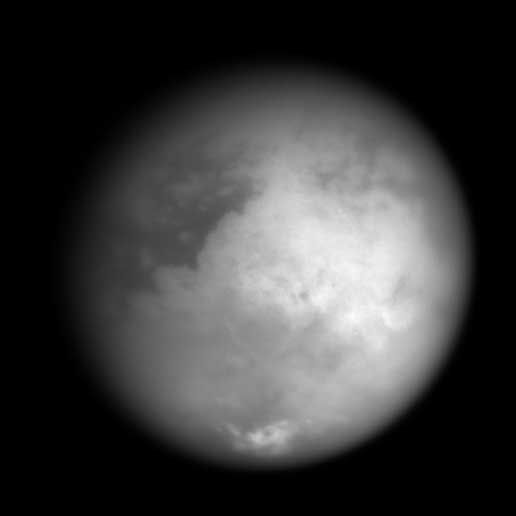
One of the most significant features identified in these initial images was a massive, bright, continent-sized region that researchers eventually dubbed "Xanadu." This feature, spanning thousands of kilometers, appeared to possess high albedo, suggesting a composition distinct from the darker, surrounding plains. Scientists observed mountain ranges, large basins, and what appeared to be smooth, flat regions—hints of a landscape shaped by exotic geological processes.
Unlike the rocky, volcanic worlds of the inner solar system, Titan’s surface is characterized by temperatures around -290 degrees Fahrenheit (-179 degrees Celsius). At these temperatures, water ice acts as the bedrock, and methane and ethane exist as liquids. The images provided the first physical evidence supporting the theory of a "methane cycle" on Titan, analogous to Earth’s water cycle, where methane evaporates from surface lakes, forms clouds, and precipitates back onto the surface.
Official Perspectives and Mission Objectives
NASA and ESA officials described the October 26 event as the "opening of a new chapter in planetary science." Dr. Carolyn Porco, who led the Cassini Imaging Team, noted at the time that the complexity of the surface features—such as the streaks, cracks, and bright patches—demanded a complete re-evaluation of Titan’s history.
"We are seeing a world that is not just a cold, dead rock," remarked mission scientists during post-flyby briefings. "We are seeing a world with weather, with topography, and with a chemical complexity that suggests it is one of the most interesting laboratories in our solar system for studying pre-biotic chemistry."
The primary implication of the flyby was the validation of the mission’s descent trajectory for the Huygens probe. By measuring the density and composition of the upper atmosphere, scientists were able to refine the landing model, ensuring that the probe would survive its plunge through the dense, smoggy atmosphere. Without the data provided by this specific October flyby, the success of the Huygens landing three months later would have been significantly more precarious.
Broader Implications: The Earth Connection
The importance of the 2004 flyby extends far beyond the mission duration. Titan is often cited as a "time capsule" for the early Earth. By studying the chemical reactions occurring in Titan’s nitrogen-rich atmosphere, which is bombarded by solar radiation, scientists have gained insights into how organic compounds—the building blocks of life—might have formed on our own planet billions of years ago.
The flyby also cemented the importance of "hitchhiker" missions. The marriage of the American-built Cassini orbiter with the European-built Huygens lander remains a gold standard for international cooperation in space exploration. It demonstrated that complex, multi-stage missions could successfully coordinate across continents and space agencies to achieve objectives that no single nation could realistically manage alone.
Furthermore, the longevity of the mission—which lasted until its "Grand Finale" in 2017—was predicated on the success of these early Titan encounters. Over the course of 13 years, Cassini performed 127 close flybys of the moon, mapping virtually its entire surface and uncovering the existence of vast, liquid methane seas near the poles. Every one of these later discoveries traces its lineage back to that pivotal day in October 2004.
The Legacy of the Cassini-Huygens Mission
As we look back on the mission, the October 2004 flyby stands out not just for the photos it produced, but for the fundamental shift it caused in the public imagination. Titan transitioned from being an abstract concept to a tangible, geography-rich world. It became a destination.
The scientific analysis of the images and data confirmed that Titan is a world of dunes, river channels, and volcanic-like structures (cryovolcanoes). It challenged the established boundaries of what makes a world "habitable." While Titan is far too cold to support life as we know it, its chemical environment is rich enough to suggest that life could exist in exotic forms, potentially within its subsurface liquid water ocean or in the hydrocarbon lakes on its surface.
In the years following the 2004 encounter, the data gathered by Cassini and Huygens has been cited in thousands of peer-reviewed papers. It has spurred the development of new mission concepts, such as NASA’s upcoming Dragonfly rotorcraft, which is designed to explore the surface of Titan in the 2030s. The 2004 flyby was the spark that ignited the current era of "Titan-mania," a sustained interest that continues to drive planetary research to this day.
By providing the first clear look at the surface of Saturn’s largest moon, the Cassini spacecraft did more than just fulfill a mission requirement; it bridged the gap between our observation of the heavens and our understanding of the physical processes that govern planetary evolution. The October 26, 2004, flyby serves as a definitive reminder of the power of persistence in science. It proves that when we choose to look closer, to push our technology to its limits, and to explore the unknown, we are invariably rewarded with a more profound, and often more startling, understanding of our place in the universe.