Apple Inc. finds itself at a critical juncture in its corporate history as it navigates the rapidly evolving landscape of artificial intelligence. In a comprehensive and revealing interview with Wired journalist Steven Levy, newly appointed Apple Chief Executive Officer John Ternus offered a robust defense of the tech giant’s deliberate and measured approach to artificial intelligence development. The discussion brought to light the company’s internal philosophy regarding technological integration, user experience, and the future of consumer hardware at a time when critics and market analysts frequently question whether Apple has fallen behind its Silicon Valley competitors.
The public perception that Apple has lagged behind industry rivals such as OpenAI, Google, and Microsoft has been a persistent narrative over the past several years. This sentiment intensified primarily due to repeated delays in delivering a significantly more powerful, context-aware version of Siri. Although Apple eventually rolled out its modernized voice assistant to the public over the summer, the prolonged wait fueled intense industry speculation regarding the company’s AI capabilities. Despite these hurdles, Ternus—a longtime hardware engineering executive who officially assumed the role of CEO on September 1, succeeding Tim Cook—remained steadfast in his endorsement of Apple’s current trajectory. Acknowledging the external noise, Ternus remarked that while "everyone has an opinion," he genuinely likes where the company stands today.
The Philosophy of Intentional Innovation
At the core of Ternus’s defense is Apple’s longstanding corporate philosophy of prioritizing seamless user experience over the rapid, reactionary deployment of nascent technologies. During his conversation with Levy, the CEO emphasized that Apple is fully committed to leveraging artificial intelligence within its sprawling ecosystem of hardware and software products. However, he drew a sharp distinction between adopting AI for marketing momentum versus genuine utility.
"We don’t want to ship AI for AI’s sake," Ternus stated during the interview. He elaborated on the company’s vision for integration, noting that when Apple implements artificial intelligence correctly, the end-user should not be forced to decipher whether a specific feature is powered by complex machine learning algorithms or traditional software architecture. According to Apple’s leadership, the underlying mechanism is secondary to the ultimate goal: building products that resonate deeply with consumers and solve real-world problems intuitively.
This philosophy has historically guided Apple through various technological shifts, from the transition to mobile computing to the adoption of custom silicon processors. By embedding intelligence quietly into the background of iOS, macOS, and watchOS rather than forcing users into distinct, standalone chatbot environments, Apple hopes to differentiate itself from competitors whose AI implementations often feel disconnected from the core operating system.
The Threat of Autonomous Agents and the Future of Apps
One of the most thought-provoking moments of the interview arose when Levy pressed the new CEO on a broader, more existential question facing the tech industry: the rise of autonomous AI agents. As artificial intelligence grows increasingly sophisticated, industry experts predict a future where AI agents can execute complex multi-step tasks across the web and operating systems, potentially rendering traditional graphical user interfaces and individual software applications obsolete.
When asked if such a paradigm shift could fundamentally disrupt Apple’s lucrative App Store ecosystem and device architecture, Ternus maintained a grounded, human-centric perspective. He acknowledged that while such automation could theoretically make life exceptionally easy for consumers, the core mission of Apple extends far beyond pure functional efficiency. "The creation of products is a deeply human and personal thing, something that we love to do," Ternus replied, signaling that Apple views hardware and application design not merely as utilities to be automated away, but as canvases for creative and emotional expression.
This perspective underscores Apple’s unique economic position. Unlike software-centric platforms that rely strictly on cloud services and ad-driven interactions, Apple derives a massive portion of its revenue from premium hardware sales—iPhones, iPads, Macs, and wearables—complemented by a thriving services ecosystem. For Apple, preserving the value of the device and the intimate relationship between the user and the physical product remains paramount.

A Timeline of Transition and Evolution
To fully understand Ternus’s positioning, it is necessary to examine the chronological sequence of events that has defined Apple’s recent AI journey.
The pressure on Apple intensified significantly following the late 2022 explosion of generative artificial intelligence across the global market. While competitors rapidly integrated large language models into search engines, productivity suites, and operating systems, Apple spent the subsequent years restructuring its internal machine learning teams and acquiring specialized talent to build an on-device and cloud-hybrid AI infrastructure known as Apple Intelligence.
By early 2024, rumors began circulating regarding internal friction and delays in updating Siri to compete with advanced conversational models. These delays pushed expected major software releases further down the calendar. Throughout 2025, Apple faced mounting pressure from shareholders and industry commentators who argued that the company was risking its market dominance by failing to lead the AI revolution.
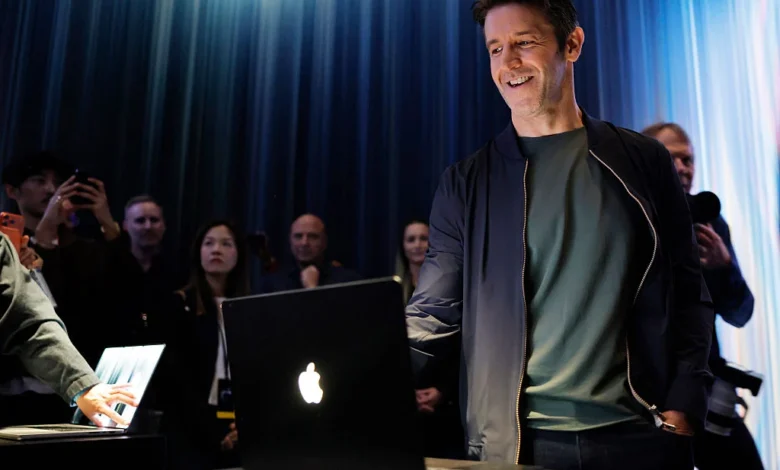
The turning point in the executive suite occurred in late summer 2026. Following long-standing succession planning, John Ternus was announced as the incoming Chief Executive Officer, stepping into the top post on September 1, 2026. In his very first internal memo and public addresses, Ternus signaled a major upcoming product push, culminating in heavily publicized product showcases in Los Angeles. Just prior to his elevation to the CEO office, Apple finally delivered its long-anticipated, overhauled version of Siri during the summer of 2026, a release that critics initially described as anticlimactic but which laid the groundwork for deeper system-wide integration.
Market Implications and Strategic Outlook
As John Ternus settles into his tenure as chief executive, the market continues to evaluate the financial and strategic implications of Apple’s strategy. Financial analysts point out that Apple’s vast active install base—surpassing two billion active devices globally—provides the company with a massive distribution network that few competitors can rival. By rolling out AI capabilities incrementally and ensuring they run efficiently on existing hardware via powerful custom neural engines, Apple minimizes the friction of consumer adoption.
Furthermore, Apple’s emphasis on privacy and on-device processing continues to serve as a key differentiator. While cloud-heavy competitors harvest vast amounts of user data to train centralized models, Apple’s hybrid approach—utilizing on-device models for everyday tasks and a secure cloud infrastructure for heavier computations—appeals strongly to privacy-conscious consumers and enterprise clients alike.
However, challenges remain. The race for AI supremacy is far from over, and consumer expectations for intelligent automation are higher than ever. As developers and users increasingly demand proactive, autonomous digital assistants, Apple will need to prove that its deliberate pace does not translate to permanent technological disadvantage.
Ternus’s remarks to Wired signal confidence in Apple’s internal roadmap. By framing AI not as a frantic race for feature parity, but as a subtle, human-centric enhancement to an already beloved ecosystem, Apple is doubling down on the brand identity that has defined its success for decades. Whether this patient, design-first strategy will satisfy impatient markets and rapidly shifting consumer demands remains one of the most compelling storylines in modern technology.
Related posts: