The Final Years of the Hubble Space Telescope: NASA Looks to Commercial Spaceflight to Save Its Iconic Observatory

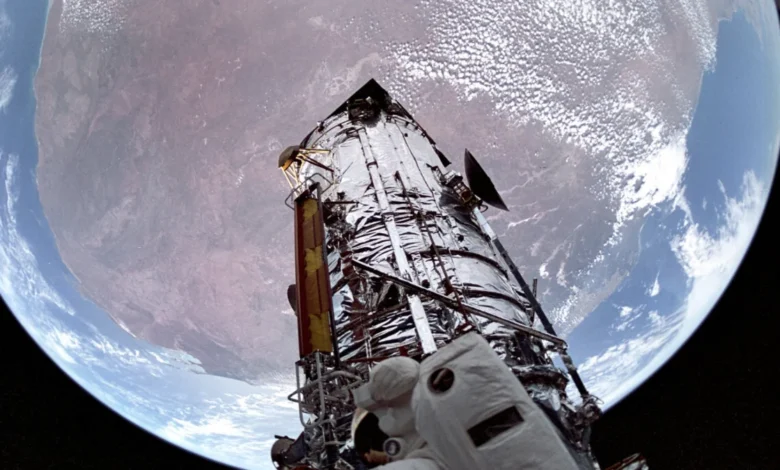
Launched into low-Earth orbit in April 1990 aboard the Space Shuttle Discovery, the Hubble Space Telescope has spent more than three decades redefining humanity’s understanding of the cosmos. Responsible for some of the most scientifically profound and visually breathtaking images in astronomical history, the aging observatory is now on a slow, inexorable descent toward Earth’s atmosphere. Without intervention, atmospheric drag will eventually pull Hubble out of orbit, leading to an uncontrolled and fiery re-entry projected to occur sometime between 2033 and 2034. While the telescope is largely expected to burn up during its descent, portions of the massive hardware could survive the extreme thermal stresses of atmospheric entry, raising potential safety concerns regarding debris impact zones.
Faced with severe federal budget constraints that preclude a dedicated crewed servicing mission using traditional government-funded spacecraft, NASA is turning to the burgeoning private aerospace industry. The space agency has issued a formal Request for Information (RFI) to the commercial sector, seeking innovative, cost-effective proposals to either elevate Hubble into a higher, safer orbit to extend its operational lifespan or securely guide its terminal descent into an isolated oceanic impact zone. This outreach underscores a shifting paradigm in space exploration, where civil space agencies increasingly rely on private enterprise to solve complex logistical and engineering challenges.
The Technical and Logistical Challenge of Saving Hubble
The engineering hurdle facing potential commercial partners is monumental. To successfully extend Hubble’s operational life, a spacecraft must rendezvous with the telescope at an altitude of approximately 330 miles (530 kilometers) and push it upward by more than 370 miles (600 kilometers) into a significantly higher orbit. Achieving this requires precise orbital mechanics, advanced autonomous docking capabilities, and propulsion systems powerful enough to elevate a 24,500-pound observatory that was never designed for automated grappling.
Historically, Hubble’s longevity was maintained through human intervention. During the Space Shuttle era, NASA conducted five dedicated servicing missions—most notably STS-61 in 1993, which corrected the telescope’s infamous optics, and STS-109 in 2002, which replaced critical power and attitude-control systems. Astronauts performed spacewalks to swap out instruments, install corrective optics, and upgrade gyroscopes. However, the retirement of the Space Shuttle fleet in 2011 permanently ended NASA’s organic capability to conduct crewed maintenance in Hubble’s specific orbital regime.
Without the physical presence of astronauts to handle delicate mechanical linkages and servicing interfaces, any rescue or boost mission must rely heavily on cutting-edge robotics, machine vision, and autonomous rendezvous technologies—capabilities that have advanced rapidly within the commercial aerospace sector over the past decade.
Chronology of Hubble’s Orbit and Decay
The orbital dynamics governing the Hubble Space Telescope are intrinsically tied to solar activity and atmospheric density. Operating in low-Earth orbit, Hubble is subjected to minute traces of atmospheric gases that create drag, continuously robbing the spacecraft of orbital energy and momentum.
- April 1990: The Space Shuttle Discovery deploys the Hubble Space Telescope into low-Earth orbit during the STS-31 mission. Initial deployment places the telescope at an altitude of roughly 370 miles (600 kilometers).
- December 1993 (STS-61): Astronauts successfully repair Hubble’s flawed primary mirror using the Corrective Optics Space Telescope Axial Replacement (COSTAR) system, restoring its visionary clarity.
- February/March 2002 (STS-109): The fourth servicing mission upgrades the telescope’s power systems and installs the Advanced Camera for Surveys (ACS), significantly boosting its observational capabilities.
- May 2009 (STS-125): The final space shuttle servicing mission upgrades Hubble with new instruments, including the Wide Field Camera 3 and the Cosmic Origins Spectrograph, while repairing failing gyroscopes and insulation. NASA estimates this will keep the telescope viable through the 2020s.
- 2011–2020s: Following the retirement of the Space Shuttle, Hubble operates without human maintenance. Natural orbital decay accelerates during periods of high solar activity, which heats and expands Earth’s upper atmosphere, increasing drag on the spacecraft.
- 2022: NASA and SpaceX initiate a joint, un-funded study to explore the feasibility of using a Dragon spacecraft to boost Hubble into a higher orbit, laying the groundwork for broader commercial interest.
- Present Day: Hubble’s altitude continues to decline. NASA issues a formal Request for Information to the commercial space sector to solicit actionable concepts for orbital re-boost or controlled de-orbit.
- 2033–2034 (Projected): Absent a successful orbital boost or controlled de-orbit maneuver, Hubble is projected to re-enter Earth’s atmosphere, culminating in a fiery descent.
Official Responses and the Rise of Commercial Space partnerships
The RFI issued by NASA represents a deliberate effort to leverage the rapid innovations pioneered by private space companies. In a public statement on NASA’s official portal, Nicky Fox, associate administrator for the Science Mission Directorate, emphasized the maturation of the private sector.
"Commercial industry has rapidly evolved in recent years to offer new capabilities for in-space satellite capture and servicing," Fox stated. "Given the time we have until Hubble’s anticipated re-entry, we are eager to explore the breadth of possibilities to boost Hubble to a higher orbit while we develop the flagship mission to follow."
This sentiment is echoed by agency leadership, including NASA Administrator Jared Isaacman, who has frequently highlighted the dual obligation to maximize the scientific return on taxpayer-funded assets while ensuring public safety. The prospect of an in-space rescue mission is expected to draw robust interest from major industry players. Companies such as Elon Musk’s SpaceX—which has extensive experience with automated docking via its Dragon capsule—and Peter Beck’s Rocket Lab, renowned for precision aerospace engineering and mid-air recovery techniques, possess technological portfolios that align well with the complexities of a Hubble rescue mission.
Furthermore, private industry has already demonstrated its reliability in high-stakes orbital rescue operations. In recent years, commercial crew vehicles have provided critical lifelines for stranded orbital personnel, cementing the private sector’s role as an indispensable partner to government space agencies.
Broader Scientific and Economic Implications
The potential loss of the Hubble Space Telescope marks the nearing end of an era, even as successor observatories like the James Webb Space Telescope (JWST) push astronomical discovery into the infrared spectrum. While JWST peers deeper into the early universe, Hubble remains uniquely optimized for ultraviolet and optical observations, providing complementary data that cannot be captured by newer platforms. Extending Hubble’s operational lifetime not only preserves continuous, multi-decade baseline datasets essential for tracking long-term cosmic phenomena, but it also provides a vital operational bridge for educational and scientific institutions worldwide.
From an economic and geopolitical standpoint, a successful commercial rescue of Hubble would validate a new class of in-space services. The ability to rendezvous, dock with, and physically alter the orbit of an uncooperative legacy satellite—meaning a spacecraft not originally designed for autonomous retrieval—unlocks massive commercial potential. Such capabilities are crucial not only for preserving valuable scientific infrastructure, but also for addressing the growing global crisis of orbital debris. Techniques perfected to save Hubble could easily be adapted to clear defunct satellites, refuel commercial platforms, and manage traffic in increasingly congested low-Earth orbit environments.
As NASA evaluates the responses to its Request for Information, the fate of the world’s most famous telescope hangs in the balance. Whether private enterprise rises to meet the technical challenge will determine if Hubble is granted a second lease on life high above the Earth, or if its historic run will conclude in the skies above a planet it forever changed our understanding of.
Related posts: