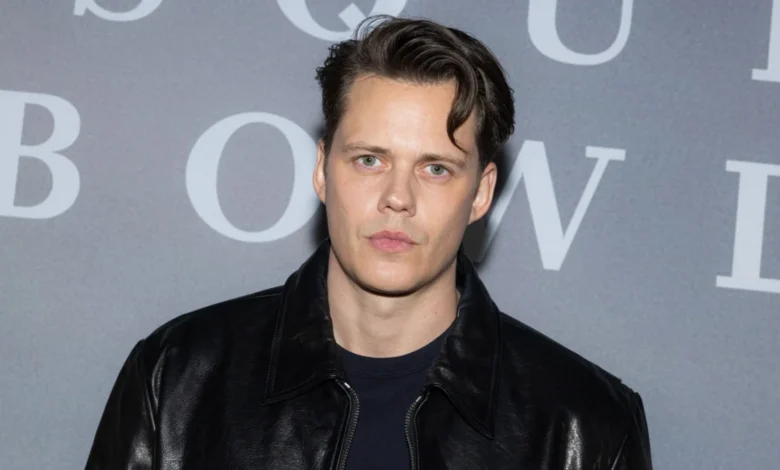
Playing Villains and Clarifies He Was Never Approached for James Bond
Bill Skarsgard is stepping back from the shadows, revealing that he feels creatively exhausted by the parade of menacing figures that has largely defined his cinematic resume over the past decade. The acclaimed Swedish actor, whose striking physical transformations and chilling portrayals have made him a modern master of screen terror, recently opened up about his career trajectory, his selective approach to future antagonist roles, and the persistent rumors linking him to the legendary James Bond franchise.
During a candid and extensive appearance on Josh Horowitz’s popular Happy Sad Confused podcast, Skarsgard discussed the physical and psychological toll of inhabiting deeply disturbing characters. Known universally for his terrifying turn as the ancient shape-shifting entity Pennywise in the blockbuster It adaptations, the actor has steadily built a formidable reputation as Hollywood’s go-to purveyor of cinematic dread. Beyond Stephen King’s universe, his dark portfolio includes playing the vampire Count Orlok in Robert Eggers’ gothic reimagining of Nosferatu, the tragic antihero Eric Draven in the action-thriller The Crow, and the ruthless aristocrat Marquis Vincent Bisset de Gramont in the global action phenomenon John Wick: Chapter 4.
Despite the critical acclaim and commercial success accompanying these dark roles, Skarsgard confessed that the well has temporarily run dry regarding traditional villainy.
"For a villain, it would have to be something that felt original to me, that was something that hadn’t been done before," Skarsgard shared during the podcast discussion. "I feel, kind of, spent with those things. But there’s villains [that] could be really fun in different ways and if it’s the right kind."
The Evolution of a Character Actor
Skarsgard’s journey to becoming one of horror and action cinema’s most recognizable faces stems from a deep lineage of international acting talent. Hailing from Sweden’s famous Skarsgard acting dynasty—led by his father, Stellan Skarsgard, and alongside brothers Alexander, Gustaf, and Valter—Bill carved out a distinct path by leaning heavily into eccentric, physically demanding characters.
His breakout performance as Pennywise in 2017’s It required intense physical discipline, vocal modulation, and the ability to project sheer terror through layers of heavy prosthetics. The film shattered box office records, grossing over $700 million globally and cementing Skarsgard’s status as a formidable talent capable of commanding the screen without relying on traditional leading-man tropes. He reprised the role in 2019’s It Chapter Two, which added another massive financial success to his belt.
However, sustaining such a high volume of intense character work inevitably leads to professional fatigue. Industry analysts note that typecasting remains one of the primary hurdles for actors who achieve breakout success in genre filmmaking. Skarsgard’s explicit desire to pivot away from repetitive villainous archetypes mirrors a broader industry trend where versatile performers actively seek out grounded dramatic roles to maintain artistic longevity and avoid audience saturation.
Addressing the 007 Rumors and the Search for the Next Bond
The conversation on Happy Sad Confused naturally drifted toward one of Hollywood’s most enduring casting mysteries: the ongoing search for the next actor to step into the tuxedo of Agent 007 following Daniel Craig’s departure after No Time to Die (2021). For years, fan communities and entertainment journalists have floated Skarsgard’s name as an ideal candidate to play a chilling, sophisticated Bond villain.
When Horowitz pressed him on these long-standing online speculations, Skarsgard quickly cleared the air, revealing that the rumors had no basis in actual casting conversations.
"Yeah! Well, because they didn’t call me about James Bond. I don’t know what that was about," Skarsgard quipped, highlighting the gap between fan casting and studio reality. "Maybe they were like, ‘We can’t do a Swede for this guy.’ I wasn’t even thrown into the mix."
When evaluating the prospect of joining the iconic British espionage franchise, Skarsgard expressed pragmatic hesitation. Agreeing with Horowitz’s assessment that signing a multi-picture contract spanning a decade or fifteen years might stifle an actor’s creative freedom, Skarsgard noted that he would only be open to a contained, one-off villainous assignment. In making this distinction, he pointed to acclaimed performances by past franchise antagonists delivered by actors like Mads Mikkelsen (Casino Royale) and Javier Bardem (Skyfall), both of whom brought distinct psychological depth to single-appearance adversary roles without being tied down to long-term studio obligations.
The State of the James Bond Franchise
Skarsgard’s comments arrive at a pivotal moment for Eon Productions and Amazon MGM Studios as they navigate the highly anticipated next chapter of the James Bond series. With acclaimed filmmaker Denis Villeneuve frequently cited among industry insiders as a dream choice for the director’s chair, the studio has kept official details regarding the casting process tightly under wraps.
Recent industry reporting has highlighted the exhaustive and secretive nature of the screen-testing phase. The Hollywood Reporter previously revealed that actors such as Callum Turner, Jack Lowden, and Josh O’Connor had participated in formal screen tests for the iconic secret agent role. Subsequent reports expanded that competitive field significantly, confirming that high-profile names including Robert Pattinson had also tested for the part, while British actor Nicholas Hoult has consistently emerged in trade circles as another serious contender under consideration by studio executives.
The deliberative pace of the casting process underscores the immense commercial and cultural weight riding on the franchise’s next iteration. Producers Barbara Broccoli and Michael G. Wilson have historically taken their time between eras, ensuring that whoever inherits the Walther PPK can sustain the global blockbuster brand for multiple films over a significant span of years.
Transitioning to New Horizons: The Mosquito Bowl
While Skarsgard may be closing the door on repetitive villainous roles for the foreseeable future, his professional calendar remains exceptionally busy. The actor is currently promoting his latest project, stepping out of the horror genre and into historical war drama with Peter Berg’s The Mosquito Bowl.
Based on the acclaimed non-fiction book by Buzz Bissinger, the film explores the true story of a brutal football game played on Christmas Eve in 1944 on Guadalcanal by members of the United States Marine Corps, many of whom were former college and professional football stars before answering the call to serve in World War II. The project reunites Skarsgard with high-profile ensemble storytelling and allows him to showcase his range in a grounded, dramatic military setting.
The Mosquito Bowl is currently enjoying a theatrical run before making its streaming debut on Netflix on November 25. The film has already drawn positive early reviews for its visceral depiction of camaraderie and sacrifice, signaling a deliberate shift in the types of projects Skarsgard chooses to champion.
Broader Implications for Hollywood Casting
Skarsgard’s candid remarks shed light on the mechanics of modern franchise filmmaking and the growing disconnect between fan-driven internet speculation and real-world casting decisions. In an era where social media campaigns frequently attempt to dictate major studio castings—such as casting directors pairing popular character actors with monolithic intellectual properties like James Bond or the Marvel Cinematic Universe—actors themselves are increasingly vocal about the realities of their career choices.
By openly acknowledging his fatigue with villain roles and clarifying his lack of involvement with Eon Productions, Skarsgard reasserts control over his public narrative. As he moves past the intense physical demands of monsters and mobsters, the industry will undoubtedly watch closely to see which artistic avenues the versatile Swedish actor chooses to explore next. Whether through prestige dramas, independent cinema, or unexpected genre turns, Skarsgard’s deliberate curation of his career ensures that his next moves on the silver screen will remain as unpredictable as ever.