Portable Charger Fire Forces KLM Boeing 777 Turnaround Over Atlantic and Prompts Safety Probe

The aviation industry operates under a stringent framework where safety margins are calculated down to the smallest detail, yet an everyday consumer electronic device hidden inside a passenger’s pocket nearly triggered a catastrophic inflight emergency high above the Atlantic Ocean. On September 17, a routine intercontinental service operated by KLM Royal Dutch Airlines was abruptly cut short when a portable lithium-ion charger, commonly known as a power bank, spontaneously caught fire in the cabin. The incident aboard KLM flight 735, a Boeing 777 widebody aircraft traveling from Amsterdam Airport Schiphol to the Caribbean island of Curaçao, forced the flight crew to execute an emergency turnaround, dumping fuel and returning to the carrier’s primary hub in the Netherlands.
While the fire was swiftly contained by the trained cabin crew using standard onboard firefighting equipment, the consequences of the thermal runaway event extended far beyond the immediate mid-air scare. The emergency landing triggered a complex logistical cascade, resulting in flight cancellations, stranded passengers requiring overnight accommodations, and a multi-day grounding of a high-value widebody aircraft for mandatory safety inspections and cabin repairs.
Adding a layer of high-profile intrigue to the aviation mishap, subsequent reports in Dutch media outlets linked the malfunctioning device to Camiel Eurlings, the former chief executive officer of KLM. While the airline has maintained a strict policy of passenger confidentiality regarding the identity of the individual involved, and the former executive has declined multiple requests for comment from international media, the political and corporate visibility of the alleged owner propelled the incident into global headlines. More importantly, the event has reignited urgent conversations among aviation regulators, safety experts, and airline executives regarding the persistent, growing hazards posed by lithium-ion batteries carried inside passenger cabins. On November 4, the Dutch Safety Board formally stepped in, announcing the launch of an independent investigation to examine the exact circumstances of the fire and to evaluate the broader systemic risks associated with portable power sources on commercial aircraft.
Chronology of the Incident: Flight KLM 735
The sequence of events on September 17 unfolded with the rapid precision characteristic of modern commercial aviation emergency protocols, yet it highlighted the vulnerability of commercial airliners to consumer electronics.
KLM Flight 735 pushed back from the gate at Amsterdam Airport Schiphol, carrying hundreds of passengers eager to reach the tropical destination of Curaçao. The Boeing 777, the backbone of KLM’s long-haul fleet, climbed steadily toward its cruising altitude, clearing European airspace and heading out over the vast expanse of the Atlantic Ocean.
Hours into the journey, while passengers were either resting or attending to personal activities, a sudden chemical reaction occurred within the cabin. A portable charger, stowed either on a passenger’s person or within easy reach, experienced thermal runaway—a phenomenon where a lithium-ion cell enters an unstoppable, self-heating state that rapidly generates extreme temperatures, toxic gases, and ultimately, open flames.
Cabin crew members, trained rigorously in safety and emergency procedures, responded immediately to the sighting of smoke and fire. Utilizing onboard fire extinguishers and thermal containment procedures specifically designed for battery fires, the crew successfully suppressed the flames before the fire could spread to aircraft wiring, insulation, or adjacent passenger seating.
Despite the successful containment, standard operational protocols for inflight lithium-ion fires dictate that an aircraft must land at the nearest suitable airport to allow for a thorough technical inspection, emergency services evaluation, and passenger reassurance. The flight crew of Flight 735 initiated a turnaround, coordinated with air traffic control, and safely navigated the widebody jet back to Amsterdam Airport Schiphol. Emergency vehicles met the aircraft upon landing, and medical personnel treated one individual who sustained injuries during the incident, though details regarding the nature and severity of the injury remained largely protected under medical privacy guidelines.
Ripple Effects: Operational Disruption and Grounding
The emergency return of the Boeing 777 to Amsterdam was only the beginning of a severe operational headache for KLM’s network controllers and ground operations teams. When an intercontinental widebody aircraft is suddenly pulled from service, the schedule repercussions ripple outward across the entire global network.
The affected Boeing 777 was rendered immediately unserviceable, requiring extensive engineering checks to ensure that no structural damage, smoke contamination, or hidden electrical issues remained within the cabin environment. According to operational tracking data, the aircraft remained grounded for nearly three days, finally returning to active commercial service on September 20.
During this mandatory grounding window, KLM was forced to scramble alternative arrangements for the hundreds of passengers booked on the delayed Curaçao service and subsequent rotations tied to that specific airframe. Providing overnight hotel accommodations, meal vouchers, rebooking assistance, and passenger compensation represents a massive logistical and financial undertaking for any legacy carrier. While airlines maintain contingency funds for irregular operations, the cumulative cost of fuel dumping, flight delays, passenger care, and lost revenue underscores the disproportionate financial impact that a single pocket-sized device can impose on a multi-billion-dollar enterprise.
Furthermore, the incident placed a spotlight on the logistical strain faced by hub airports like Schiphol when sudden long-haul turnarounds occur, requiring gate reassignments, customs coordination, and rapid communication channels to keep stranded travelers informed.
The High-Profile Connection and Media Scrutiny
As investigations into aviation incidents often uncover unexpected human elements, the KLM Flight 735 fire quickly transcended standard aviation reporting due to reported links involving airline leadership. Dutch investigative and mainstream media outlets soon reported that the portable charger in question allegedly belonged to Camiel Eurlings, who served as the chief executive officer of KLM from 2013 to 2014, and who has maintained a prominent profile in Dutch corporate and public spheres.
The involvement of a former corporate chief executive of the very airline operating the flight introduced a layer of irony that fueled international tabloid interest. Media outlets across Europe and the Americas picked up the story, focusing heavily on the personal identity angle rather than the technical mechanics of the accident.
However, major commercial aviation analysts and safety organizations quickly emphasized that the identity of the passenger is fundamentally secondary to the broader mechanical and regulatory challenges at hand. Whether a lithium-ion battery belongs to a frequent flyer, a leisure traveler, or a former airline executive, the chemical composition, thermal properties, and potential hazards of the device remain entirely identical. The intense public focus on the passenger’s identity served primarily to amplify a safety conversation that aviation regulators have been attempting to force into the mainstream consciousness for years.
Official Responses and the Dutch Safety Board Investigation
In the wake of the incident, regulatory bodies and the airline itself moved to address the situation through formal channels. KLM issued statements confirming the nature of the emergency and praising the swift and professional actions of its flight and cabin crew in containing the fire and ensuring the safe return of the aircraft. However, the airline declined to publicly verify or comment on the identity of the passenger, citing strict adherence to passenger privacy laws and corporate confidentiality policies.
Representatives for Camiel Eurlings did not respond to inquiries from international aviation journalism outlets seeking clarification or comment regarding the ownership of the device.
On November 4, the Dutch Safety Board (Onderzoeksraad voor Veiligheid) formally announced that it had opened an independent investigation into the September 17 incident aboard KLM flight 735. The Dutch Safety Board is tasked with investigating accidents and serious incidents with the ultimate objective of improving transport safety across aviation, maritime, rail, and road sectors.
Unlike judicial investigations that seek to assign blame or liability, the Safety Board’s inquiry focuses exclusively on uncovering systemic safety lessons. Investigators will examine the exact make, model, and condition of the portable charger, the behavior of the lithium-ion battery during thermal runaway, the effectiveness of the crew’s response, and the adequacy of current regulatory frameworks governing the transport of consumer power banks in passenger aircraft. The findings and subsequent safety recommendations issued by the board are expected to carry significant weight, potentially influencing European Union aviation authorities and global bodies like the International Civil Aviation Organization.
The Broader Context: The Lithium-Ion Battery Crisis in Aviation
To understand the true significance of the KLM Flight 735 incident, one must examine the explosive growth of lithium-ion technology in modern consumer electronics and the corresponding rise in aviation safety risks. Lithium-ion batteries power nearly every portable device carried by contemporary travelers—including smartphones, laptops, tablets, electronic cigarettes, digital cameras, and portable power banks.
While these energy storage devices are lightweight, rechargeable, and remarkably efficient, they are fundamentally volatile. Inside every lithium-ion cell is a combustible organic liquid electrolyte separated by a micro-thin plastic sheet. If a battery is physically damaged, manufactured with internal defects, overcharged, exposed to extreme heat, or subjected to an internal short circuit, it can undergo thermal runaway. During this process, temperatures inside the cell can spike above 1,000 degrees Celsius (1,800 degrees Fahrenheit), igniting surrounding materials and releasing a cocktail of toxic, flammable gases.
According to data compiled by international civil aviation authorities, incidents involving smoke, fire, or extreme heat from lithium-ion batteries inside aircraft cabins and cargo holds have shown a steady upward trajectory over the past decade. Because passenger demand for portable power has surged—driven by longer travel times, personal device reliance, and the ubiquity of USB-rechargeable gadgets—the total volume of lithium energy traveling through the skies on any given day is unprecedented.
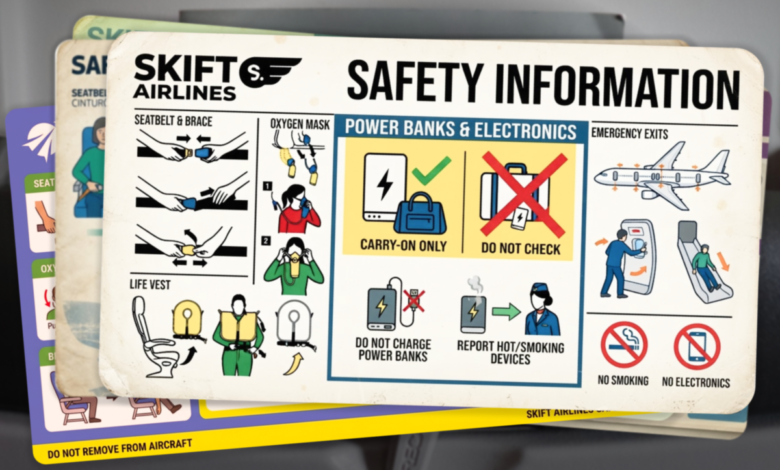
Current international regulations established by the International Civil Aviation Organization and enforced by national authorities generally require passengers to carry spare lithium-ion batteries and portable power banks exclusively in their carry-on baggage, explicitly prohibiting them in checked luggage. The rationale behind this rule is straightforward: if a battery begins to smoke or catch fire in the passenger cabin, flight crews can detect the anomaly immediately and intervene with extinguishers and fire containment bags. By contrast, a lithium-ion fire in the unattended cargo hold can rapidly breach structural barriers, overwhelm automated fire suppression systems, and lead to catastrophic structural failure before the flight crew can safely land.
However, the requirement to carry power banks in the cabin creates a paradox: while it prevents unmonitored cargo fires, it places potentially hazardous thermal runaway events directly into the passenger seating area, surrounded by human life, emergency evacuation pathways, and critical aircraft interior components.
Implications for Future Airline Policies and Passenger Compliance
The KLM Flight 735 incident is already prompting renewed debate within the aviation sector regarding whether current restrictions on portable electronics go far enough. Industry observers and safety advocates are raising fundamental questions about airline policies, passenger education, and technology manufacturing standards.
1. Enhanced Passenger Education and Awareness
Many travelers remain entirely unaware of the inherent volatility of lithium-ion power banks. While airlines routinely broadcast safety videos and display warnings about prohibited items during the booking and check-in processes, compliance often relies on passenger self-reporting and common sense. Industry stakeholders argue that airlines must implement more aggressive, highly visible pre-flight messaging specifically addressing the dangers of cheap, damaged, or uncertified power banks purchased from unregulated online marketplaces.
2. Stricter Manufacturing and Quality Standards
A significant portion of lithium-ion battery incidents can be traced back to substandard manufacturing, lack of internal safety circuits, or counterfeit branding. Regulators are under increasing pressure to crack down on the influx of cheap, uncertified consumer power banks entering global markets, advocating for mandatory international safety certifications for all lithium-ion products permitted aboard commercial flights.
3. Crew Training and Advanced Containment Equipment
As thermal runaway events become more frequent, airlines are continually refining their onboard emergency procedures. Modern flight and cabin crews are receiving more specialized training in identifying early warning signs—such as a chemical smell or a device rapidly swelling—long before open flames erupt. Furthermore, many carriers are upgrading their onboard safety kits to include advanced high-temperature fire containment bags, which allow crew members to isolate a burning device safely and monitor it for the remainder of the flight.
4. Regulatory Evolution
The findings of the Dutch Safety Board’s investigation into the September 17 incident will likely serve as a catalyst for regulatory reviews across Europe and internationally. Should investigators identify specific vulnerabilities in how portable chargers are carried or monitored, new rules could emerge limiting the maximum capacity of power banks allowed in passenger cabins, mandating specific storage methods, or introducing stricter enforcement protocols at security checkpoints.
Conclusion
The emergency turnaround of KLM Flight 735 over the Atlantic Ocean serves as a stark, high-stakes reminder of how a microscopic failure in modern consumer technology can instantly disrupt global travel, endanger hundreds of lives, and challenge the operational resilience of a major international carrier. While the involvement of a former corporate executive generated widespread media attention, the true narrative of the flight lies in the ongoing, systemic challenge that lithium-ion batteries present to aviation safety. As the Dutch Safety Board moves forward with its independent investigation, the lessons learned from the smoke-filled cabin of that Boeing 777 will undoubtedly reverberate through boardrooms, regulatory agencies, and airport security checkpoints worldwide, driving the constant evolution required to keep the skies safe in an era of ubiquitous personal electronics.