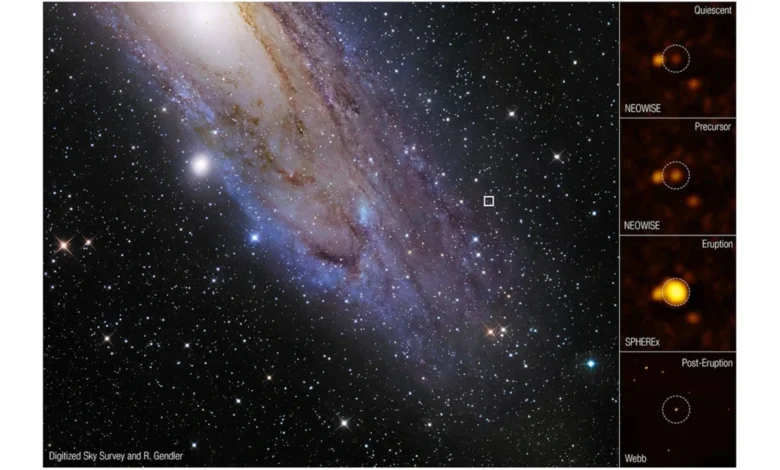
For decades, astrophysicists have theorized that binary star systems—pairs of stars orbiting a common center of mass—often meet a violent end when one member exhausts its nuclear fuel. As a star reaches the end of its life, it expands into a bloated red giant, inevitably encroaching upon the space occupied by its smaller neighbor. Until now, this process was purely a matter of mathematical modeling and theoretical speculation. However, a landmark study published on November 18 in the journal Nature confirms that scientists have finally witnessed this celestial cannibalism in real-time.
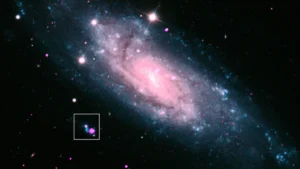
The event, which occurred in the Andromeda galaxy (M31), approximately 2.5 million light-years from Earth, involved a binary system nicknamed "Bao." The primary subject of the observation was a red giant star identified as WNTR23bzdiq, an object roughly seven times the mass of our sun and possessing a radius 350 times greater. The discovery provides the first empirical look at how these stellar titans physically consume their companions, a process that has long been considered a primary mechanism for the formation of certain types of exotic stars and complex nebulae.
A Chronology of a Cosmic Collision
The observation of the Bao system was not a sudden stroke of luck but the result of sustained, multi-year monitoring. The timeline of this stellar merger began long before the final eruption was captured by modern instruments.
- 2018: The red giant WNTR23bzdiq began exhibiting signs of increased luminosity. This gradual brightening served as the first warning sign that the companion star had begun its final, fatal spiral toward the core of the giant.
- 2023: Data from NASA’s NEOWISE (Near-Earth Object Wide-field Infrared Survey Explorer) and the WINTER telescope at Palomar Observatory confirmed that the star’s brightness was continuing to escalate. Astrophysicists interpreted this as the companion star losing orbital energy due to friction as it plunged into the dense, outer layers of the red giant’s atmosphere.
- Late 2025: The merger reached its climax. Astronomers observed a massive, cataclysmic eruption of light, signaling the moment the companion star was fully absorbed into the core of the giant.
- Early 2026: Just 47 days after the eruption, the James Webb Space Telescope (JWST) was deployed to analyze the aftermath. The high-resolution infrared capabilities of the JWST allowed researchers to peer through the thick shroud of dust and debris created by the explosion, confirming the physical nature of the event.
The Physics of Stellar Engulfment
The mechanism behind this event is rooted in the complex dynamics of binary interactions. When a star enters its red giant phase, its outer atmosphere becomes loosely bound and significantly more expansive. If a smaller companion star orbits within or near this expanded envelope, it encounters gas drag. This friction causes the companion to lose orbital velocity, forcing it to spiral inward toward the primary star’s core.
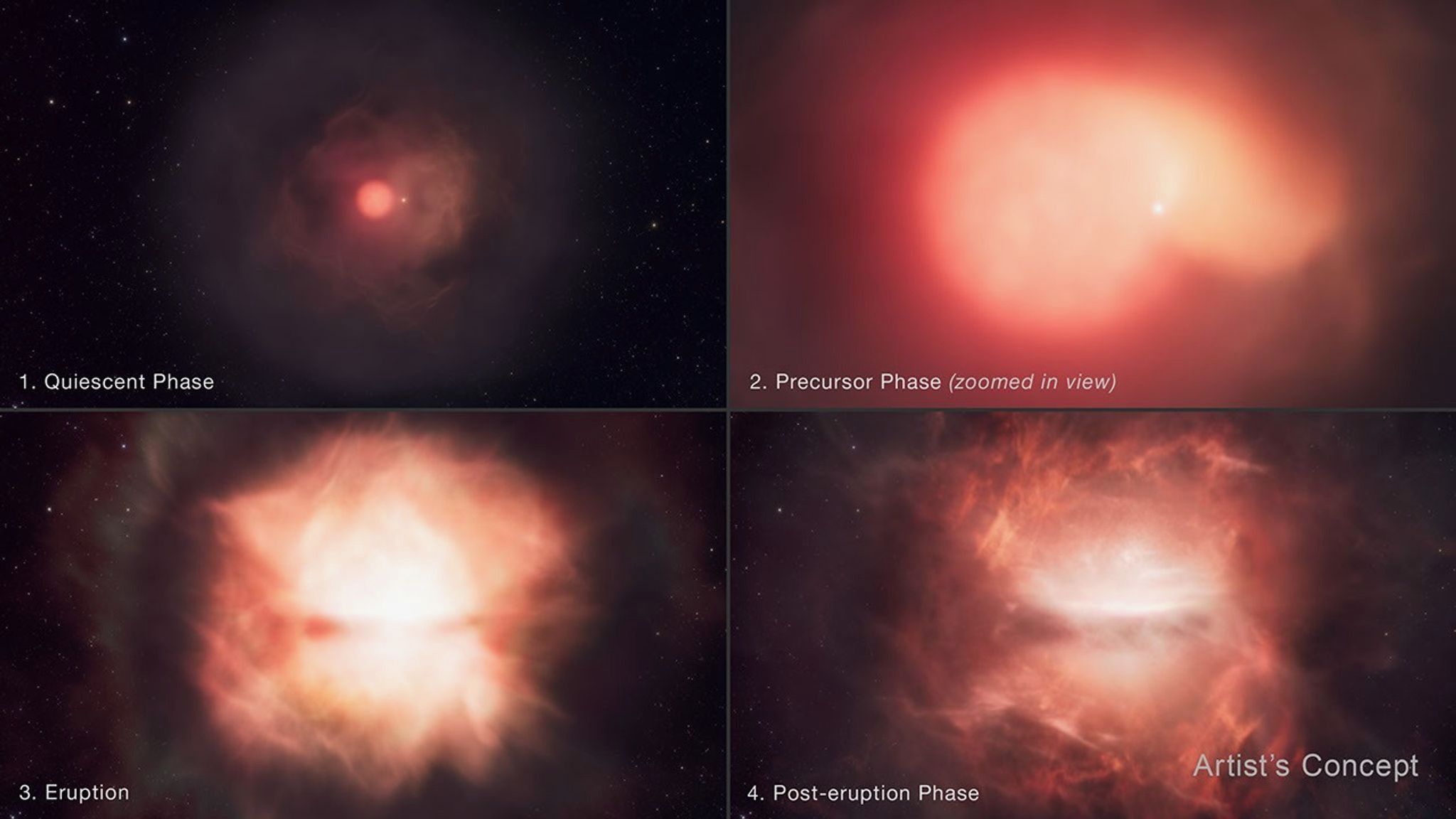
"Catching a star engulfing its companion in the act is very difficult," said Viraj Karambelkar, an astrophysicist at Columbia University and lead author of the study. "When a star engulfs its companion, its effect is very subtle—like throwing a bucket of water in a large ocean. We need sensitive telescopes monitoring the sky for a long time in order to catch this effect."
The energy released during this process is immense. The study estimates that the eruption expelled between 0.1 and 0.2 solar masses of material into the surrounding space. This material, likely composed of heavy elements enriched by the stars’ previous fusion cycles, is now expanding outward, forming a shell that will eventually contribute to the interstellar medium of the Andromeda galaxy.
Implications for Stellar Evolution and Galactic Dynamics
The confirmation of the Bao system merger has significant implications for our understanding of how stars evolve in binary configurations. Many stars in the universe do not exist in isolation like our sun; they are part of complex, multi-star systems. The "Bao" event serves as a template for what happens to these systems as they age.
Astrophysicists believe that such mergers may be responsible for the creation of "blue stragglers"—stars that appear younger and hotter than their neighbors in a cluster—or the progenitors of Type Ia supernovae, which are essential for measuring the expansion rate of the universe. By observing the lifecycle of the Bao system, researchers can better refine their models regarding how often these mergers occur and what percentage of stellar evolution is driven by these "cannibalistic" interactions.
Furthermore, the study highlights the necessity of long-term temporal monitoring in modern astronomy. The transition from the 2018 brightening to the 2025 eruption demonstrates that stellar deaths are not always instantaneous events but can be drawn-out processes spanning years or decades.
Future Outlook and Scientific Consensus
While the data strongly suggests a total merger, the scientific team remains cautious. "It is not the only possibility," Karambelkar noted. "The other possibility is that both stars survived, in a much shorter orbit. In order to conclusively determine what happened, we need to continue monitoring what the system does, once the heft of the eruption settles down."
If the stars did indeed merge, the resulting object will likely be a rapidly rotating, highly luminous star that will evolve differently than its progenitors. If they survived as a tight binary, the system will eventually undergo another round of interaction as the primary star continues to evolve.
The success of this observation has galvanized the scientific community, emphasizing the role that next-generation observatories will play in the coming decade. The Nancy Grace Roman Space Telescope and the Vera Rubin Observatory are expected to be instrumental in identifying hundreds of similar events. These upcoming missions will provide a broader statistical sample, allowing researchers to determine if the Bao system is an outlier or if such mergers are a common feature of galactic life.
The research published in Nature stands as a testament to the power of international collaboration and the capability of the James Webb Space Telescope to resolve transient phenomena at vast distances. By providing the "missing link" between theoretical models of binary evolution and observable astronomical events, the team has opened a new window into the violent, transformative processes that shape the architecture of the cosmos. As researchers continue to analyze the data from the Bao system, the findings will likely lead to a more nuanced understanding of how stars—the engines of the universe—live, interact, and ultimately expire.
Related posts: