The Provenance of a Literary Landmark
For Colson Whitehead, the act of moving has historically functioned as a rhythmic marker of his creative output. As he noted in his 2003 book The Colossus of New York, the apartments he has inhabited are "caretakers of your reinventions." Throughout his career, Whitehead has maintained a nomadic relationship with New York City, residing in diverse neighborhoods including Clinton Hill, Fort Greene, and the West Village. Each location served as a backdrop for seminal works, ranging from the architectural intrigue of The Intuitionist to the historical exploration of John Henry Days.
The West End Avenue property, acquired by Whitehead and his wife, literary agent Julie Barer, shortly after the author’s 2017 Pulitzer Prize win for The Underground Railroad, represents a chapter of stability and high-level acclaim. The residence is not merely a home; it is a repository of his literary accolades. Listing materials reveal a collection of prestige awards, most notably his National Book Award, displayed prominently on Haller consoles within the living space.
Architectural Significance of 610 West End Avenue
The building itself, known as "The Evanston," holds a storied place in New York City’s architectural history. Completed in 1912, the structure was the work of George and Edward Blum, brothers whose Paris-influenced aesthetic earned them a reputation for "nonconformist" design. Unlike the repetitive, utilitarian brick towers that began to dominate the cityscape in the early 20th century, the Blum brothers prioritized architectural character and unique floor-plate configurations.
The Evanston was originally designed to cater to the city’s elite, offering spacious duplexes and a central courtyard on 90th Street that optimizes natural light and structural privacy. The building’s moniker is derived from a prominent dentist who famously attended to the dental needs of Napoleon Bonaparte—a historical tidbit that feels distinctly aligned with the thematic sensibilities of a Whitehead novel.
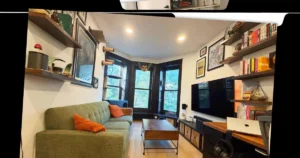
The apartment unit currently on the market occupies the ninth floor and serves as a corner residence, providing sweeping vistas of the Hudson River and the surrounding historic brownstone districts. The interior maintains a high degree of prewar integrity, featuring original parquet flooring, intricate ceiling moldings, period-appropriate French doors, and antique glass hardware. A particularly notable feature is the semi-circular nook off the formal dining room, which retains its original stained-glass elements.
The Anatomy of a Writer’s Workspace
For observers of the literary process, the apartment provides a rare glimpse into the author’s working environment. A profile published in The New Yorker in June 2026 detailed how Whitehead utilized a specific desk positioned at the edge of the living room—an Eames desk unit—to draft his recent projects.

Central to this workspace is a vintage sign for a knife-sharpening service, which Whitehead has previously described as a "totem." He has credited the object with serving as a constant, physical reminder to "work a sentence into something sharper," a sentiment that underscores his disciplined approach to prose. The formal dining room, meanwhile, has been repurposed into a library, lined with floating modular shelving that houses an extensive collection of volumes, signaling the scholarly rigor required for his expansive body of work, which spans the Harlem Trilogy and his more recent historical inquiries into World War I-era New York.
Market Context and Real Estate Implications
The decision to sell the property arrives at a juncture of both personal and professional shifts for the author. With his eldest child having recently transitioned to college, the family is likely recalibrating their space requirements. Professionally, the completion of his highly acclaimed Harlem Trilogy—concluding with the July publication of Crook Manifesto—marks a natural conclusion to a specific cycle of labor.
From a market perspective, the $4.495 million asking price reflects the enduring demand for "trophy" co-ops in the West End Avenue corridor. While the luxury real estate market in Manhattan has faced fluctuations due to interest rate environments and inventory levels, prewar units with verified architectural provenance and historic detail consistently hold value among high-net-worth buyers. The listing offers more than just square footage; it offers the prestige of a well-maintained, architecturally significant building and the cultural cachet of a home inhabited by one of contemporary literature’s most celebrated voices.
The Broader Impact on Neighborhood Dynamics
The departure of a high-profile figure like Whitehead from the Upper West Side highlights the ongoing evolution of the neighborhood. While once the primary enclave for the city’s intellectual and artistic middle-to-upper class, the area has seen a consistent uptick in valuation, pushing many longtime residents toward different areas of the city. However, the presence of residents like Whitehead has helped maintain the Upper West Side’s reputation as a bastion of literary history.
The sale of 610 West End Avenue is expected to attract significant interest from buyers looking for a blend of classic New York elegance and cultural pedigree. As the property enters the market, it invites potential owners to occupy a space that has already been imprinted with the creative energy of a Pulitzer winner.
Chronology of a Residence
- 1912: Completion of The Evanston (610 West End Avenue) by architects George and Edward Blum.
- 2017: Colson Whitehead receives the Pulitzer Prize for The Underground Railroad.
- 2018: Whitehead and Julie Barer purchase the ninth-floor unit at 610 West End Avenue.
- 2026 (June): A New Yorker profile highlights the apartment’s unique library setup and the author’s writing "totem."
- 2026 (July): Publication of the final installment of the Harlem Trilogy.
- 2026 (November): The apartment is officially listed for sale, priced at $4.495 million.
As the listing enters the public sphere, the residence remains a testament to the intersection of art and architecture. For the next occupant, the apartment offers a legacy of craftsmanship and intellectual inquiry, qualities that have been woven into the fabric of the building since its inception over a century ago. Whether the sale proceeds swiftly or lingers in the current market, the property at 610 West End Avenue will remain a significant footnote in the history of New York City real estate, forever tethered to the tenure of one of its most prolific chroniclers.