Two-Time Oscar Winner Mahershala Ali Opens Up About Hollywood’s Material Shortage and Industry Realities

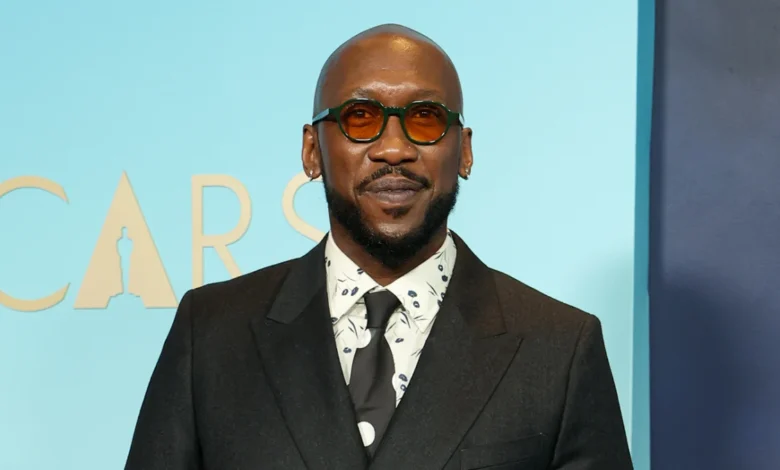
The glittering allure of Academy Awards gold often creates a public perception of boundless opportunity, yet for decorated performers like Mahershala Ali, the reality of navigating Hollywood tells a vastly different story. Despite historic wins for his unforgettable performances in Barry Jenkins’ Moonlight and Peter Farrelly’s Green Book, the esteemed actor recently pulled back the curtain on the mechanics of the entertainment industry, revealing that his prestigious accolades have done little to shield him from a fundamental industry shortage: a lack of substantive, well-written roles.
Appearing as a guest on the 7PM in Brooklyn podcast, hosted by former NBA star Carmelo Anthony and media personality Kazeem “Kaz” Famuyide, Ali offered a candid, measured assessment of the contemporary film and television landscape. Rather than complaining about personal career slumps, the actor utilized the platform to articulate broader systemic challenges, including the scarcity of compelling material, the impact of shifting corporate diversity initiatives, and the exhausting demands placed on artists of color who seek to tell authentic human stories without being pigeonholed by executive tokenism.
The Myth of the Oscar Safety Net
For decades, the Academy Award has been framed as the ultimate career insurance policy in Hollywood—a golden ticket that supposedly guarantees access to premier scripts, lucrative franchise deals, and unrestricted creative freedom. However, Ali was quick to dismantle this romanticized notion, explaining that gold statuettes do not manufacture good writing out of thin air.
“There’s a lot of great actors that don’t have Oscars, who are also looking for good material,” Ali shared during the podcast discussion. Clarifying that his remarks carried no disrespect toward the Academy of Motion Picture Arts and Sciences, he emphasized a basic supply-and-demand imbalance that plagues the entire acting community. “Oscar or no Oscar, there’s a lot of good actors out there. There’s more good actors than there is good material.”
The actor elaborated on the mathematical and logistical barriers that reduce casting opportunities, even for elite talent. He noted that the bottleneck is not merely about competition among peers for the same handful of high-profile parts. Instead, it stems from the sheer scarcity of developed projects that align with an actor’s specific demographic, age, and skill set.
“It’s just that out of all the material made, there’s only a handful of them that check certain boxes. And then you got to be right for it,” Ali explained. “The vast majority of projects that get greenlit, there are not roles for me in those. You gotta think that way, you know what I mean? So, it doesn’t matter if I got 17 Oscars. If someone is not writing something for you or greenlighting something with you in mind, you’re like everybody else waiting and looking and searching.”
Background Context: A Storied Career Marked by Groundbreaking Roles
To understand the weight of Ali’s observations, one must examine the trajectory of his career, which serves as a masterclass in versatility and delayed industry recognition. Born in Oakland, California, and raised in Hayward, Ali initially pursued a career in basketball before shifting his focus to acting, earning a master’s degree in acting from New York University’s Tisch School of the Arts in 2000.
For years, Ali was a ubiquitous presence in television and film, building a reputation as a reliable, magnetic character actor. His early resume featured memorable turns in critically acclaimed series such as The 4400 and House of Cards, as well as supporting film roles in cinematic heavyweights like The Curious Case of Benjamin Button and The Place Beyond the Pines.
However, it was his breathtaking portrayal of Juan, a complex Miami drug dealer who becomes a surrogate father figure to a young boy in Moonlight (2016), that catapulted him into global superstardom. The performance earned him his first Academy Award for Best Supporting Actor, making him the first Muslim actor to win an Oscar. Just two years later, he cemented his status cinematic royalty by portraying visionary jazz pianist Don Shirley in Green Book (2018), securing his second Academy Award in the exact same category.
Despite these historic milestones—which placed him in an elite echelon of performers—Ali has consistently gravitated toward intellectually stimulating, emotionally demanding indie projects and prestige television, including his gripping lead performance in the third season of HBO’s True Detective and the upcoming film Your Mother Your Mother Your Mother. Yet, as his recent comments demonstrate, even an actor of his caliber remains tethered to the whims of studio gatekeepers and executive greenlight committees.
The Shrinking Footprint of Corporate Diversity Initiatives
Beyond the baseline scarcity of quality scripts, Ali addressed how shifting cultural and political landscapes directly influence the types of stories that receive financial backing from major studios. In recent years, Hollywood has experienced a noticeable contraction in corporate diversity, equity, and inclusion (DEI) funding and institutional initiatives, driven by broader sociopolitical shifts and corporate restructuring.
When asked about these changes, Ali acknowledged that the scaling back of DEI programs has a tangible, if sometimes insidious, effect on greenlight decisions across the entertainment sector.
“I don’t know how much of an impact it has, but I just know that if certain companies are allowed to not feel a pressure to be reflective of the world we live in, they’ll just keep centering who they see in their offices, and it ain’t a bunch of us in those offices,” Ali observed.
Industry analysts have noted that corporate risk aversion often correlates inversely with demographic representation. When economic pressures mount or political backlashes against inclusion efforts gain traction, studio executives frequently retreat to historically familiar formulas, centering narratives around traditional demographics that mirror the homogeneity of executive boardrooms. Consequently, original stories featuring culturally diverse protagonists face steeper hurdles to securing production financing, forcing creators to fight harder for smaller slices of the cinematic pie.
The Exhausting Reality of Self-Producing and Indie Filmmaking
When faced with a system that fails to consistently generate suitable roles, actors generally have two choices: wait passively for the phone to ring or take matters into their own hands by developing and producing their own content. However, Ali was candid about the grueling timeline and logistical hurdles associated with the latter route.
While acknowledging that self-producing is a viable pathway for creative empowerment, Ali offered a sobering reality check for fans and aspiring artists who view it as an easy fix. “That’s a five-year journey itself,” he noted, highlighting the immense expenditure of time, emotional energy, and capital required to shepherd an independent film or television series from initial conception to final distribution.
For an actor accustomed to diving deep into character work, pivoting to the role of a producer means navigating the labyrinthine worlds of financing, script development, talent acquisition, and distribution negotiations—a marathon undertaking that offers no guarantee of commercial success or creative satisfaction at the finish line.
Deconstructing the Trap of "Validation" and Tokenism
The conversation on the 7PM in Brooklyn podcast also touched on a recurring cultural phenomenon: the tendency among fans and media outlets to frame industry recognition—specifically Academy Awards—as the ultimate validation of a Black actor’s talent or humanity.
Famuyide pressed Ali on this notion, prompting a sharp and grounded rebuttal from the actor, who dismissed the idea that institutional trophies translate into meaningful day-to-day changes in an artist’s professional life.
“It’s kind of just talk. It doesn’t translate to anything real,” Ali stated plainly.
He elaborated on the psychological burden placed on minority artists who are frequently forced to carry the weight of representation, transforming their individual art into collective statements. Ali expressed a desire to be evaluated purely on the merit of his creative output rather than being neatly categorized as a representative of a specific demographic milestone.
“You don’t want to find yourself in a situation where, oh, that’s ‘the diversity project.’ You just want to do great material as a Black person. You’re not thinking of yourself as this exotic other, per se. You just are living your life,” Ali reflected. “You wake up. You put your pants on like everybody else. You just want to be like, ‘Yo, this is my offering. This is my story. This is my work.’ Opposed to, ‘Man, who are the best Black actors?’”
Industry Implications and Future Outlook
Mahershala Ali’s candid critique arrives at a critical juncture for the entertainment industry. As traditional studios grapple with declining box office returns, the streaming wars’ cooling off period, and broader economic uncertainties, risk aversion has become the dominant operational philosophy in executive suites.
Industry observers point out that Ali’s remarks expose a glaring disconnect between awards-season virtue signaling and the day-to-day realities of film and television financing. While Hollywood is quick to celebrate diversity during celebratory broadcasts, the structural pipeline for greenlighting and financing diverse, character-driven narratives remains fragile and heavily dependent on corporate impulses.
For viewers and industry stakeholders, Ali’s insights serve as a vital reminder that institutional accolades do not dismantle systemic gatekeeping. True progress in cinema requires a continuous commitment to expanding the scope of greenlit material, empowering diverse voices within executive suites, and ensuring that storytellers of all backgrounds have equitable access to the resources needed to bring complex human stories to the screen.
As Mahershala Ali continues to chart his own course through prestige cinema and television, his willingness to speak transparently about Hollywood’s inner workings offers a refreshing dose of realism—challenging both the industry and its audience to look beyond the red carpet glamour and confront the foundational challenges that shape modern storytelling.