The Rising Cost of B2B Google Ads: Analyzing the 21 Percent Increase in CPC for Non-Branded Keywords

The digital advertising landscape for B2B enterprises has undergone a significant transformation over the past year, marked by a notable uptick in the cost of customer acquisition through search engine marketing. A comprehensive research report released in October 2026 by the agency Grey Matter has shed light on this phenomenon, revealing that non-branded Google Ads keywords saw a 21% year-over-year increase in cost-per-click (CPC) between April and September 2026. This analysis, which isolated specific variables to determine the true cost of "the same click," provides a critical benchmark for B2B marketers navigating an increasingly expensive digital auction environment.
Methodology and Scope of the Investigation
To arrive at these findings, Grey Matter scrutinized Google Ads Search campaign data from 14 of its B2B clients. The study deliberately excluded Performance Max, Shopping, and Display campaigns to maintain a focus on core search intent. Furthermore, the agency filtered out brand and competitor-specific keywords, as well as broad match keywords and those operating within "Maximize Clicks" bidding strategies. By isolating 1,349 non-brand keywords—each tracked within a single account—the researchers were able to control for external noise.
The study period covered six quarters, spanning from April 2025 to September 2026. By comparing the performance of the same keywords year-over-year (April–September 2026 vs. April–September 2025), the agency aimed to strip away the influence of advertiser-specific choices and reveal the underlying market inflation. The headline 21% figure was reached after using a regression model that accounted for campaign spend, impression share lost to budget, top-of-page position, and Quality Score. Without these controls, the raw data indicated a much higher 29% increase, illustrating that a portion of rising costs is often masked by shifts in account management strategies.
A Chronology of Rising Costs
The data paints a picture of a gradual but persistent tightening of the B2B auction space. In the first quarter of the analysis, advertisers were still navigating a relatively stable environment. However, as the 2026 fiscal year progressed, the integration of increasingly sophisticated automated bidding strategies—such as Maximize Conversions—began to reshape how budgets were deployed.
When the researchers examined the correlation between increased spending and CPC, they found that for every 10% increase in campaign budget, there was a corresponding 1.4% increase in CPC, independent of general market trends. In the most extreme instances, some advertisers quadrupled their non-brand search budgets, resulting in a staggering 132% increase in CPC for the same keywords. This suggests that as B2B firms pushed for higher volume, they were forced into more competitive, higher-cost auction segments that their previous bidding strategies had effectively bypassed.
Deconstructing the 36 Percent Increase
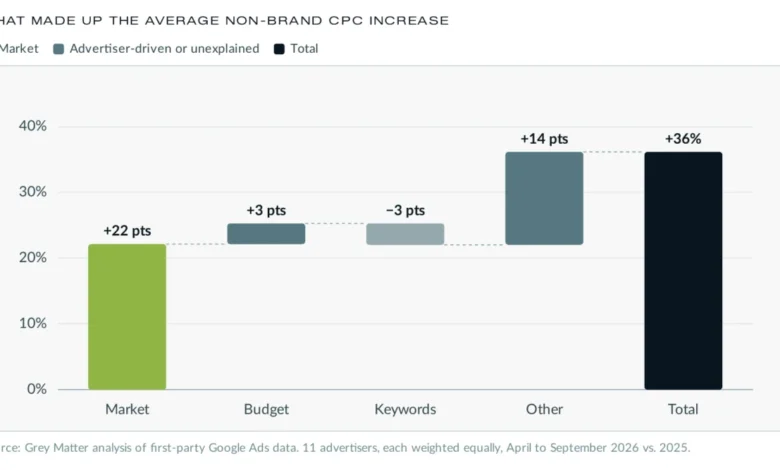
While the headline 21% represents the "market" increase, the reality for many advertisers was even steeper. Among a subset of 11 advertisers, the total year-over-year increase in non-brand CPC reached 36%. Grey Matter’s analysis breaks this down into four distinct categories:
- Market Inflation: 22 percentage points, representing the baseline increase in competition for the same inventory.
- Increased Spending: 3 percentage points, tied to the aggressive expansion of budgets.
- Strategic Adjustments: A 3-point deduction, reflecting the impact of changing match types, keyword pruning, and bid strategy optimization.
- Unexplained Variance: 14 percentage points, which likely captures hyper-competitive shifts in specific B2B industry niches where auction intensity reached localized peaks.
This "waterfall" of costs illustrates that while marketers can mitigate some inflation through disciplined account management, they are largely beholden to the macroeconomic forces of the Google Ads auction.

Contextualizing the Findings: Why CPC Is Not a Standalone Metric
It is essential to distinguish between the agency’s findings and the public data released by Alphabet. In its third-quarter 10-Q filing for 2026, Alphabet reported a modest 4% year-over-year increase in search CPC. This figure is an aggregate of all click-driven revenue across all platforms, including mobile, desktop, and various product types. Because Alphabet’s metric is influenced by shifts in device usage, geography, and product mix, it does not directly contradict Grey Matter’s more granular, keyword-specific analysis.
Industry analysts have cautioned against interpreting higher CPCs as a failure of marketing strategy. In a column for Search Engine Journal, Jyll Saskin Gales emphasized the "High CPC Paradox," noting that under modern Smart Bidding, a higher CPC is often a symptom of an account successfully targeting high-intent, high-value users. Therefore, the rise in CPC must be measured against conversion rates and Return on Ad Spend (ROAS). If an advertiser is paying 21% more per click but achieving a higher lead-to-customer conversion rate, the investment may be entirely justified.
Broader Implications for B2B Marketing Strategies
The findings suggest that the "easy growth" era of B2B search may be reaching a plateau. For companies planning their 2027 budgets, the implications are twofold. First, the report underscores the necessity of granular reporting. Advertisers who track only their average CPC will likely miss the underlying inflation of their core keywords, potentially leading to misinformed budget allocations.
Second, the correlation between automated bidding and rising CPCs warrants a shift in tactical oversight. As Google’s algorithms seek to maximize conversions, they will naturally seek out higher-cost auctions. Consequently, marketers must establish clear value parameters for those additional conversions before authorizing budget increases. The report advises a "scale-and-assess" approach: incrementally increasing budgets while closely monitoring the marginal cost of the new clicks acquired.
Limitations and Statistical Validity
It is important to view these figures within the context of the study’s size. With only 14 advertisers, the margin for error is non-trivial. The study’s authors acknowledged that the estimated 21% increase comes with a broad confidence interval, ranging from 1% to 44%. When the largest spender was removed from the dataset, the estimate dropped to 17%, with a range that touched zero.
These fluctuations highlight the volatility of the B2B search market. Because the report does not categorize the industries of the participating companies, it is difficult to determine whether these trends are uniform across sectors—such as SaaS, manufacturing, or professional services—or if they are driven by specific high-competition industries.
Conclusion and Future Outlook
The Grey Matter report serves as a diagnostic tool rather than a predictive forecast. It provides a sobering reminder that "same-keyword" performance is not immune to the pressures of the digital marketplace. For the B2B sector, where sales cycles are long and the cost of customer acquisition is high, the 21% increase in CPC is a call for greater transparency in reporting and a more surgical approach to bidding.
As we look toward 2027, the primary challenge for B2B search teams will be to discern the difference between "good" inflation—where higher costs are offset by better lead quality—and "bad" inflation, where the auction environment is simply becoming too expensive to sustain previous levels of scale. By holding the account and the keyword constant, the industry now has a clearer framework to conduct that analysis, ensuring that marketing budgets remain grounded in data rather than mere participation in an increasingly aggressive auction. Future strategies should prioritize setting strict target ROAS and CPA thresholds to counteract the tendency of automated bidding to chase volume at the expense of efficiency.