The Essential Guide to Answer Engine Optimization and Selecting the Right AEO Checker for Your Brand

In the rapidly evolving landscape of digital search, the traditional "ten blue links" paradigm is being fundamentally dismantled. As users increasingly pivot toward generative AI interfaces like ChatGPT, Perplexity, and Google’s AI Overviews to satisfy their informational needs, the mechanics of visibility are undergoing a tectonic shift. For marketing professionals and business owners, this transition necessitates a move beyond traditional search engine optimization (SEO) toward the emerging discipline of answer engine optimization (AEO). An AEO checker is no longer a luxury; it is a critical diagnostic tool designed to determine whether your brand is being cited, mentioned, or ignored within the synthesized responses provided by modern artificial intelligence.
The Rise of the Zero-Click Search Era
The shift began in earnest with the maturation of large language models (LLMs) and reached a critical milestone in May 2024, when Google integrated AI Overviews (AIOs) directly into its search results. Unlike traditional search, which serves as a directory, answer engines act as curators. They ingest vast datasets, synthesize information, and present a concise summary directly on the results page. While this improves user experience by minimizing the time spent navigating multiple sites, it presents a significant challenge for brands: visibility can now vanish into an answer that never requires a click.
![AEO checker tools that measure answer engine visibility [2026]](https://53.fs1.hubspotusercontent-na1.net/hubfs/53/aeo-checker-1-20260903-3858273.webp)
This "zero-click" phenomenon forces a re-evaluation of digital presence. If a potential customer asks an AI for the "best project management software" and receives a list that excludes your brand, your visibility is effectively zero, regardless of how high you rank on a traditional search engine results page (SERP). The goal of AEO is to ensure your brand is not only present in these AI-generated snippets but also perceived as an authoritative, cited source.
Chronology of a Digital Transformation
The trajectory of search behavior has been consistent over the past decade, moving from keyword-based queries to natural language intent.
- Early 2020s: The emergence of voice search and featured snippets laid the groundwork for summary-style results.
- Late 2022: The public release of ChatGPT demonstrated the power of conversational search, signaling the end of the traditional search monopoly.
- May 2024: Google officially rolled out AI Overviews to the general public, embedding AI-synthesized summaries into the world’s most popular search engine.
- June 2026: Google introduced generative AI performance reports, acknowledging that brands require specific data on how their assets perform within the new AI-driven ecosystem.
As these engines continue to refine their retrieval-augmented generation (RAG) capabilities, the reliance on structured data, verifiable primary sources, and high-authority content has intensified. Engines prioritize content that is "parsable"—information that is clearly formatted, factually backed, and directly responsive to user queries.
![AEO checker tools that measure answer engine visibility [2026]](https://no-cache.hubspot.com/cta/default/53/9dd5e54b-fbef-4dd0-bc44-1689feb1ea18.png)
Understanding the AEO Checker Ecosystem
An AEO checker functions as the bridge between your content strategy and the black-box algorithms of AI engines. At its core, an effective tool must be capable of four primary tasks: measurement, diagnosis, prioritization, and reporting.
Measurement involves tracking the frequency of brand mentions and citations across various engines. Diagnosis identifies the "content gap"—the difference between why a competitor is cited for a specific query and why your brand is not. Prioritization ranks these gaps based on the potential impact on brand authority and traffic. Finally, reporting provides a continuous, longitudinal view of performance, which is vital because AI responses are not static; they fluctuate based on the specific session, user location, and query history.
Manual vs. Automated Monitoring
![AEO checker tools that measure answer engine visibility [2026]](https://53.fs1.hubspotusercontent-na1.net/hubfs/53/aeo-checker-2-20260903-852936.webp)
For smaller organizations, manual checking remains a viable, albeit labor-intensive, starting point. This involves performing incognito searches using a controlled list of branded and informational keywords, then manually documenting whether an AI response appears, whether your domain is cited, and what context is provided. However, manual processes fail to scale. Because AI responses are probabilistic rather than deterministic, a single manual check is statistically insignificant. Automated AEO checkers solve this by sampling queries across thousands of sessions, providing a dataset that is statistically robust.
The Market Landscape: Choosing the Right Tool
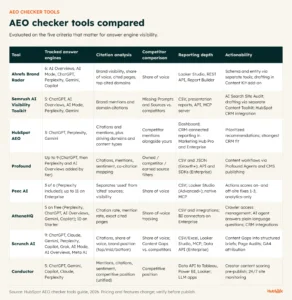
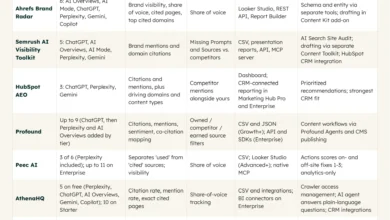
The software market for AEO has bifurcated into several distinct categories, each offering unique strengths:
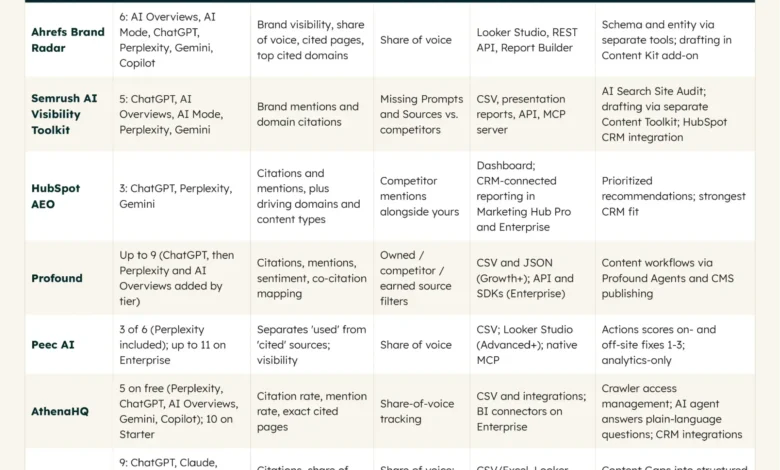
- AI Overviews Tracking: Tools like Ahrefs Brand Radar and the Semrush AI Visibility Toolkit focus heavily on Google’s ecosystem. They excel at mapping the transition from traditional ranking keywords to AI-triggered search results, helping teams prioritize which pages require optimization to capture those elusive overview slots.
- Citation Detection: Platforms such as HubSpot AEO and Profound specialize in monitoring ChatGPT and other LLMs. These tools track not just when a link is provided, but whether the brand is explicitly mentioned in the text, providing a nuanced view of brand sentiment and awareness.
- Perplexity and Specialized Engines: Newer entrants like Peec AI and AthenaHQ focus on the growing market of specialized answer engines. These platforms provide deep-dive analytics into the citation patterns of Perplexity, which has become a preferred search tool for power users and researchers.
- Infrastructure and Schema Readiness: Tools like Scrunch AI and Conductor prioritize the technical foundation of AEO. They ensure that a brand’s technical SEO—schema markup, site speed, and entity recognition—is optimized so that crawlers can ingest and process the site’s information without friction.
The Strategic Implications of AEO Metrics
![AEO checker tools that measure answer engine visibility [2026]](https://53.fs1.hubspotusercontent-na1.net/hubfs/53/aeo-checker-3-20260903-8904553.webp)
To successfully navigate this era, organizations must track metrics that go beyond traditional traffic. Key performance indicators (KPIs) now include "Citation Coverage," which measures the percentage of relevant queries where your brand is cited; "Mention Share," which tracks how often your brand is named even without a backlink; and "AI-Referenced Traffic," which isolates visitors coming specifically from AI-generated links.
While these metrics provide insight, they must be interpreted as trends. A week-over-week increase in citation coverage is a more reliable indicator of success than a single daily spike. It is also important to acknowledge that AI-referred traffic often carries higher intent; a user who clicks through an AI citation has usually already been qualified by the answer engine’s summary.
Official Perspectives and Future Outlook
Industry analysts suggest that the tension between "zero-click" results and publisher revenue will remain a central theme of the next few years. In response, companies like HubSpot have integrated AEO directly into their CRM and content management systems. By connecting visibility data to actual deal pipelines, these platforms aim to solve the "attribution gap," allowing marketers to see exactly how AI-driven brand awareness contributes to revenue.
![AEO checker tools that measure answer engine visibility [2026]](https://53.fs1.hubspotusercontent-na1.net/hubfs/53/aeo-checker-4-20260903-6212698.webp)
The consensus among digital strategists is clear: AEO is not a replacement for SEO, but an evolution of it. The authority signals generated by high-quality, traditional SEO—such as backlinks, domain authority, and structured data—remain the fuel that powers AI citations. Consequently, the most successful brands will be those that integrate their AEO efforts into their broader content lifecycle, using AI-generated insights to inform their content creation and technical updates.
As we look toward the future, the integration of generative AI into the fabric of the internet will only deepen. For brands, the challenge is to move from a reactive posture—wondering why they aren’t being cited—to a proactive one, where they structure their information to be the definitive answer for their industry. The era of the answer engine is here; those who effectively utilize AEO checkers to navigate this shift will define the next generation of digital visibility.
Related posts: