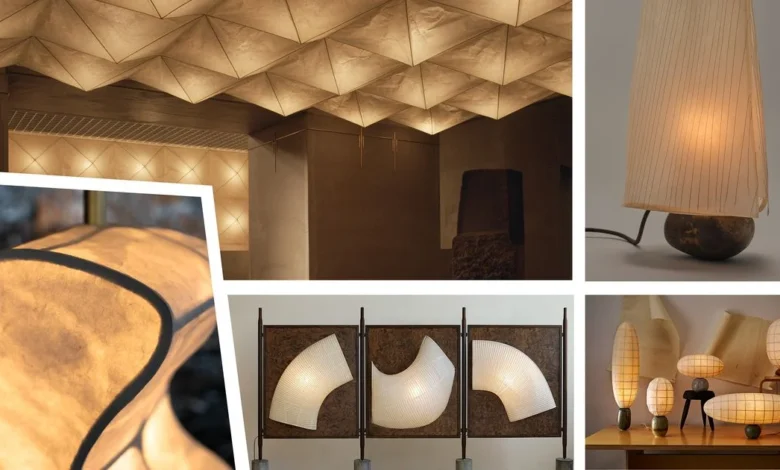
On Park Avenue in the heart of midtown Manhattan, the lobby of the Lever House offers a striking visual dialogue between mid-century architectural ambition and the timeless, delicate glow of paper and light. Visitors and office workers alike are greeted by more than a dozen Akari light sculptures—the iconic creations of Isamu Noguchi. These pieces are not mere office décor; they represent a deliberate bridge between the building’s architect, Gordon Bunshaft, and the artist Noguchi, who was originally commissioned in the 1950s to populate the site with sculpture. While that original commission remained unfulfilled for decades, the presence of the Akari lamps serves as a testament to the enduring legacy of a design movement that continues to influence contemporary creators.
The Genesis of Akari and the Gifu Connection
The story of the Akari lamp begins not in a design studio, but in the historic Japanese region of Gifu. In 1951, seeking to revitalize the area’s traditional paper-lantern industry, the mayor of Gifu invited Noguchi to lend his vision to the craft. Working alongside Ozeki & Co., Ltd., a family-owned manufacturer, Noguchi spent his time immersing himself in the local techniques of washi paper production and bamboo construction.
Noguchi’s intervention was revolutionary. By stripping the lanterns of their traditional colors and ornate calligraphy, and by replacing oil-based lighting with modern electrical bulbs, he transformed a centuries-old cultural artifact into a piece of modernist art. The resulting Akari series, which would eventually comprise over 200 distinct models, emphasized geometric purity, weightlessness, and the diffusion of light. To mark the 75th anniversary of this pivotal moment, the Noguchi Museum is currently hosting "No Ordinary Light: Akari at 75," an exhibition that remains on view until September 5, 2027.
Challenging the Boundaries of Sculpture and Design
Throughout his career, Noguchi wrestled with the classification of his work. While he viewed himself primarily as a sculptor, his foray into industrial design—specifically the creation of the Akari lamps—was often met with skepticism by the art establishment. This friction was most visible during the 1986 Venice Biennale. As the first American artist to receive a solo presentation at the event, Noguchi chose to dedicate two rooms of the pavilion to his paper lamps. The move was controversial; critics argued that the inclusion of functional lighting undermined his standing as a fine artist.
Despite the pushback, Noguchi remained steadfast. The exhibition, titled "What Is Sculpture?," was a defiant assertion that the distinction between industrial design and fine art is a human construct, not a functional reality. The massive, singular Akari structure he created for that show, now a centerpiece of the current museum retrospective, serves as a permanent rebuttal to those who would dismiss the beauty and technical rigor of his light-based work.
A New Wave of Artisans
Today, a new generation of design studios is looking back at Noguchi’s methodology not as a template to copy, but as a philosophy to build upon. These designers are navigating the tension between the "repeatable" nature of product design and the "unique" soul of hand-crafted art.
Andrea Claire Studio: The Intersection of History and Texture
Andrea Claire, who transitioned from a Brooklyn-based practice to a studio in Los Angeles, credits her fascination with lighting to an early visit to the Noguchi Museum. For Claire, the manufacturing process of the Akari lamps is essential knowledge. "To this day, when someone starts working for me, I have them sit down and watch the same video of how Akari are made as an introduction," she notes.
In 2020, Claire began experimenting with hanji, a traditional Korean paper. Her "Totemic" collection represents a departure from her earlier, mobile-style chandeliers, focusing instead on vertical, marble-like structures that conceal light sources behind layers of hand-wrapped, textured paper. For Claire, the digital precision of 3D modeling is useful, but the "human touch" remains the final, vital ingredient in providing the work with depth.
Kawabi: Archival Forms and Material Hybrids
The New York-based duo Aaron and Irisa Chan-Kawabi, graduates of the Parsons School of Design, approach paper lanterns as "migrants from another place." Their practice, Kawabi, emphasizes what they call "archival forms"—a blend of traditional architecture and historical archetypes.
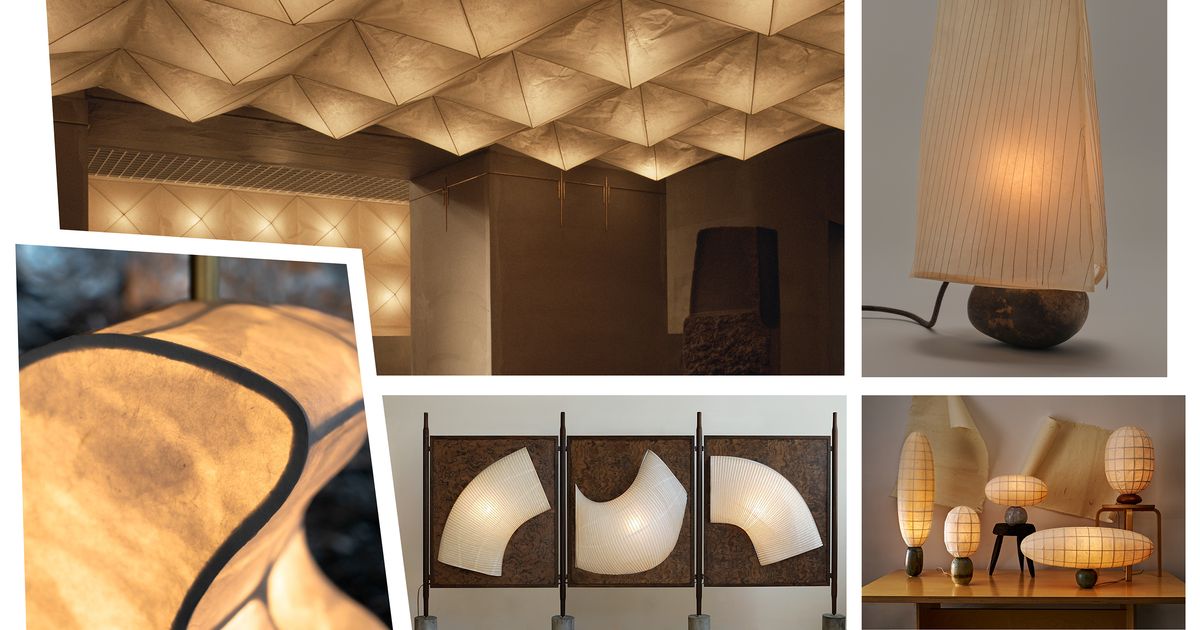
The studio’s "Confluence" collection, launched in 2025, showcases their willingness to experiment with materiality. The Tea Screen Lamp, for example, functions as a hybrid room divider and light fixture, utilizing mulberry-bark paper encased in walnut-burl panels. By studying directly with master wood craftsmen and papermakers in Japan, the duo continues to employ the traditional technique of coiling reeds over collapsible wooden molds—the very process championed by Noguchi. Their recent "Amica" collaboration with ceramicist Christopher Merchant further demonstrates a desire to blend the permanence of clay with the ephemerality of paper, resulting in a more structured, Western-influenced aesthetic.
Vy Voi: Honoring Natural States
Steffany Tràn, the mind behind Vy Voi, is a designer who occupies the space between artist and industrialist. Based in New York, she began incorporating dó paper—a Vietnamese material with an 800-year history—into her ceramic works in 2024.
Tràn’s work is deeply rooted in personal history and the natural world. Her "Rễ Cây" collection features shades inspired by root vegetables that "sprout" from porcelain bases, while other designs pay homage to specific Vietnamese cultural objects, such as traditional whistling kites. Her approach is grounded in a philosophy of honesty: "There’s a clear respect in the natural state of what Noguchi chose to use, and I aim to echo that in my own work," she says. Her insistence on hand-crafting—from bending frames to brushing on lacquer—is a calculated rejection of mass production and the "extreme waste" of the modern era.
Thomas Yang: The Ritual of Craft
Thomas Yang, who gained prominence following a 2024 residency at Colony, represents a departure from the "means to an end" mentality often found in industrial design. His practice is defined by the physical labor of sourcing materials, including heavy stones from upstate riverbeds.
His "Tian Den" series utilizes Yame Kozo Hadaura paper, a regional mulberry-bark paper, and features shades that are sensitive to the slightest movement of air. Yang’s more recent "Stone" series introduces an architectural technique known as ishibadate, where wooden columns rest on foundation stones without the use of permanent anchors. By leaving wires and frames exposed, Yang invites the observer to understand the mechanics of the light. "I hope that an object can speak beyond its form to what has come before, and to how it may shape the conversation going forward," Yang says, emphasizing his desire to create objects that feel as "ordinary" and enduring as a well-loved kitchen utensil.
Broader Implications for the Design Industry
The resurgence of interest in paper-based lighting reflects a broader shift in the design world. As consumers become increasingly conscious of the environmental impact of mass-produced, petroleum-based plastic lighting, the revival of biodegradable, renewable, and hand-crafted materials like mulberry paper and bamboo has gained significant momentum.
However, this trend also highlights a critical challenge: scalability. While these designers have found success in the high-end, bespoke market, the transition from artisanal craft to widespread availability remains a hurdle. Noguchi’s genius was in his ability to bridge this gap, working with factories to ensure his designs were accessible without sacrificing their artistic integrity.
For the contemporary designers profiled, the goal is not necessarily to recreate the ubiquity of the Akari, but to honor the spirit of curiosity that defined Noguchi’s career. By embracing the "telltale signs" of human production and the natural imperfections of their chosen materials, these studios are contributing to a dialogue that connects the past—the 75-year-old tradition of the Akari—with the needs of a future that increasingly values craftsmanship, sustainability, and the quiet, transformative power of light.
As the Noguchi Museum continues its commemorative exhibition, the lessons of the Akari remain clear: good design is not defined by its distance from utility, but by its capacity to exist in the home as both a functional object and an enduring work of art. Through their varied techniques and cultural influences, this new generation of makers is ensuring that the light Noguchi kindled in Gifu continues to burn, evolved and reimagined for a new century.