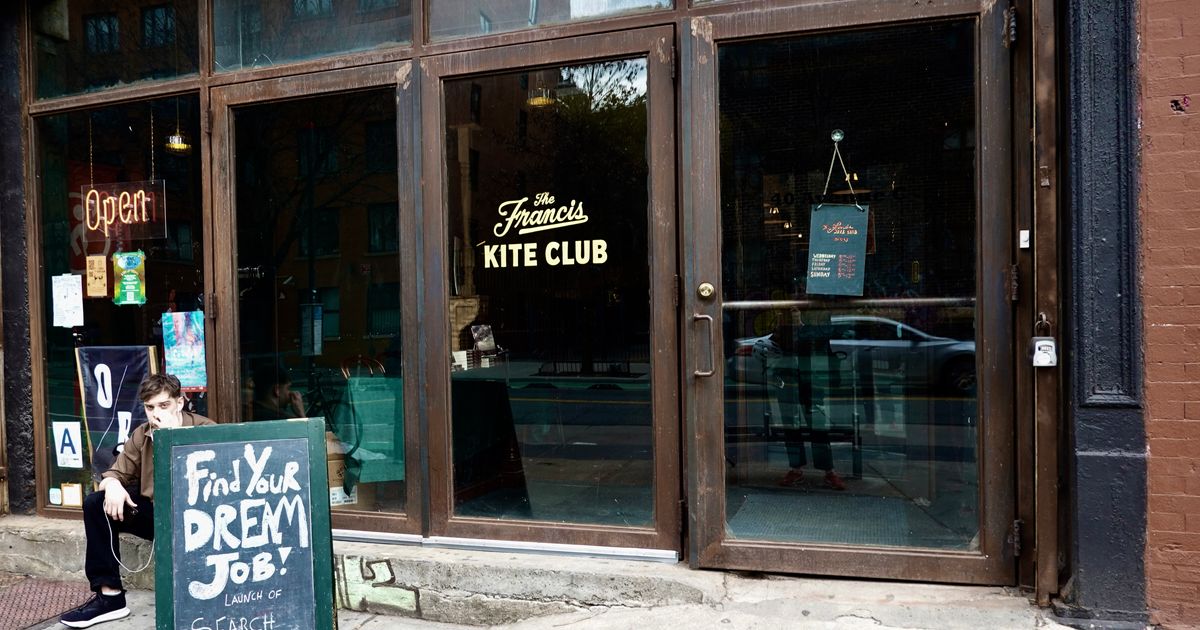
In the heart of Manhattan’s Alphabet City, a chalkboard stands on the sidewalk of Avenue C, offering a curious invitation to passersby: “Find Your Dream Job!” To the casual observer, the Francis Kite Club appears to be a standard East Village establishment—a dimly lit sanctuary of dark-green banquettes, folding chairs, and a low-slung stage. However, between the hours of 10 a.m. and 6 p.m. from Monday through Thursday, this nightlife staple undergoes a metamorphosis. It sheds its identity as a cocktail lounge and transforms into the headquarters for two distinct pillars of independent media: OR Books and Lux Magazine.
This arrangement is more than a quirky neighborhood anecdote; it represents a pragmatic response to the "brutal economics" of New York City real estate and a broader shift in the global understanding of the workplace. As traditional office towers face record vacancy rates and the publishing industry continues to contract, the Francis Kite Club has become a case study in the "third space" evolution, where the boundaries between commercial, social, and creative environments are permanently blurred.
The Economics of a Bar-Office Hybrid
The financial architecture of the arrangement at Francis Kite Club is a testament to the necessity of shared resources in a high-cost urban environment. OR Books, an independent publisher known for its lean, print-on-demand business model, pays $1,700 per month to utilize the bar’s "green room" from Monday through Wednesday. On Thursdays, the baton is passed to Lux, a feminist magazine, which pays a daily rate of $250.
For these small-scale media entities, the traditional commercial lease has become an insurmountable barrier. In 2024 and 2025, Manhattan’s commercial real estate market saw a significant "flight to quality," where top-tier firms migrated to new, high-amenity glass towers, leaving older, smaller office stock in a state of precariousness. For a small publisher, a standard office lease in lower Manhattan could easily exceed $5,000 to $10,000 per month, not including utilities, insurance, and maintenance. By "time-sharing" a bar, OR Books and Lux have reduced their overhead by more than 60%, allowing capital to be redirected toward author advances and production costs.
Colin Robinson, the co-founder of OR Books, notes that the move was born of necessity rather than a desire for novelty. Following the death of their previous landlord, the company was left without a gathering space. The relationship with the Francis Kite Club—co-owned by a collective of artists, including Kyp Malone of TV on the Radio—offered a lifeline. "It’s just brutal economics," Robinson explains. This sentiment is echoed across the industry as even the "Big Five" publishers retrench. Scholastic recently sold its iconic New York headquarters, Oxford University Press liquidated its Manhattan offices for $40 million, and Penguin Random House has sublet over 110,000 square feet of its headquarters to mitigate costs.
A Chronology of the Workspace Shift
The transition of the Francis Kite Club into a daytime workspace follows a specific timeline that mirrors the post-pandemic recovery of New York City’s hospitality and media sectors.
- Post-2020 Real Estate Crisis: As remote work became the standard, small publishers realized that maintaining a full-time office was no longer viable. Many shifted to fully remote models, but found that editorial collaboration suffered without a physical hub.
- 2023: The Partnership Formation: OR Books began searching for a flexible space that could double as an event venue. The Francis Kite Club, which primarily operates in the evenings, had significant "dead time" during the day.
- 2024: The Entry of Lux Magazine: Recognizing the success of the OR Books model, Lux Magazine joined the arrangement, utilizing the space on Thursdays to coordinate its feminist editorial projects and community outreach.
- 2025-2026: The "Fluxo" Expansion: A startup called Fluxo launched, formalizing the concept of "hot-desking" in bars and restaurants across New York. This provided a platform for other venues to monetize their off-hours, turning neighborhood bars into a decentralized network of offices.
The Symbiotic Daily Routine
The daily operation at the Francis Kite Club is characterized by what founder Sarah Leonard of Lux Magazine calls a "sitcom-like" atmosphere. The transition from office to bar is seamless but requires a unique set of protocols. At 5 p.m., as the editorial workday winds down, bartenders arrive to begin their shifts. This creates a built-in "happy hour" for the editors, who often trade their laptops for wine glasses without leaving their seats.
The relationship is deeply integrated. Joey Daniel, who handles audiobooks for OR Books, has found himself signing for beer deliveries when the bar staff is absent. Conversely, the bar staff often receives book shipments on Saturdays when the editors are away. The "office" itself—the bar’s back room—is a cramped but vibrant repository of 17 years of intellectual labor. Shelves reaching to the ceiling are packed with OR Books titles, while back issues of Lux sit beneath drum kits and sound equipment.
However, the arrangement is not without its challenges. Because the venue serves as a performance space on weekends, Monday mornings often involve a "clearing of the deck." Editors have reported finding everything from abandoned stage costumes and pantyhose to photographic evidence of "crazier-than-imagined" weekend parties. Despite the clutter, there is a mutual respect for the property; Robinson notes that while visitors often leave books behind in the hopes of being noticed, no one has ever stolen a volume from their extensive archives.
Supporting Data: The Rise of the Flexible Workspace
The trend observed at Avenue C is supported by broader economic data regarding the "work-from-anywhere" (WFA) movement. According to recent labor statistics, approximately 25% of the New York City workforce remains in a hybrid or fully remote arrangement. This has led to a surge in demand for "neighborhood hubs"—spaces that are more professional than a living room but more social than a traditional office.
Startups like Fluxo have capitalized on this by partnering with venues like Albert’s Bar near Grand Central. Their data suggests that workers are increasingly seeking environments with guaranteed Wi-Fi and a social atmosphere. The "bar-office" model specifically appeals to the creative class—writers, editors, and artists—who find the sterile environment of a WeWork or a corporate lobby antithetical to the "play of ideas."
For the bar owners, the benefits are equally clear. With the cost of commercial leases for hospitality venues rising by nearly 15% in certain Manhattan corridors over the last two years, the additional revenue from daytime rentals can be the difference between staying in business and shuttering. By hosting book launches, fundraisers, and political readings, the bar also builds a loyal clientele that returns during evening hours.
Broader Impact and Cultural Implications
The success of the Francis Kite Club as a dual-purpose space has significant implications for urban planning and the future of "Main Street" businesses. It suggests a move toward a "15-minute city" model, where work, social life, and commerce are integrated into the same local infrastructure.
Furthermore, this model preserves the cultural fabric of neighborhoods like the East Village. By housing radical publishers and feminist magazines, the Francis Kite Club ensures that the neighborhood remains a hub for intellectual discourse, even as gentrification threatens to price out non-corporate entities. The presence of high-profile figures like Slavoj Žižek and Norman Finkelstein for OR Books events, or Chelsea Manning DJing for Lux, reinforces the bar’s status as a contemporary "literary salon."
Rachel Meade Smith, an author who recently launched her collection of essays Search Work at the club, notes that the environment changes the nature of professional interaction. The "casual, grubby" feeling of the room strips away the corporate pretense. "I felt like we were just peers having a real conversation," Smith said of her initial editorial meetings. "I didn’t have to impress them."
Analysis of the Future Office
As we look toward the latter half of the decade, the Francis Kite Club model may become a blueprint for small businesses across various sectors. The "brutal economics" that Colin Robinson described are unlikely to ease, and the flexibility of "time-shared" real estate offers a sustainable path forward.
For the publishing industry, which has long struggled with thin margins and high overhead, the move to non-traditional spaces may be the key to survival. It allows for a physical presence that fosters community without the crushing weight of a long-term commercial lease. For New York City, these hybrid spaces represent a new form of resilience—a way to keep the lights on and the printers running in an ever-changing economic landscape.
As the workday ends on Avenue C, the transition from manuscript to martini is more than just a change in beverage; it is a celebration of a new kind of workplace—one that is humane, sustainable, and deeply rooted in the community it serves. Whether it is printing a resume for a Japanese-fluent job seeker or hosting a reading for a late Palestinian poet, the Francis Kite Club proves that in the modern economy, the most productive office might just be the one with a liquor license.