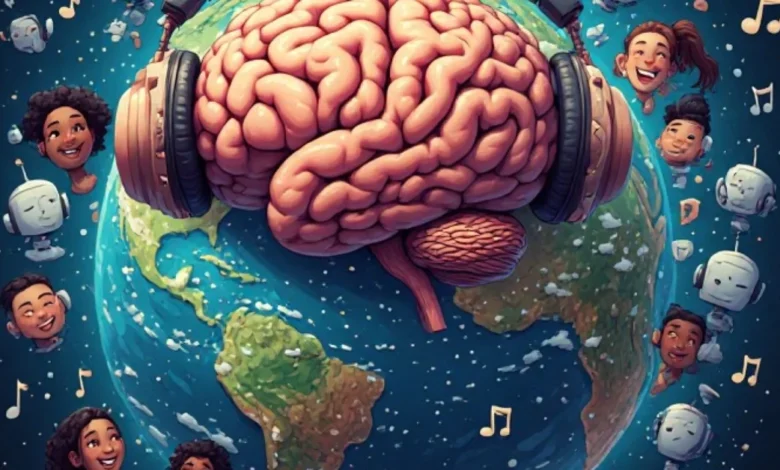
The ethereal notes of that cool new pop song resonating from the radio provoke a contemporary question: was this melody crafted by a human mind or an artificial intelligence? This query underscores a profound shift in the landscape of music creation and consumption, highlighting the increasingly intertwined relationship between technological advancement and our auditory experience. AI-powered music production applications now allow users to transform nascent audio ideas or lyrical fragments into surprisingly polished song recordings with minimal input, adjusting only a few parameters. This development is not merely a novelty; it represents a significant leap in the enduring interaction between technology and music listening, prompting widespread discussions across artistic, psychological, and economic spheres.
The AI Frontier: Reshaping Musical Creation
The proliferation of sophisticated AI tools like Google Magenta, OpenAI Jukebox, Amper Music, and AIVA has democratized music production while simultaneously challenging traditional notions of authorship. These platforms leverage machine learning algorithms trained on vast datasets of existing music to generate original compositions, melodies, harmonies, and even full instrumental tracks. Artists and producers are increasingly using AI not just for ideation but for refining arrangements, generating background scores, or exploring new sonic textures previously unattainable. This paradigm shift raises critical questions regarding the definition of creativity. If an algorithm can compose a commercially viable track, what constitutes human artistry?
This technological surge has ignited debates concerning intellectual property and copyright. Who owns the rights to a song generated by AI? Is it the developer of the algorithm, the user who provided the initial prompt, or does the concept of ownership need to be entirely re-evaluated? Legal frameworks are struggling to keep pace with these innovations, creating a complex environment for artists and industry stakeholders. While some musicians embrace AI as a powerful collaborative tool that expands their creative horizons, others voice concerns about potential job displacement, the devaluation of human skill, and the homogenization of musical styles. Major record labels and industry bodies are actively exploring strategies to adapt to this new reality, balancing the pursuit of innovation with the protection of artists’ rights and compensation. The global market for AI in music, while nascent, is projected to grow significantly, indicating a future where AI’s presence in music production is not just pervasive but integral.
The Enduring Human-Music Connection: A Psychological Perspective
Beyond the mechanics of creation, psychologists remain deeply invested in understanding the profound ways humans process music. Music is far more than mere sound; it is a potent catalyst for memory, emotion, and cognitive function. Researchers have consistently confirmed that music listening activates a diverse array of brain systems, engaging not only the auditory cortex but also regions associated with emotion (the limbic system, particularly the amygdala), reward and motivation (the nucleus accumbens and ventral tegmental area), and higher-order cognitive processes (the prefrontal cortex). The burgeoning field of the psychology of music offers unparalleled insight into cognition, memory, and emotions, revealing how soundscapes can shape our inner worlds.
The therapeutic applications of music are well-documented and evidence-based. Music therapy is employed across various clinical settings to improve alertness, facilitate speech recovery in stroke patients, enhance motor skills, manage chronic pain, and even regulate mood in individuals suffering from anxiety or depression. The neurological underpinnings of these effects are increasingly understood, with studies showing that music engages key neurological reward circuits, releasing neurotransmitters like dopamine that contribute to feelings of pleasure and motivation. Crucially, music also plays a pivotal role in the formation of our personal identity. Longitudinal studies suggest that the music we consumed during our formative years, particularly between the ages of puberty and emerging adulthood, significantly helped to shape our personal sense of self, forming a "reminiscence bump" where these memories are most vividly retained and emotionally resonant. These foundational connections between music and the self are universally acknowledged, transcending cultural and technological shifts.
A Historical Symphony: Technology’s Evolution in Music
The intimate bond between technology and music is not a recent phenomenon but a historical continuum stretching back millennia. Before the advent of recording technology, music was, by necessity, a live experience. Early musical instruments, crafted from wood, brass, animal skins, and strings, represented the cutting edge of material technology in their respective eras. From simple flutes and drums to intricate lyres and harps, these instruments allowed humans to produce the unique timbres that formed the basis of early musical expression. Performance spaces—ranging from ancient amphitheaters and communal dance halls to grand churches and elaborate theaters—were the architectural marvels of their time, meticulously designed to optimize acoustics and best present live music to audiences within their physical confines. For centuries, the only way to experience music was to be present at its creation, performed by musicians, bands, and orchestras, or to perform it oneself.
The late 19th and early 20th centuries marked a revolutionary turning point with the introduction of electricity and its subsequent application to sound reproduction. In 1877, Thomas Edison’s invention of the phonograph, which recorded sound onto wax cylinders, heralded the era of recorded music. A decade later, Emile Berliner’s gramophone, utilizing flat discs, offered a more durable and reproducible format, laying the groundwork for the modern record industry. This innovation fundamentally transformed music consumption, allowing individuals to enjoy performances in the privacy of their homes, democratizing access previously limited to live venues.
The mid-20th century witnessed further leaps:
- Radio Broadcasting (1920s onwards): The widespread introduction of radio broadcasting in the 1920s brought music into virtually every household. This technology enabled instantaneous mass distribution of diverse musical styles, breaking down geographical barriers and fostering a shared cultural experience. Music became a ubiquitous soundtrack to daily life, accompanying individuals wherever they went.
- Vinyl Records (1940s-1980s): The evolution from shellac 78s to vinyl LPs (Long Plays) and 45s transformed the album into an art form. Album covers became canvases, and the curated sequence of tracks told stories, contributing significantly to youth culture and the emergence of distinct musical genres like rock and roll, jazz, and folk.
- Magnetic Tape (1960s-1990s): Cassette tapes and later 8-tracks introduced unprecedented portability, allowing music to be enjoyed in cars, on personal stereos, and facilitating the rise of the "mixtape" as a form of personal expression and social bonding. This era also saw the first major challenges to copyright with the rise of home recording and piracy.
- Compact Discs (CDs) (1980s-2000s): CDs offered superior sound quality, durability, and digital storage, marking a pivotal step towards the digital age of music. They rapidly replaced vinyl as the dominant format, ushering in an era of pristine audio reproduction.
- MP3s and the Internet (Late 1990s-Early 2000s): The advent of the MP3 format and the internet-driven file-sharing phenomenon (epitomized by Napster) caused seismic shifts in the music industry. Music became easily downloadable and shareable, leading to a dramatic decline in physical album sales but paving the way for ubiquitous digital access and personal music libraries on devices like the iPod.
The Digital Deluge: Streaming and Hyper-Personalization
Today, digital delivery platforms offer an almost infinite variety of streaming musical styles and artists. Services like Spotify, Apple Music, and YouTube Music stream audio 24/7 to our devices, offering nearly unlimited global media content. As of 2024, there were over 200 million music tracks available on streaming services, a number growing by approximately 10% per year. This sheer volume of accessible online musical selections far exceeds what was available to prior generations and represents more musical content than any individual could possibly listen to in a lifetime. This "playlist culture," driven by algorithmic recommendations, has not only expanded listener horizons but also created new challenges for artist discovery and fair compensation models. The global reach of these platforms means that music from obscure artists in distant lands can find an audience instantaneously, fostering unprecedented cultural exchange and diversification.
Music, Identity, and Social Cohesion
In this hyper-connected world, the fundamental question persists: what does music mean to you? What were the most impactful songs in your life? Chances are that some of the most meaningful songs were those you encountered during adolescence and emerging adulthood. This period is a critical time for self-discovery, and music serves as a powerful anchor for developing one’s "sense of self," influencing how individuals think about themselves and their place in the world.
Psychology of music research identifies three basic reasons why adults listen to music:
- To regulate arousal and mood: Music is a powerful tool for emotional management, whether to energize, relax, or process feelings.
- To achieve self-awareness: This relates directly to music’s role in personal identity, serving as a soundtrack to our individual narratives and reflecting our values and beliefs.
- As an expression of social relatedness: Music fosters connections, builds communities, and acts as a vehicle for social identity and group cohesion.
Whether an individual identifies with classical or jazz, punk, rock, rap, or heavy metal, these choices are not merely aesthetic preferences; they are potent markers of individual, group, and cultural identity. Technology, particularly social media and streaming platforms, has amplified this phenomenon, allowing individuals to connect with like-minded fans globally, share curated playlists, and participate in online communities centered around specific genres or artists. This strengthens both individual and collective identities, demonstrating how technology facilitates and reinforces the social dimension of music.
Implications and The Road Ahead
What lies next for music technology? The trajectory points towards increasingly immersive and integrated experiences. While robotic musicians that sing and dance remain largely within the realm of performance art and research, their sophistication continues to grow. The concept of directly beaming music into a music-brain interface, or even the Matrix-style downloading of a musical skill like playing the violin directly into our brains, currently remains science fiction. However, advancements in neurotechnology and brain-computer interfaces (BCIs) suggest these capabilities, once unimaginable, may not be perpetually out of reach. Researchers are already exploring rudimentary BCIs for controlling musical parameters or translating thought into sound.
The implications of these potential futures are vast. Personalized music generation, tailored to an individual’s real-time mood or physiological state, could become commonplace. Immersive virtual reality (VR) and augmented reality (AR) concerts could redefine the live music experience, offering unparalleled sensory engagement regardless of physical location. Yet, such advancements also present ethical dilemmas: questions of authenticity, the value of human creative effort in an AI-dominated landscape, and the potential for new forms of digital manipulation (e.g., deepfakes in music). The economic models for artists and the industry will undoubtedly continue to evolve, demanding adaptive legal frameworks and innovative compensation structures.
In conclusion, the relationship between technology and music is a dynamic, ever-evolving partnership that has profoundly shaped human experience across millennia. From the earliest crafted instruments to the latest AI-driven compositions and global streaming networks, technology has consistently redefined how music is created, distributed, consumed, and integrated into our lives. As we venture further into the digital age, this symbiotic relationship will only deepen, continuing to influence our individual identities, foster social connections, and enrich the very fabric of human culture in ways we are only just beginning to comprehend. The harmony between humanity and technology in music is an ongoing, powerful composition.
Related posts: