The Quest for AI Governance: Alex Bores and the Battle Over Regulatory Authority in the Age of Silicon Valley Influence

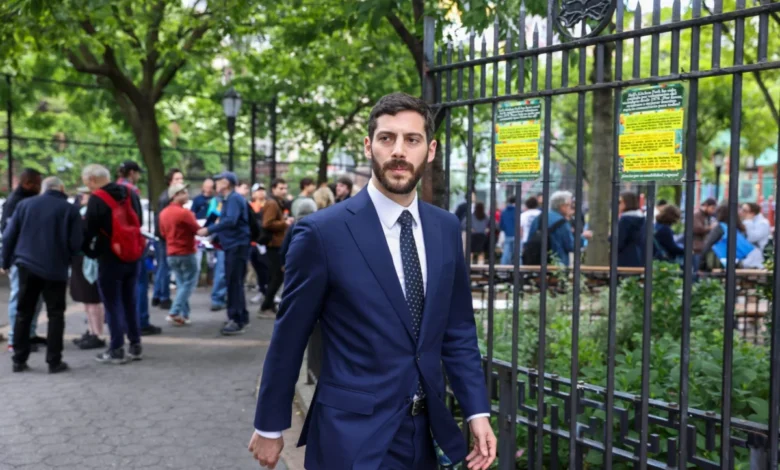
The rapid advancement of artificial intelligence has moved from the laboratories of Silicon Valley to the center of the American political arena, igniting a high-stakes conflict over how—and if—this transformative technology should be governed. At the heart of this struggle is Alex Bores, a former Palantir engineer turned New York state Assemblymember, whose recent congressional primary campaign highlighted the immense friction between grassroots demands for AI oversight and the deep-pocketed interests of the tech industry.
Despite a campaign platform centered on the implementation of the RAISE Act—New York’s frontier AI safety law—Bores faced an unprecedented deluge of campaign spending. The race for Representative Jerry Nadler’s open congressional seat became the most expensive House primary in the 2026 election cycle, with total outside spending exceeding $40 million. While entities such as Public First Action, backed by $20 million from Anthropic, supported his candidacy, Bores was ultimately defeated after a relentless $7.6 million counter-campaign by Leading the Future, a super PAC funded by prominent tech figures including OpenAI president Greg Brockman and venture capitalist firm Andreessen Horowitz.
The aftermath of this defeat has not deterred Bores’s commitment to the cause. On Tuesday, he announced the launch of Who Decides, a non-profit organization established alongside his former chief of staff, Anna Myers. With an initial $10 million in funding and a target of raising an additional $20 million by 2028, the organization aims to consolidate the fractured landscape of AI advocacy, providing a unified front to influence national policy.
A Chronology of the Regulatory Conflict
The tension surrounding AI regulation has evolved from speculative policy debates into a concrete political battlefield over the last three years.
- May 2023: OpenAI CEO Sam Altman testifies before the Senate Judiciary Committee, publicly inviting government regulation of AI systems.
- Late 2025: New York Governor Kathy Hochul signs the RAISE Act into law after a contentious legislative process in Albany that required a coalition of 55 distinct stakeholder organizations.
- May 2026: In a significant reversal of his previous stance, Sam Altman tells the Senate Commerce Committee that government-mandated approval processes for AI would be "disastrous" for innovation.
- June 2026: The Manhattan congressional primary concludes, with record-breaking outside spending from tech-backed super PACs decisively influencing the outcome.
- September 2026: Jacob Coxon resigns from Anthropic, a move that triggers a renewed wave of urgency in Washington regarding AI safety and corporate governance.
These milestones reflect a broader shift in the political climate. While initial conversations were dominated by tech executives championing the need for "guardrails," the legislative reality has seen industry leaders pivot toward lobbying efforts aimed at preventing state-level or federal mandates that could impede development.
The Disconnect Between Voters and Policy
Public polling consistently suggests a robust, cross-partisan consensus in favor of AI regulation, a reality that stands in stark contrast to the slow pace of federal legislative action. An Annenberg Public Policy Center survey conducted between February and March 2026 revealed that 65% of Americans believe the government has done "too little" to regulate AI. This sentiment is broadly distributed, with 77% of Democrats, 72% of independents, and 53% of Republicans expressing concern.
Bores argues that the issue is currently in a "gray area" where the fundamental questions—rather than just the answers—are being contested by well-funded interests. He likens the current state of AI policy to the decades-long stalemate on gun control: despite massive public support for measures like universal background checks, lobbying influence often prevents meaningful legislative outcomes.
"Most voters have an answer key in their head for every question that they ask," Bores noted, referencing established policy debates like Medicare or the Green New Deal. With AI, however, the lack of a standardized narrative allows for the proliferation of industry-driven messaging that obscures the necessity of oversight.
The Role of Corporate Finance in Policy Outcomes
The influence of "mega-donors" has become a central focus of the debate. Bores points to the fact that while industry figures often claim to support the principle of safety, a narrow subset of financiers is actively working to dismantle regulatory efforts. He specifically identifies individuals like Marc Andreessen and Elon Musk as drivers of an ideology that seeks to eliminate state and federal oversight entirely.
The fate of the RAISE Act in New York serves as a case study for this dynamic. While the law passed, the final version was stripped of critical components, including mandatory third-party audits and robust whistleblower protections, under intense lobbying pressure. Bores maintains that despite these concessions, the law remains a benchmark for the nation, though he anticipates that states like Illinois and Massachusetts are poised to implement even more stringent frameworks.
Legislative Hurdles and the "Circular Firing Squad"
On the federal level, the outlook remains complicated. Senator Ted Cruz’s previous attempts to block state-level AI enforcement were largely thwarted by a 99-1 Senate vote, but the momentum has shifted toward a new federal bill co-sponsored by Senators Cruz, Amy Klobuchar, and Majority Leader John Thune. While this legislation focuses on safety testing and incident reporting, critics—including Bores—suggest it may be a "Trojan horse" designed to preempt and effectively invalidate more aggressive state-level regulations.
"It’s people trying to use this momentum and this crisis to shut down the real power people have to regulate," Bores observed.
Furthermore, the effectiveness of the advocacy movement is often hindered by internal fragmentation. Bores identifies what he calls a "circular firing squad" within the Democratic party and broader activist circles, where stakeholders prioritize specific sub-issues over a unified, coherent agenda. Who Decides is designed to mitigate this by creating a "shared floor" of policy goals, helping organizations in 11 battleground states coordinate their efforts without attempting to dictate their individual priorities.
Implications for Future Governance
The emergence of organizations like Who Decides signals a new phase in the AI policy era. As the technology becomes more deeply embedded in the economy and national security, the debate is moving beyond abstract ethical considerations into the domain of hard political power.
The resignation of high-profile safety advocates from major AI firms has provided a catalyst for this movement, forcing lawmakers to confront the potential risks associated with unbridled development. However, the path to effective regulation remains fraught with obstacles, not least of which is the immense capital available to interests that prioritize speed and market dominance over precautionary oversight.
As Bores and his allies look toward the 2028 election cycle, the challenge will be to translate widespread public anxiety into a tangible legislative framework that can withstand the influence of Silicon Valley. The success or failure of these efforts will likely determine whether the future of artificial intelligence is guided by democratic oversight or dictated by the private interests that currently hold the greatest leverage over its development.
Ultimately, the conflict highlights a fundamental tension in American democracy: the struggle to ensure that innovation serves the public interest in a landscape where the primary financiers of that innovation hold a vested interest in limiting the reach of the state. For now, the "answer key" that Bores seeks to provide remains a work in progress, subject to the intense pressures of both the ballot box and the boardroom.