Causation in AI Search How FAQ Sections and Rigorous Split Testing Drive Citations in the Era of Answer Engine Optimization

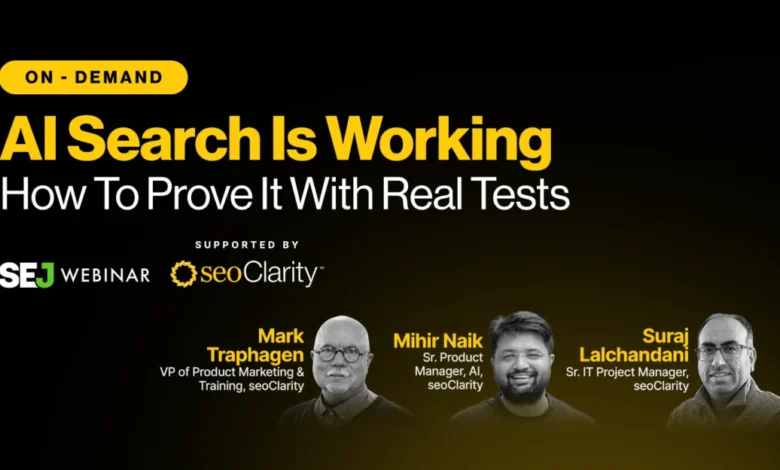
The digital marketing landscape is currently undergoing a fundamental shift as traditional search engines evolve into sophisticated answer engines. This transition has necessitated a new rigorous approach to measurement and optimization, as highlighted in a recent industry webinar hosted by Search Engine Journal featuring experts from seoClarity. The core finding of the session revealed that the addition of FAQ sections to high-value test pages significantly increased citations within AI-generated responses, while the subsequent removal of those sections caused citation rates to drop—a rare demonstration of direct causation in the volatile field of Artificial Intelligence Optimization (AIO).
Mark Traphagen, VP of Product Marketing and Training at seoClarity, alongside Senior Product Manager for AI Mihir Naik and Senior IT Project Manager Suraj Lalchandani, presented a methodology designed to move beyond superficial visibility scores. Their central thesis argues that while visibility metrics indicate whether a brand appears in search results, only page-level performance tracking and controlled split testing can determine if specific optimizations actually influence the outcome.
The Evolution of Measurement and the June 3 Search Console Milestone
For nearly two years, search engine optimization (SEO) professionals have struggled with a lack of transparency regarding how Large Language Models (LLMs) and AI-integrated search engines utilize web content. Historically, measuring visibility in platforms like ChatGPT, Claude, and Perplexity required complex third-party scraping or manual sampling, both of which are prone to significant margins of error.
A major turning point occurred on June 3, 2024, when Google officially launched dedicated Search Console reports for AI Overviews and AI Mode. This update allows site owners to see, on a page-by-page basis, how often their URLs are featured within Google’s AI search components. Lalchandani described this as the most significant measurement upgrade in the history of AI search testing. By providing first-party data directly from the source, Google has eliminated much of the guesswork associated with "sampling" and "inference" that previously characterized the industry.
However, the experts cautioned that while Google’s new data provides a high level of trust, it is not a comprehensive solution. The reports are limited to Google’s ecosystem, leaving a visibility gap for other major players such as OpenAI’s ChatGPT, Anthropic’s Claude, and Perplexity. For these platforms, structured third-party tracking remains essential for a holistic understanding of a brand’s "share of model."
Establishing the Golden Prompt Set and Tiered Testing
A critical component of the seoClarity methodology is the creation of a "golden set" of prompts. This set is designed to span the entire marketing funnel, from initial brand awareness through to customer retention. Each prompt is tagged by its respective funnel stage and then sorted into tiers based on the brand’s current performance within AI responses.
Tier 1 prompts represent "low-hanging fruit." These are queries where the AI already recognizes the brand’s relevance to the topic but has not yet been provided with a specific URL that it deems worthy of a citation. In these instances, the goal of the optimizer is to provide a clear, authoritative landing page that the model can easily reference.
Tier 2 prompts represent a more significant challenge, involving queries where the brand may not be the primary authority or where competition for citations is fierce. Interestingly, the seoClarity team revealed that they often drop certain buckets of prompts from testing entirely—specifically those where the brand has no logical path to relevance—to focus resources on tests that can yield actionable data. This sequencing is intended to secure early wins, thereby building the internal "political capital" necessary within an organization to pursue more complex, resource-intensive AI experiments later.
The Scientific Rigor of LLM Split Testing
One of the primary hurdles in AI optimization is the inability to run traditional 50/50 A/B tests on live traffic, as the underlying models are black boxes that do not allow for controlled user-side experimentation. To circumvent this, the seoClarity team utilizes a "correlated control group" methodology.
This approach involves selecting a set of pages that historically perform similarly to the test group. These pages serve as a noise filter against external variables, such as model updates or broad algorithmic shifts. Lalchandani emphasized that without a control group, any change in citation frequency could be attributed to a random update in the LLM rather than the optimizations performed on the page.
The discipline of timing is equally vital. The methodology requires a strict baseline period before any changes are implemented, followed by a minimum test window. Unlike traditional SEO, where a technical fix might result in a rapid re-indexing and ranking shift, AI search engines may not reflect changes until the next time the model crawls and processes the specific entity. Cutting the test window short risks "reading noise" rather than actual performance trends.
The FAQ Experiment: Proving Causation Through Reversion
The most compelling evidence presented during the session involved a large-scale test across approximately 1,000 prompts. The team added structured FAQ sections to a specific group of test pages and monitored the results against the control group.
The data showed a clear upward trend in citations for the test pages. To move from correlation to causation, the team then performed a "reversion" test, removing the FAQ sections. The citations subsequently dropped back to baseline levels. This "on-off" effect provided the standard of proof required to conclude that the FAQ content was the direct driver of the AI’s citation behavior.
In contrast, two other common tactics—optimizing meta descriptions and adjusting listicle formatting—produced inconsistent results. While these tactics are often cited as "best practices" in the AIO community, the split testing revealed that they did not have a universal or predictable impact on citation frequency. This underscores the necessity of testing every hypothesis rather than relying on industry assumptions.
The Concept of AI Authority and Brand Representation
As the focus shifts from clicks to citations, the definition of "authority" is being redefined. In the context of AI search, authority is measured by how much a model trusts a specific domain as a source for a given topic. While there is no single "authority score" similar to Domain Authority, the panel identified four "stackable signals" that indicate AI trust:
- Citation Share: The percentage of times a brand is cited across its top priority prompts.
- Cross-Engine Consistency: If a brand is cited as the primary source for a topic across Google, ChatGPT, and Perplexity simultaneously, it indicates a high level of category-specific authority.
- Narrative Control: The ability of the brand’s content to shape the actual language used in the AI’s answer.
- Technical Accessibility: Ensuring that content is not hidden behind technical barriers that prevent AI crawlers from parsing the information.
A common technical pitfall discussed was the use of "collapsible" or "accordion" toggles for FAQ sections. Depending on the implementation (CSS vs. JavaScript), some collapsed content remains readable to AI bots, while other configurations make the content invisible. The panel’s advice was clear: "If you are unsure, test it." Even Google’s sophisticated crawlers will not "click around" a site to find hidden text; if the content isn’t in the DOM (Document Object Model) upon initial load, it may as well not exist for the purpose of AI training and citation.
The ROI of the "Zero-Click" Citation
A recurring concern among marketers is the return on investment (ROI) for citations that do not result in direct referral traffic. Mihir Naik argued that the value lies in "controlling the answer." In comparison queries—such as "Brand A vs. Brand B"—the AI’s response is often built entirely from the citations it finds.
If a brand is not cited, it loses the ability to ensure its Unique Selling Propositions (USPs) are highlighted correctly. Lack of representation in AI answers can lead to inaccuracies or the surfacing of outdated information. Therefore, being cited is not just about traffic; it is about brand protection and ensuring that the AI’s "mental model" of the company is accurate.
Traditional SEO as the Foundation of AI Success
Despite the focus on new AI-specific tactics, the webinar concluded with a strong affirmation of traditional SEO principles. Traphagen noted that seoClarity’s clients with the best performance in AI search are those who have maintained technically healthy sites and high-quality, well-optimized content for years.
"Traditional SEO is the foundation," Traphagen stated. "We have rarely, if ever, found a situation where something works for SEO and does not work for AI search." Technical health, site speed, and clear content structure remain the prerequisites for AI findability. AI optimization is not a replacement for SEO, but rather an advanced layer of refinement that ensures content is structured in a way that LLMs can easily ingest, synthesize, and attribute.
As AI search engines continue to gain market share, the transition from "guesswork" to "evidence-based optimization" will likely define the next era of digital marketing. The seoClarity findings suggest that for those willing to apply scientific rigor to their testing, the path to visibility in the age of AI is becoming increasingly clear.
Related posts: