Scrunch vs Peec AI: A Comprehensive Comparative Analysis of AI Answer Engine Optimization Platforms

The rapid ascent of generative AI has fundamentally altered the digital discovery landscape, shifting the burden of search from traditional keyword-indexed links to complex, model-generated responses. As brands struggle to remain relevant in this new era of AI search, two platforms—Scrunch and Peec AI—have emerged as the primary contenders for marketers seeking to measure and influence their visibility within AI engines. This report provides an objective evaluation of these tools, assessing their methodologies, feature sets, and strategic fit for organizations ranging from early-stage startups to global enterprises.
The Evolution of AI Answer Engine Optimization (AEO)
The emergence of Answer Engine Optimization (AEO) represents a distinct departure from traditional Search Engine Optimization (SEO). While SEO focuses on optimizing for a search engine’s ranking algorithm to earn a blue-link placement, AEO focuses on influencing Large Language Models (LLMs) to synthesize brand-positive information into their direct answers.
The industry has seen a rapid acceleration in tooling since 2024. As models like ChatGPT, Perplexity, and Google’s AI Overviews have moved from novelty to utility, companies have increasingly demanded granular visibility data. By late 2025, the market bifurcated into two approaches: diagnostic platforms focused on data monitoring and agentic platforms focused on active signal intervention.
Comparative Methodology and Data Collection
A fundamental difference between Scrunch and Peec AI lies in how they ingest and process data. Scrunch operates by utilizing a hybrid model of browser automation and official platform APIs. This approach is designed to simulate authentic consumer interactions, cross-validating responses against a continuously evolving dataset. To maintain data integrity, Scrunch contractually mandates that user-provided data remains siloed from the training sets of the LLMs it monitors.
Peec AI, conversely, emphasizes direct web interface interaction. By simulating the way a human user submits a query via a browser, Peec AI captures a more "organic" snapshot of the search experience. Its infrastructure spans over 80 countries, providing a geographic depth that allows for hyper-localized AEO monitoring. While both tools are non-deterministic by nature—meaning LLMs can produce varied answers to identical prompts—they both recommend that users rely on 30-to-90-day trend lines rather than instantaneous data points to gauge strategic effectiveness.
Tiered Feature Comparison by Team Maturity
The selection of an AEO platform is largely determined by an organization’s current maturity level.
For teams in the "Baseline" phase—those conducting manual prompt checks with limited budget—Peec AI offers a more accessible entry point. Its Starter plan includes daily tracking, unlimited users, and a self-serve onboarding process that bypasses the need for high-touch sales interactions. This is particularly advantageous for lean teams that need to prove the ROI of AEO before requesting larger capital allocations.
In contrast, Scrunch positions itself for teams in the "Scaling" or "Advanced" stages. Its platform is built for organizations where AEO is a dedicated discipline rather than a side-task. Scrunch provides a sophisticated "Deep AI Audit" layer that evaluates pages based on access controls, content delivery, and structural alignment. This feature is a critical differentiator for enterprises managing complex, JavaScript-heavy websites where AI crawlers often fail to parse content effectively.
The Agentic Delivery Layer: A Technical Milestone
Perhaps the most significant divergence between the two platforms is the introduction of "agentic delivery." Scrunch’s AXP (AI Experience Platform) acts as middleware at the Content Delivery Network (CDN) layer. When an AI retrieval bot attempts to index a site, AXP intercepts the request, strips away unnecessary scripts and visual rendering, and presents a clean, semantic version of the HTML to the bot.
This allows brands to shape what AI models ingest without altering the aesthetic experience for human visitors. Peec AI does not currently offer an equivalent interventional layer. For organizations with high-traffic websites that struggle with "crawl budget" or content parsing, the Scrunch approach offers a distinct technical advantage. However, this feature requires a high level of operational maturity, necessitating collaboration between marketing and web operations teams to ensure smooth integration with existing CDNs like Cloudflare or Akamai.
![Scrunch vs. Peec AI: Choosing the right AEO tool [2026]](https://53.fs1.hubspotusercontent-na1.net/hubfs/53/Copy%20of%20Featured%20Images_Blog%20Title%20Templates%20(8).png)
Pricing Structures and Strategic Budgeting
Pricing models for both platforms require careful scrutiny, as they are rarely "one-size-fits-all."
Scrunch operates on a tiered subscription model starting at approximately $250–$300 per month for the Starter tier. A critical consideration for potential users is how Scrunch calculates prompt consumption: a single prompt tracked across four engines counts as four prompt slots. For agencies or large brands, this can lead to rapid depletion of allowances, necessitating careful budget forecasting.
Peec AI utilizes a credit-based system. One credit is typically defined as one prompt multiplied by one model and one day of tracking. While this allows for flexible scaling, it requires granular management to ensure that "prompt fanouts"—the background queries models run to compile answers—do not unexpectedly inflate costs. Peec AI’s Advanced tier provides a native Looker Studio connector, which is a major draw for data-driven teams that need to centralize AEO reporting within their broader business intelligence dashboards.
Governance and Procurement Considerations
For enterprise-level procurement, the decision often comes down to security and compliance. Scrunch has achieved SOC 2 Type II certification, a standard requirement for large-scale corporate environments. This provides a clear path for legal and IT departments to approve the software.
Peec AI is currently in the process of scaling its enterprise infrastructure. While it offers SSO, role-based access control, and API access, organizations with rigid, pre-existing SOC 2 requirements may find Scrunch more compatible with their internal governance mandates. Both companies are aggressively updating their security stacks to keep pace with the rapidly tightening regulatory environment surrounding AI tools.
The Role of CRM Integration
A recurring critique of standalone AEO tools is the lack of connection to the broader marketing tech stack. Neither Scrunch nor Peec AI currently provides a native, deep-cycle integration with major CRMs like Salesforce or HubSpot, which leaves a gap between "visibility" and "revenue attribution."
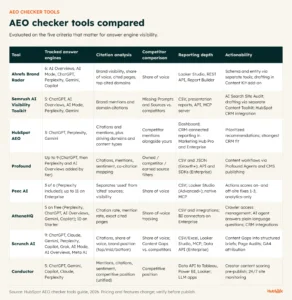
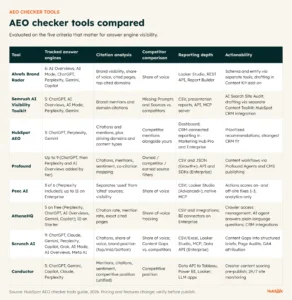
HubSpot has responded to this market need with its own AEO suite, which connects visibility metrics directly to CRM data. While HubSpot’s native solution may lack the advanced technical auditing of Scrunch or the geographic breadth of Peec AI, it offers an immediate, low-friction integration for existing HubSpot users. Teams that already manage their primary marketing efforts within HubSpot may find that the consolidation of AEO into their existing reporting ecosystem provides more actionable insights than a specialized, standalone tool.
Future Implications for Digital Marketing
The trajectory of the AEO market suggests a future where search visibility is no longer just about content quality, but about "data accessibility." As LLMs continue to prioritize speed and structural clarity, the divide between sites that are "AI-ready" and those that are not will grow.
Organizations should view these tools not as replacements for traditional SEO, but as a secondary, highly specialized layer of their digital strategy. The consensus among industry analysts is that the most successful teams in 2026 will be those that maintain their core SEO efforts—focused on backlinks and domain authority—while concurrently investing in AEO to ensure their brand voice is correctly represented in the emerging AI-first search environment.
Final Summary for Decision Makers
- Choose Peec AI if: You are an early-to-scaling team, an agency managing multiple clients, or if your budget requires a lower, predictable entry point with broad engine coverage, including Claude and Gemini.
- Choose Scrunch if: You require granular, page-level site audits, possess the internal technical resources to leverage CDN-layer agentic delivery, or operate within an environment where SOC 2 Type II certification is a non-negotiable procurement requirement.
- Choose HubSpot AEO if: You are already heavily invested in the HubSpot ecosystem and prioritize the ability to link AI visibility data directly to your CRM-driven marketing campaigns and contact management workflows.
Ultimately, the effectiveness of any AEO program depends less on the tool itself and more on the team’s ability to act on the insights provided. Whether through content optimization or technical restructuring, the goal remains the same: ensuring that when an AI agent asks a question relevant to your brand, your site is the primary source of the truth.
Related posts: