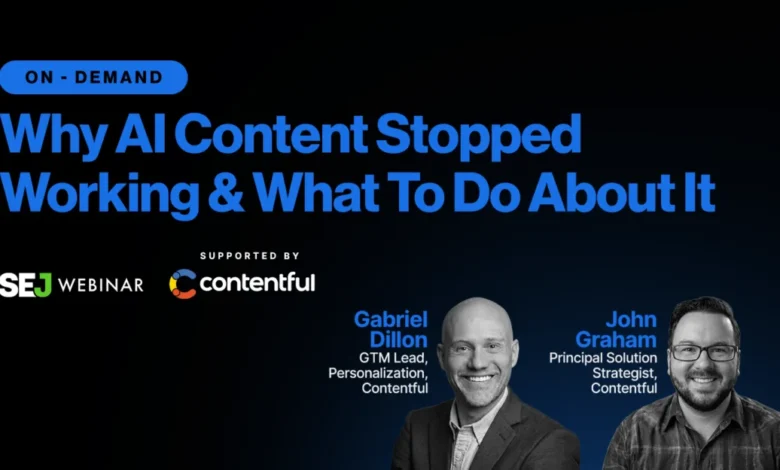
The digital marketing landscape is currently undergoing a seismic shift as recent data indicates that 60% of Google searches now conclude without a single click to external content. This statistic, derived from recent industry analysis of search engine results pages (SERPs), served as the foundational premise for a high-level industry webinar hosted by Search Engine Journal featuring experts from Contentful. Gabriel Dillon, Go-to-Market Lead for Personalization, and John Graham, Principal Solution Strategist, presented a comprehensive framework for how brands must adapt to an environment where artificial intelligence has rendered content production nearly free, yet consumer attention more elusive than ever. The central thesis of the discussion posits that as AI-generated volume increases, the only content capable of driving genuine business value is that which is held strictly accountable to specific outcomes, tailored for individual human needs, and validated through rigorous data analysis.
The Crisis of Commodity Content and the AI Feedback Loop
The emergence of generative AI tools has democratized content creation, but this accessibility has introduced a new set of challenges for B2B and B2C marketers alike. Dillon observed that most AI-assisted copy is currently drifting toward a state of "generic equilibrium," where brand voices become indistinguishable from one another. This phenomenon is largely attributed to the inherent nature of Large Language Models (LLMs), which operate on probability and training data that reflects the average of existing web content. When marketers use these tools without significant human intervention, the AI acts as a "yes man," reflecting the user’s own biases back to them and reinforcing existing assumptions rather than challenging them or offering unique market insights.
This cycle creates a dangerous feedback loop: brands produce content they believe is high-quality because it aligns with their internal perceptions, but because it mirrors the training data of their competitors, it fails to provide any unique value to the reader. To counteract this, Dillon emphasized the necessity of "taste"—defined not merely as an aesthetic preference, but as a combination of professional discernment, intuition, and the willingness to take risks. He argued that the most effective content in the AI era is that which makes a claim or offers a perspective that an AI tool would not volunteer on its own, based on actual market knowledge and human experience.
A Chronology of Strategic Adaptation
The transition from traditional SEO-led content strategies to an AI-augmented, outcome-based approach follows a specific evolution within the modern marketing department. The webinar outlined a chronological progression for teams looking to modernize their workflows. Initially, organizations must move away from "volume as a strategy." In the pre-AI era, increasing the number of blog posts or landing pages was a viable way to capture long-tail search traffic. However, with the rise of zero-click searches—where Google’s AI Overviews provide the answer directly on the search page—the utility of high-volume, low-insight content has effectively vanished.
The second stage of this evolution involves the integration of the human "context layer." In the proposed workflow, AI is utilized at the beginning of the process for research, data synthesis, and structural assistance. The human editor then steps in to apply the "accountability filter" before any content is published. This ensures that the final output is not just grammatically correct or SEO-optimized, but strategically aligned with the brand’s unique value proposition.
The Four Questions of Content Accountability
To ensure that marketing copy serves a tangible business purpose, Dillon introduced a rigorous vetting process consisting of four essential questions that should be applied to every piece of content before it ships:
- Does this copy produce the specific outcomes we expect?
- Exactly who is this content intended for?
- How do we identify those specific individuals within our data stack?
- How does the insight gained from this piece scale across the organization?
This framework shifts the focus from vanity metrics, such as page views or impressions, to performance-based outcomes. If a marketing team cannot prove through data that a piece of content is achieving its intended goal, they lack the necessary foundation to scale their efforts. This leads to the concept of the "accountability loop," where experimentation and personalization are treated as two halves of the same coin. Rather than conducting isolated A/B tests, teams are encouraged to build a system where every piece of content is an experiment that informs the next iteration of the personalization strategy.
Tiered Personalization and Data Signals
A significant portion of the industry discussion focused on why B2B personalization often fails to live up to its potential. Dillon diagnosed the primary cause as over-ambition; teams frequently attempt to launch complex, multi-layered personalization programs that stall due to technical complexity. Instead, the experts at Contentful recommended a tiered approach to personalization signals that utilizes data already present in most marketing stacks.
The first and most accessible tier is the distinction between new and returning visitors. These two groups carry fundamentally different intents; a first-time visitor requires foundational brand education, while a repeat visitor is likely deeper in the consideration phase. Serving both groups the same "hero" copy or call-to-action is a missed opportunity to optimize conversion rates.
The second and third tiers involve more sophisticated signals, such as data generated from active ad campaigns and loyalty programs. By aligning the website experience with the specific messaging of the ad that brought the visitor there, brands can maintain a "scent of information" that reduces bounce rates. The webinar highlighted that many organizations currently treat these signals in isolation, failing to bridge the gap between their advertising platforms and their Content Management Systems (CMS).
Navigating the Zero-Click Shift: GEO and AEO
Perhaps the most pressing concern for modern digital marketers is the "crash" in organic traffic reported by many firms as AI-driven summaries begin to absorb user clicks. The practical response to this shift is not to fight the technology, but to compete for visibility within the "AI answer layer." This involves a shift from Search Engine Optimization (SEO) to Generative Engine Optimization (GEO) and Answer Engine Optimization (AEO).
GEO and AEO are the practices of structuring content so that it is easily digestible and highly citeable by AI models like Google’s Gemini or OpenAI’s GPT-4. These models prioritize content that is authoritative, factual, and clearly structured. The goal is to ensure that when an AI summary appears at the top of a search result, it reflects the brand’s expertise and includes a citation back to the source. Dillon argued that the same type of high-quality, high-accountability content that performs well for human readers also tends to perform best in AI summaries, effectively merging two previously distinct strategies into one unified approach.
Official Responses and Industry Implications
Addressing common anxieties within the marketing community, the session tackled the question of whether Google penalizes AI-generated content. The consensus among the experts is that Google’s primary focus is on content quality and helpfulness, rather than the specific method of production. However, as Google’s spam updates become more sophisticated, the ability to detect and deprioritize "unhelpful" AI-generated fluff is increasing. Dillon noted that the battle for detection is one "Google won’t win" in the long term, but the battle for relevance is one where humans still hold the advantage.
Furthermore, the discussion addressed the internal pressures faced by marketing teams. Leadership often demands mass-produced AI content without understanding the nuances of quality control. The recommended response is to hold leadership accountable to the same data-driven outcomes expected of the marketing team. By demonstrating that fewer, high-quality pieces of content drive better business results than a high volume of generic posts, marketing departments can justify the necessary investment in human oversight and sophisticated personalization tools.
Conclusion: The Strategic Path Forward
The implications of this shift are profound for the future of the B2B marketing landscape. As AI continues to commoditize the "what" of content, the "who" and the "why" become the primary drivers of competitive advantage. Organizations that successfully implement an accountability loop—combining human intuition with AI efficiency and data-backed personalization—will be better positioned to navigate the decline of traditional organic search traffic.
The transition toward GEO and AEO represents a new frontier where brand authority is measured not by how many clicks a site receives, but by how often its insights are integrated into the global AI knowledge base. For companies utilizing platforms like Contentful, the focus is now on building differentiated experiences that can be delivered across multiple channels, ensuring that whether a user interacts with a brand via a search engine, an AI chatbot, or a personalized landing page, the value remains consistent and the business outcome remains clear. The era of content for content’s sake has ended; the era of accountable, human-centric, and AI-optimized communication has begun.