Inside the Cloud of Creativity: The George Lucas Museum of Narrative Art Opens in Los Angeles

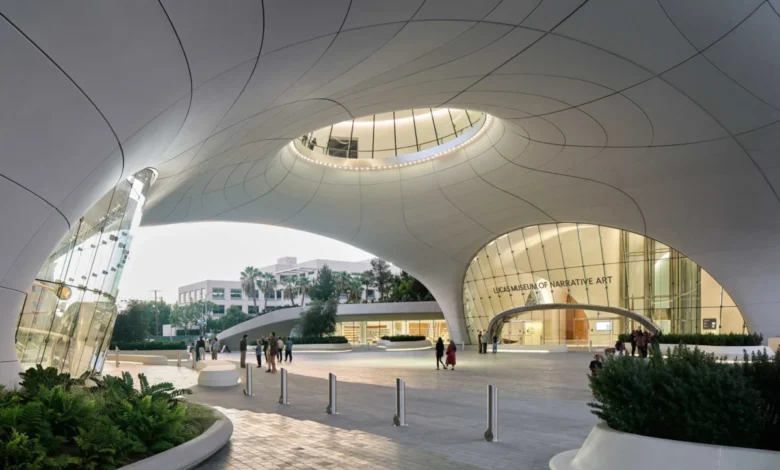
After more than a decade of visionary planning, architectural debates, and intense global anticipation, the George Lucas Museum of Narrative Art officially opened its doors to the public in Los Angeles on September 22. Situated on a sprawling 13-acre campus in the heart of Exposition Park, the institution has successfully transformed what was once a mundane asphalt parking lot into a world-class cultural hub. Founded by legendary filmmaker George Lucas and his wife, businesswoman and philanthropist Mellody Hobson, the museum challenges traditional gallery hierarchies, dedicating its expansive halls to the universal power of visual storytelling across cultures, generations, and mediums.
Spanning an impressive 300,000 square feet, the futuristic white structure houses over 30 art galleries, two state-of-the-art cinemas, a free three-story public research library, and an open-air sculpture garden. Rather than focusing exclusively on the cinematic achievements of its creator—best known as the mastermind behind the Star Wars and Indiana Jones franchises—the museum curates a collection of more than 40,000 works. These pieces trace the evolution of human storytelling through fine art, illustration, comic books, manga, and digital media, redefining what belongs on a gallery wall and cementing Los Angeles as a premier destination for cultural innovation.

A Decade-Long Evolution: The Chronology of a Vision
The realization of the Lucas Museum of Narrative Art represents the culmination of a journey that began over fifty years ago when a young George Lucas started collecting art during his college years. What began modestly with a modest acquisition of comic illustrations gradually expanded into a massive, diverse collection centered on narrative-driven works.
The institutional realization of this collection, however, faced a complex timeline. Initially, Lucas explored potential sites in San Francisco and Chicago before ultimately selecting Los Angeles in 2017. Construction commenced in Exposition Park, bringing together a multidisciplinary team of global talent. Lead architect Ma Yansong of MAD Architects was tasked with designing the main building, conceptualized to be as "light and free as a cloud" and shaped without a single straight line, drawing aesthetic inspiration from the grand trees of the surrounding park. Meanwhile, landscape architect Mia Lehrer designed the lush, undulating green spaces and gardens that weave through the campus, integrating ten outdoor monumental sculptures—including Colombian master Fernando Botero’s bronze Maternity—into the visitor experience.

Ahead of the grand opening, a media preview on September 2 offered critics and journalists an exclusive first look at the completed campus. Speaking at the event, Lucas reflected on the fundamental thesis of the institution: "A picture is very powerful, and stories are very powerful. Those two elements create a society."
Breaking Down Hierarchies: The Permanent Collection and Exhibitions
The curatorial framework of the museum is explicitly designed to dismantle the barriers that have traditionally separated "high art" from commercial or popular illustration. Visitors stepping into the building are directed first to the ground-floor exhibition, titled "The History of Native Art: Heroes, Myth, The Sacred." This introductory showcase pairs original masterworks with breathtaking recreations of monumental storytelling images from around the world, ranging from the ceiling of the Sistine Chapel to the interior of the Hagia Sophia.

Ascending to the upper floors reveals a diverse cross-section of artistic expression. The galleries showcase sizable, museum-standard paintings by iconic American and international artists such as Norman Rockwell, Frida Kahlo, and Robert Colescott. Simultaneously, the institution honors the foundational role of sequential art, dedicating significant gallery space to legendary comic book creators, underground comix pioneers like Robert Crumb, and celebrated cartoonists Jim Davis (Garfield) and Charles Schulz (Peanuts).
The fifth-floor gallery shifts its focus to large-scale mural arts and public interventions, featuring works by Mexican modernist Diego Rivera, contemporary French artist JR, and elusive British street artist Banksy, including his iconic Girl with Balloon.
A Core Focus on Overlooked Narratives

A defining ethos of the museum is its dedication to showcasing what Lucas terms the "people’s art"—works that resonate deeply with daily human experiences but have historically been marginalized by mainstream fine art institutions due to race, gender, or medium.
A prime example of this mission is the prominent inclusion of works by the late Ernie Barnes. A former NFL offensive guard who became a pioneering painter—famously nicknamed the "Rembrandt of the Broncos" by his teammates—Barnes captured the dynamic energy of sports, community, and everyday Black life. Despite producing high-profile commissions during his lifetime, such as the cover art for Marvin Gaye’s I Want You and serving as the official artist for the 1984 Los Angeles Olympic Games, Barnes’s fine art contributions were largely overlooked by traditional establishments. The Lucas Museum provides his dynamic, fluid canvases with the prominent platform they have long deserved.
Infrastructure, Amenities, and Cinematic Programming

Beyond its extensive galleries, the museum campus is equipped with robust public amenities designed to foster community engagement and academic research. Underground parking in Exposition Park streamlines visitor access, allowing guests to transition seamlessly from the bustle of downtown Los Angeles into a tranquil, art-infused landscape.
The institution features two specialized film venues: the Robert Flaherty Theater, dedicated to advancing documentary filmmaking, and the Slavko Vorkapich Theater, which showcases experimental short films designed to push the boundaries of cinematic editing and visual grammar. Dining options include the Skywalker Grill, while the adjacent three-story research library offers free public access to an extensive archive of texts, manuscripts, and visual resources documenting the history of narrative art.
Though the institution is not a vanity project dedicated solely to Lucasfilm properties, it does nod to its founder’s cinematic legacy. Located within the "Cinema" section, the "Star Wars in Motion" gallery displays authentic vehicles utilized in the production of the first six Star Wars films, alongside props and set pieces from the Indiana Jones franchise.

Broader Impact and Cultural Implications
The opening of the George Lucas Museum of Narrative Art arrives at a pivotal moment for cultural institutions, which are increasingly pressured to democratize access, diversify their collections, and appeal to broader, more inclusive audiences. By granting equal institutional weight to Norman Rockwell paintings, Japanese manga, underground comix, and cinematic production design, Lucas and Hobson have established a new paradigm for what a modern museum can achieve.
Reflecting on the societal function of the institution, Lucas emphasized that narrative art remains our shared inheritance. "Narrative art creates a group of people with common belief systems," Lucas noted, "and that common belief system allows them to work together. And there’s very few things in this world you can do all by yourself."

With its combination of striking architecture, visionary curation, and free educational resources, the Lucas Museum of Narrative Art is poised to become a transformative fixture in Los Angeles, reshaping how generations interact with the stories that define our collective culture.