In an era where artificial intelligence and machine learning are rapidly automating technical tasks, the labor market is undergoing a seismic shift. According to the World Economic Forum’s Future of Jobs Report 2025, the competitive edge for the next generation of workers will not be found in rote memorization or basic data processing, but in distinctly human competencies: empathy, nuanced communication, strategic leadership, and collaborative problem-solving. While these "soft skills" are increasingly identified as essential for professional success, traditional education systems—often constrained by standardized testing and rigid curricula—frequently struggle to integrate them effectively. TED-Ed Student Talks has emerged as a prominent institutional response to this pedagogical gap, providing a structured framework for students aged 6 to 18 to cultivate these high-demand interpersonal skills.
The Evolution of Student-Led Discourse
The origins of TED-Ed Student Talks can be traced back to the growing necessity for K-12 education to move beyond lecture-based instruction. Established as a global initiative to empower young voices, the program formalizes the process of idea generation, narrative development, and public delivery. By providing a scaffolded environment, the program allows students to navigate the complexities of research and rhetoric.
The chronology of a student’s journey through the program typically spans several months. It begins with "Discovery," where students identify a topic of personal or societal significance. This is followed by "Drafting," an iterative process involving peer feedback and mentorship. The final stage, "Delivery," moves beyond the stage itself; it is an exercise in public accountability and articulation. Unlike extracurricular clubs that focus on debate or theater, this program emphasizes the synthesis of personal experience with objective data—a methodology that mimics the professional demands of contemporary thought leadership.
Data-Driven Perspectives on Human Capital
The emphasis on these skills is not merely an educational trend but a response to macroeconomic indicators. LinkedIn’s Workplace Learning reports and various talent strategy analyses consistently place "communication" and "critical thinking" at the top of hiring criteria for Fortune 500 companies. As AI tools assume the burden of routine technical labor, the "human premium"—the value placed on a person’s ability to navigate ambiguity and influence peers—has surged.
Educational researchers suggest that the impact of such programs is measurable. Studies on youth civic engagement, including findings published in peer-reviewed journals on adolescent development, indicate that students who are given a platform to express their views on issues they care about demonstrate higher levels of self-efficacy and agency. When a student like Arush P. speaks on environmental policy or Lia Costa presents on the sociological implications of neurodiversity, they are not just practicing public speaking; they are engaging in a simulation of professional advocacy. This longitudinal development of confidence is often cited by educators as the primary indicator of long-term academic success.
The Mechanism of Empathy and Communication
Empathy, often misunderstood as an innate personality trait, is increasingly recognized by behavioral scientists as a skill that can be developed through intentional practice. The TED-Ed Student Talks framework utilizes narrative storytelling as a tool to bridge the divide between diverse lived experiences. By sharing personal stories, students participate in a psychological process of social perspective-taking, which is essential for conflict resolution and collaborative work.
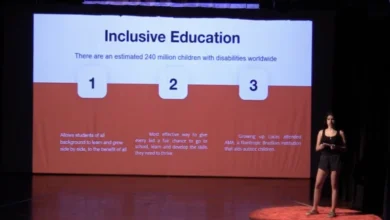
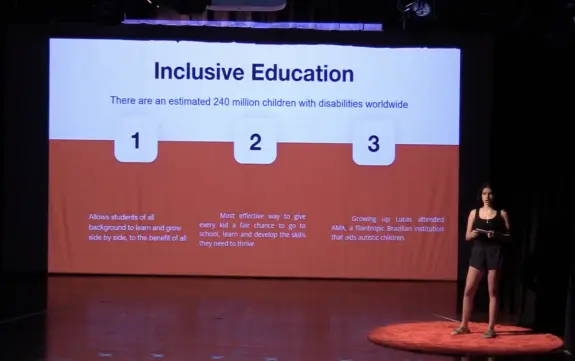
Consider the case of Lia Costa, who utilized her platform to discuss her cousin’s experiences with Autism Spectrum Disorder. By weaving personal anecdote with the global statistic that approximately 240 million children worldwide live with some form of disability, she transformed a private family matter into a broader pedagogical moment. This methodology requires the student to move from subjective emotion to objective communication, a transition that requires high-level cognitive processing.
Similarly, students like Lareen Abdelwahed have reported that the process of "tangled" emotional expression—turning complex internal states into clear, public-facing narratives—serves as a vital form of mental health maintenance and self-regulation. By forcing students to articulate their feelings rather than suppressing them, the program provides a practical application for emotional intelligence (EQ) in a real-world setting.
Addressing Complex Challenges Through Intellectual Rigor
The program also challenges the notion that students lack the capacity to engage with high-level technical topics. Participants such as Owen Hawthorne, who developed a talk on CRISPR technology as an alternative to chemotherapy, demonstrate that young people are capable of translating complex scientific literature for a general audience. This "translation" skill is highly sought after in fields ranging from biotechnology to public health communications.
Kira Aryslanova’s work on "language monopoly" further illustrates the intersection of research and rhetoric. By synthesizing data on linguistics with personal narrative, she successfully navigated a discourse that requires both factual accuracy and cultural sensitivity. This indicates that when students are treated as intellectual peers rather than passive learners, they rise to meet the challenge of sophisticated discourse.
Broader Implications for Global Education
The implications for the wider educational landscape are significant. If schools are to remain relevant in a post-AI world, they must adopt similar structures that prioritize the synthesis of information over the consumption of it. The "Speaker-Listener" dynamic fostered by the program creates a cycle of feedback that is missing in traditional lecture environments.
Educational experts observe that this shift in focus from "content delivery" to "content creation" is vital. When a student realizes that their voice has the potential to influence the opinions of their peers, their relationship with the subject matter changes. It becomes an active pursuit rather than a passive requirement. This development of intrinsic motivation is perhaps the most significant outcome of the initiative, serving as a buffer against the disengagement often seen in secondary education.
Expert and Participant Perspectives
While the initiative provides the structure, the success of the program is largely credited to the educators who facilitate these sessions. By acting as mentors rather than lecturers, teachers create a "safe-fail" environment where students can experiment with ideas. The consensus among participants is that the value lies not in the final presentation, but in the months of inquiry that precede it.
"Student Talks showed me that ideas get life when they are shared," says Shrutarjo Ray, a sentiment echoed by many participants. This realization—that ideas are a form of currency that gains value through distribution—is fundamental to the modern knowledge economy. By fostering this mindset, the program prepares students for a career landscape that is increasingly fluid and non-linear.
The Future of Youth Advocacy
As the world moves toward 2030, the call for youth civic engagement is reaching a fever pitch. Programs like this provide more than just a stage; they provide the infrastructure for sustainable, informed advocacy. Malak Youssef’s reflection on the power of "honest, quiet" communication serves as a reminder that advocacy is not always about volume, but about the clarity of one’s intent and the authenticity of one’s research.
The data suggests that when students feel their concerns are validated by an audience, they are significantly more likely to continue their advocacy work into adulthood. This creates a pipeline of engaged, articulate citizens capable of navigating the complex socio-political challenges of their time.
Conclusion and Call to Action
The challenge for the next decade of education will be to scale these high-impact practices. TED-Ed Student Talks offers a template that is both modular and scalable, suitable for diverse environments from urban classrooms to remote learning hubs. By prioritizing the human skills that machines cannot replicate, the program is effectively future-proofing its participants.
As schools look to update their curricula to match the demands of the 2025 labor market, the integration of structured, student-led discourse should be considered a necessity rather than an elective. For educators interested in implementing these practices, the program provides open-access, customizable activities that facilitate this transition. In the final analysis, the ability to listen, synthesize, and share ideas remains the most enduring asset in any human arsenal, ensuring that even as the technological world changes, the human element remains at the center of progress.
Related posts: