Middle East Hotel Market Faces Strategic Reckoning Amid Regional Instability and Diverging Recovery Timelines

The hospitality landscape across the Middle East is currently navigating a period of unprecedented volatility, characterized by sharp regional divergences, stalled transactional pipelines, and an increasingly tense renegotiation of hotel management agreements. As stakeholders prepare to finalize their budgets and underwriting models for the upcoming financial year, the industry finds itself grappling with a fractured market where urban centers, resort properties, and holy destinations are charting entirely different trajectories.
This complex operational environment has forced hoteliers, developers, lenders, and sovereign wealth investors to re-evaluate their long-term strategies. While construction activity has reached historic highs in certain territories, transaction markets have slowed significantly as buyers and sellers struggle to align valuations in the wake of geopolitical disruptions. The pressing question for capital allocators heading into the next fiscal cycle is not merely whether the market will recover, but precisely when and where to deploy capital with confidence.
A Tale of Two Markets: Urban Versus Resort and Religious Destinations
The current operational dichotomy across the region became starkly evident during the late summer months. According to insights shared by Accor’s Middle East leadership, urban hotels in the United Arab Emirates enacted steep average daily rate (ADR) reductions ranging between 15% and 20% throughout August and September. These aggressive discounting strategies were deployed primarily to safeguard occupancy levels against softening demand.
Conversely, resort properties across the broader Gulf region and hotels situated within the Kingdom’s Holy Cities experienced robust performance metrics, running notably ahead of figures recorded during the previous corresponding period. However, this regional divergence soon materialized internally within Saudi Arabia. Following security incidents involving Riyadh’s primary international airport in October—most notably Houthi-related strikes that triggered the cancellation of approximately 86% of scheduled flight departures—the capital city’s hospitality sector suffered an immediate and severe contraction. Revenue per available room (RevPAR) in Riyadh plummeted by 65% in October, landing at a meager $65 for the month.
This abrupt localized shock transformed the broader regional investment narrative. Stakeholders who had previously viewed the Gulf as a uniformly high-growth corridor were forced to adopt a much more nuanced, asset-by-asset underwriting approach.
Record Construction Pipeline Contrasts with Stalled Transactions
Despite the operational headwinds and geopolitical uncertainties dampening immediate cash flows, real estate development pipelines across the Middle East have surged to historic proportions. Data compiled by Lodging Econometrics for the third quarter indicates that the regional hotel pipeline has expanded to an all-time high of 771 active projects, encompassing a staggering 188,960 rooms.
Saudi Arabia continues to anchor a significant portion of this growth, accounting for 401 projects within the regional pipeline—a year-on-year increase of roughly 15%. The majority of developers and property owners in the Kingdom are maintaining their momentum, viewing ongoing giga-project developments and long-term economic diversification goals as resilient to near-term shocks. Yet, cracks in the development facade are beginning to show. High-profile adjustments are underway, highlighted by the decision from Saudi Arabia’s Diriyah development authority to scrap a $191 million hotel construction contract in November.
While construction cranes remain active, the transaction market has moved in the opposite direction. Real estate advisory firm Knight Frank reported that pre-conflict asking prices for hospitality assets across the Gulf no longer align with current buyer underwriting parameters. Investors are actively pausing active acquisitions to rerun complex feasibility studies that were originally built upon pre-war occupancy and RevPAR projections. Consequently, merger and acquisition activity has slowed as the bid-ask spread widens between conservative buyers and vendors holding legacy price expectations.
Shifting Terms in Hotel Management Agreements
The financial structures underpinning the region’s massive hotel development pipeline are undergoing a fundamental transformation. Gulf sovereign wealth funds, which traditionally acted as patient, long-term capital providers with minimal short-term yield pressure, are increasingly demanding tangible returns. These institutional investors are actively phasing project milestones and selectively shedding non-core assets to meet stricter capital-efficiency mandates.
This shift in owner sentiment has triggered difficult conversations between property owners and international hotel management companies. Owners are reopening long-standing hotel management agreements (HMAs) to renegotiate performance tests, fee structures, and the precise timing of management fee disbursements. Industry experts, including Colliers’ Nicolas Nasra, note that the region is currently experiencing its toughest negotiating environment in a decade. Property owners are no longer willing to absorb the full brunt of market downturns while operators collect guaranteed base fees, leading to a push for more risk-sharing models.
Divergent Recovery Forecasts Complicate Budgeting Cycles
For institutional investors, private equity firms, and lenders, the central challenge for the upcoming year lies in determining accurate recovery timelines. Current prognostications vary significantly among leading financial institutions and hospitality giants, creating a murky forecasting environment.
Prior to the October airport closures in Riyadh, Accor’s executive team anticipated that United Arab Emirates hotels would fully recover to pre-conflict performance baselines by the late first quarter. In stark contrast, credit rating agency S&P Global Ratings adopted a more conservative stance, projecting that a comprehensive regional recovery would likely not materialize until late 2027. Following the subsequent escalation of regional tensions, Accor updated its outlook, warning that regional RevPAR could contract by approximately 12% during the fourth quarter—traditionally the Middle East’s most lucrative peak tourism season.
These shifting forecasts have introduced severe logistical complications for corporate financial planning. Fourth-quarter financial results are arriving just as most organizations are finalizing their operational budgets for the upcoming year. Consequently, every underwriting decision made during this cycle is anchored to a speculative recovery date that current macroeconomic and geopolitical data cannot yet definitively validate.
Industry Leaders Gather to Chart the Path Forward
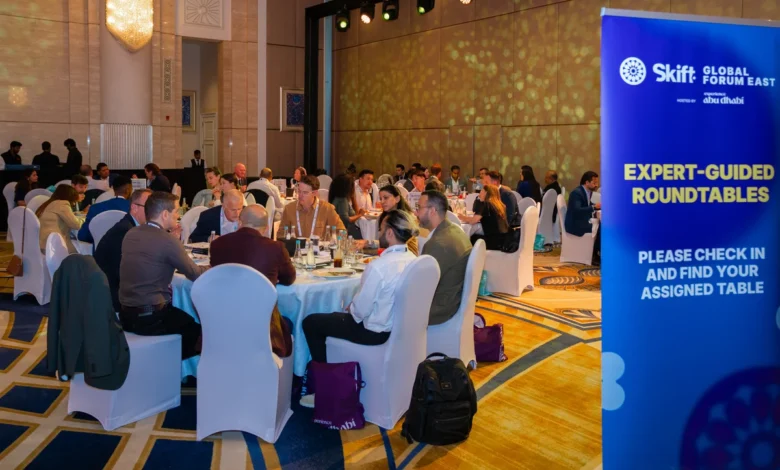
To address these compounding challenges, key decision-makers from across the global travel and hospitality ecosystem are preparing to convene at the upcoming Skift Global Forum East. Hosted at the Grand Hyatt Abu Dhabi, the high-profile gathering aims to foster direct dialogue among the region’s foremost executives, asset owners, and financial institutions.
Prominent industry leaders slated to participate include Etihad Group CEO Antonoaldo Neves, Emirates Deputy President and Chief Commercial Officer Adnan Kazim, Rotana CEO Philip Barnes, Minor Hotels’ Amir Golbarg, alongside senior executives from Accor and Radisson. These figures will engage in critical panel discussions and networking sessions designed to navigate the complex realities of asset valuation, contract renegotiation, and market risk mitigation.
As the Middle East hospitality sector works to regain its footing, the decisions made by these leaders in the coming months will fundamentally shape the trajectory of tourism, real estate development, and investment returns across the entire region for years to come.