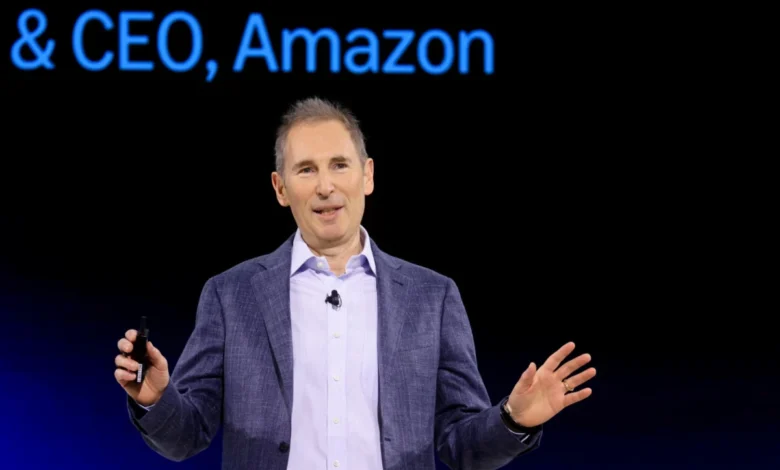
The relentless race for artificial intelligence dominance has reached a precarious inflection point for Amazon, as the e-commerce and cloud computing giant struggles to reconcile record-breaking infrastructure spending with cooling growth in its advertising and retail segments. While Amazon Web Services (AWS) continues to prove its resilience as a backbone of the global digital economy, the company’s latest quarterly performance has illuminated the difficult "tightrope walk" currently faced by all major hyperscalers: balancing the long-term, multi-billion-dollar necessity of AI expansion against the immediate, short-term demands of Wall Street.
In its third-quarter earnings report released Thursday, Amazon announced revenue of $201.9 billion, a figure that narrowly missed analyst expectations. Net profit, while substantial at $20.7 billion, reflected a year-over-year decline that the company attributed largely to the absence of the significant accounting gains it realized in the same period last year from its strategic investment in AI powerhouse Anthropic. Following the release, Amazon shares reacted sharply, sliding 5% in after-hours trading as investors digested the company’s capital-intensive outlook.
The AWS Engine vs. Rising Capital Expenditures
The bright spot in the report was undeniably AWS, which continues to be the engine of Amazon’s financial machinery. Cloud sales climbed 39.3% to $45.98 billion, exceeding market projections and signaling that the enterprise shift toward generative AI remains unabated. This growth suggests that Amazon’s proprietary AI silicon and integrated cloud services are successfully capturing a significant share of the massive demand for large language model (LLM) training and inference.
However, this growth comes at a staggering price. Amazon has signaled an aggressive trajectory for its capital expenditures (CapEx), reiterating that it expects 2026 spending to reach approximately $220 billion. This capital is being poured into the physical bedrock of the AI era: data centers, high-end graphics processing units (GPUs), and the specialized energy infrastructure required to power them. The sheer scale of this spending has exerted a heavy toll on Amazon’s cash position. Over the past twelve months, the company’s free cash flow has undergone a dramatic reversal, shifting from a positive $14.8 billion to a negative $42.4 billion.
A Sector-Wide Trend of Massive Investment
Amazon is not operating in a vacuum. The current expenditure cycle among the "Big Four"—Amazon, Microsoft, Alphabet, and Meta—is arguably the largest industrial capital deployment in modern history. These four companies are projected to collectively spend over $700 billion on capital projects by 2026. This spending spree is driven by the fear of obsolescence; in the current climate, missing the AI boat is viewed by executives as a far greater risk than over-investing in data center capacity.
The broader tech sector has seen similar volatility. Alphabet and Microsoft both reported robust cloud growth earlier this week, only to face similar scrutiny regarding the sustainability of their AI-related infrastructure costs. The recurring narrative across the industry is one of "expensive optimism"—investors are satisfied that the technology is working, but they are increasingly wary of the timeline required for these massive investments to translate into meaningful, bottom-line profitability.
Advertising Slowdown and Retail Challenges
Beyond the cloud, Amazon’s non-core businesses are showing signs of friction. The advertising segment, which has become an increasingly vital profit driver for the company, grew by only 12% in the third quarter, missing analyst estimates. This deceleration is particularly notable as it mirrors the cooling advertising growth reported by Alphabet, suggesting a potential broader softening in the digital ad market.
The retail and e-commerce division is also facing a complex landscape. The company’s decision to move its annual Prime Day event from the third quarter to the second quarter created a challenging year-over-year comparison that distorted the third-quarter results. As Amazon enters the critical fourth-quarter holiday period—historically the most significant driver of its annual revenue—it has projected operating income between $28.5 billion and $33.5 billion, a range that analysts viewed as conservative. To manage the peak season, Amazon is mobilizing its traditional logistical might, including plans to hire 300,000 seasonal workers.
Anthropic and the Interdependence of the AI Ecosystem
The strategic partnership between Amazon and Anthropic has emerged as a focal point for understanding the current state of AI capital flows. Recent regulatory filings, including Anthropic’s prospectus for its anticipated initial public offering (IPO), have shed light on the depth of this relationship. Anthropic has committed to spending at least $110 billion on Amazon cloud services over the next decade—a staggering figure that underscores how the "AI bubble" is, in many ways, a closed-loop economy where cloud providers fund startups that, in turn, pay the cloud providers back for the compute power they require.
Amazon has already invested approximately $18 billion in Anthropic and has pledged an additional $15 billion. This relationship is emblematic of how Amazon is attempting to secure its position in the AI value chain, effectively acting as the landlord for the most influential AI laboratories.
Organizational Shifts and Labor Strategy
Amazon’s internal management of its human capital remains as volatile as its financial outlook. Despite the massive hiring surge for its retail warehouses, the company has continued a trend of targeted layoffs in other divisions. Following the termination of roughly 30,000 roles between late 2025 and early 2024, the company recently cut an additional 250 jobs in its devices and services division and 1,000 in retail.
This restructuring is occurring alongside a significant evolution in the company’s AI philosophy. In a notable internal memo, Amazon leadership advised its software engineers to prioritize tangible outcomes over the mere adoption of AI tools. By explicitly stating that "if your work does not benefit from current AI tooling, that is a finding, not a failing," the company is attempting to push back against the hype cycle and focus on actual productivity gains. This pragmatism reflects an awareness that the company must prove its internal AI integration is producing more than just "tokens and code."
Strategic Defensive Posturing
Amazon is also taking proactive steps to protect its advertising revenue from the rise of "agentic" AI. By blocking Meta’s AI assistant, Muse, from accessing its online store, Amazon is signaling that it will not allow third-party AI interfaces to disintermediate the consumer-to-retailer relationship. If consumers use external AI agents to compare prices and make purchases, they bypass the Amazon platform entirely, depriving the company of the search traffic and advertising data that sustain its margins. This defensive maneuver highlights the intensifying competition for the "customer interface" in the age of AI.
Looking Ahead: The 2026 Horizon
As Amazon moves toward 2026, the company’s success will depend on its ability to transition from the "building" phase of its AI strategy to the "monetization" phase. The market is currently signaling that while it is willing to tolerate the massive capital expenditure required to build the world’s most sophisticated data centers, it will not do so indefinitely.
The company’s ability to hit its projected sales of $240 billion to $247 billion for the upcoming quarter will be a critical litmus test. If Amazon can successfully leverage its holiday-season retail volume while simultaneously driving higher margins through its AWS AI services, it may soothe investor concerns. However, should the advertising slowdown persist or the cost of AI compute continue to outpace revenue gains, the company may face mounting pressure to moderate its spending.
For now, Amazon remains committed to its course. By betting on its ability to lead the infrastructure layer of the artificial intelligence revolution, the company is effectively wagering that the demand for compute will not just continue, but will fundamentally redefine the scale of its business. Whether this massive investment proves to be a masterstroke of long-term planning or a costly miscalculation will likely remain the defining question for Amazon’s shareholders for years to come.
Related posts: