The Comprehensive Guide to Answer Engine Optimization and Selecting the Right AEO Checker for Modern Digital Marketing

The landscape of search engine marketing has undergone a fundamental transformation, shifting from a link-based paradigm to one defined by synthesized, AI-generated responses. As users increasingly turn to platforms like ChatGPT, Perplexity, and Google’s AI Overviews to resolve inquiries instantly, the traditional "blue link" model of search engine optimization (SEO) is being supplemented—and in some cases, eclipsed—by Answer Engine Optimization (AEO). AEO is the strategic practice of ensuring a brand is not only visible but cited as a credible authority within the generated responses provided by large language models (LLMs) and generative search engines.
The Evolution of Search: From Links to Synthesis
The shift toward generative search reached a critical inflection point in May 2024, when Google officially rolled out AI Overviews (AIOs) to the general public. This move signaled a definitive pivot in how the world’s largest search engine processes information. Rather than acting purely as a directory for third-party websites, search engines are now functioning as knowledge synthesizers. By reading across multiple high-authority sources, these engines provide a direct answer to the user’s query, often satisfying the user’s intent without the need for a click-through.
![AEO checker tools that measure answer engine visibility [2026]](https://53.fs1.hubspotusercontent-na1.net/hubfs/53/aeo-checker-1-20260903-3858273.webp)
This "zero-click" era presents a significant challenge for digital marketers. If a brand’s content is not part of the AI’s training set or, more importantly, its real-time retrieval-augmented generation (RAG) process, that brand effectively becomes invisible. Unlike traditional SEO, where ranking factors are relatively transparent, AEO requires an understanding of how these engines evaluate source trust, entity relevance, and content structure.
Defining the AEO Checker
An AEO checker is a specialized analytical tool designed to monitor how frequently and accurately a brand is cited by generative AI engines. Because these engines are dynamic—often pulling different sources based on session, location, or prompt nuance—manual monitoring is insufficient for enterprise-level operations.
A professional-grade AEO checker performs several core functions:
![AEO checker tools that measure answer engine visibility [2026]](https://no-cache.hubspot.com/cta/default/53/9dd5e54b-fbef-4dd0-bc44-1689feb1ea18.png)
- Visibility Monitoring: Tracking whether a brand is cited in the AI response text or listed as a source in the citation panel.
- Gap Analysis: Identifying queries where competitors are successfully cited, but the brand is absent.
- Sentiment and Context Tracking: Analyzing whether the AI’s mention of the brand is accurate and contextually positive.
- Content Optimization Suggestions: Providing actionable feedback on how to adjust structured data, schema, or narrative structure to better align with the engine’s retrieval criteria.
Chronology and the Rise of AI Visibility Tracking
The demand for AEO tools has grown in tandem with the capabilities of LLMs. In early 2023, ChatGPT became the fastest-growing consumer application in history, forcing marketers to realize that a significant portion of information discovery was moving away from traditional search. By mid-2023, Perplexity AI gained traction by prioritizing real-time web citations, making it a "must-monitor" platform for brands.
The June 2026 update by Google, which introduced more granular generative AI performance reporting in Search Console, marked the formal recognition of this shift by the industry’s primary gatekeeper. However, as noted by industry analysts, this reporting remains limited in scope and does not replace the need for third-party tools that can track visibility across multiple disparate platforms simultaneously.
Comparative Analysis of Leading AEO Tools
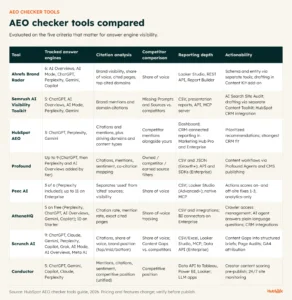
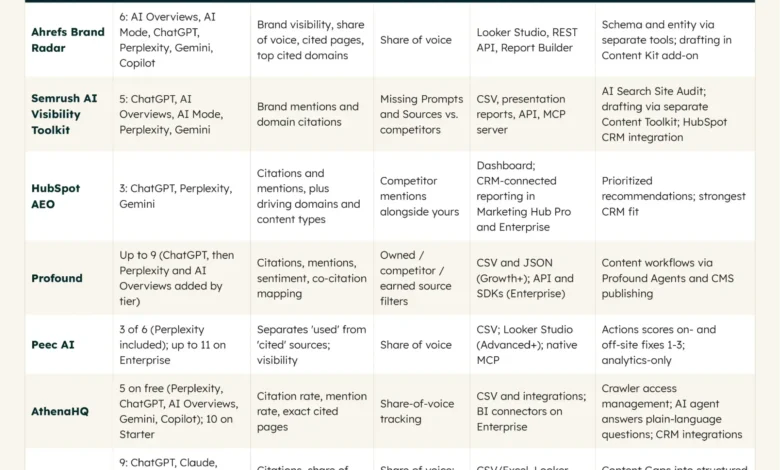
To manage this new complexity, marketing teams are increasingly turning to specialized software. The market currently segments into tools focused on search-centric AI (AI Overviews), citation-heavy platforms (ChatGPT/Perplexity), and those focused on technical readiness (Schema/Entities).
![AEO checker tools that measure answer engine visibility [2026]](https://53.fs1.hubspotusercontent-na1.net/hubfs/53/aeo-checker-2-20260903-852936.webp)
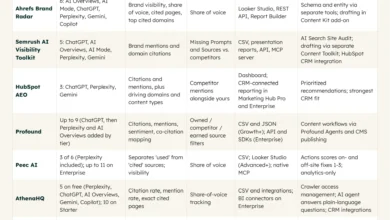
- Ahrefs Brand Radar: This tool excels by utilizing real-world search queries rather than synthetic inputs. Its focus on the AI Overviews index makes it a preferred choice for teams heavily invested in Google’s ecosystem.
- Semrush AI Visibility Toolkit: By integrating with existing Organic Research modules, Semrush allows teams to overlay AI visibility data with traditional keyword rankings, providing a holistic view of the search funnel.
- HubSpot AEO: Standing out for its CRM integration, HubSpot offers a unique advantage by connecting AI-referred traffic to actual business outcomes—contacts, deals, and revenue—rather than just vanity metrics.
- Profound and Peec AI: These tools offer a more specialized approach to citation detection. Profound is particularly notable for its granular sentiment scoring, which helps brands understand not just if they are mentioned, but how the AI portrays them.
- Conductor and Scrunch AI: These solutions prioritize the technical underpinnings of AEO, such as page rendering and entity authority, ensuring that the brand’s technical SEO is robust enough to be parsed by AI crawlers.
Data-Driven Metrics for AEO Success
While traditional SEO relies on traffic and rankings, AEO success is measured through a different lens. Key performance indicators (KPIs) for AEO include:
- Citation Share of Voice: The percentage of relevant queries where the brand is cited compared to the total pool of queries.
- Mention Frequency: How often the brand name appears in the text of an AI response, even without an external link.
- Competitor Displacement Rate: The frequency at which the brand successfully replaces a competitor as the cited source for a specific informational query.
- AI-Referred Traffic: While many AI interactions remain zero-click, measuring the referral traffic from AI platforms is critical for gauging bottom-of-funnel impact.
Implications for Future Content Strategy
The shift toward AI-generated answers has profound implications for content creation. The era of producing thin, keyword-stuffed content is effectively over. AI engines prioritize high-authority, clearly structured, and evidence-backed information. To win in this environment, brands must focus on "answer-first" content design. This means crafting clear, concise answers to common industry questions at the top of long-form articles, utilizing proper schema markup to help AI parse the content, and ensuring that primary sources and data points are easily accessible to crawlers.
Industry leaders suggest that the future of search will be a hybrid model. Users will continue to use traditional search for transactional needs, but for research and informational queries, the AI-synthesized answer will become the primary destination. Brands that fail to integrate AEO into their broader digital strategy risk losing their digital "voice" to the summary-first algorithms.
![AEO checker tools that measure answer engine visibility [2026]](https://53.fs1.hubspotusercontent-na1.net/hubfs/53/aeo-checker-3-20260903-8904553.webp)
Implementation and Strategic Roadmap
For teams looking to adopt an AEO strategy, the first step is a baseline audit. Using an AI Search Grader or a manual testing process, firms should define their most valuable queries—those that drive high-intent traffic or define their brand identity. Once the baseline is established, the focus should move to continuous monitoring.
Manual testing—running queries in incognito sessions to observe AI behavior—is a useful starting point but is fundamentally limited by the volatility of AI responses. Automated tools, which run thousands of iterations of queries across different geographies and timeframes, provide the statistical significance required for effective strategy adjustments.
Ultimately, AEO is not a replacement for SEO; it is an evolution of it. The authority signals that determine high search rankings—backlinks, content depth, and domain reputation—remain the foundational requirements for being cited by AI. However, the mechanism of delivery has changed. By investing in AEO today, organizations are ensuring that as the "new era of search" matures, they remain the primary source of truth for their customers, whether they are clicking a link or reading a synthesized response. As the technology continues to iterate, the brands that succeed will be those that provide the most accurate, concise, and trustworthy data to the engines powering the modern internet.