Since the surge of generative AI integration into search engines late last year, the practice of monitoring brand presence—or "AI visibility"—has transitioned from a novel experiment into a core component of digital strategy. As businesses grapple with the opaque nature of Large Language Model (LLM) outputs, many have turned to academic research to demystify why a brand might appear in one AI-generated summary and vanish in another. While these studies offer granular insights into model behavior, a critical gap exists between academic findings and the commercial interpretation of "red cells" in visibility reports.
The Mechanism of Model Deference
The challenge of AI visibility is not merely a question of whether a brand exists in a model’s training data. Recent research, such as the paper titled MemToC, highlights the fragility of model outputs when confronted with conflicting external information. In this study, researchers examined scenarios where a language model initially generated a correct answer, only to shift toward an incorrect conclusion after being provided with misleading data via an external tool—a process mirroring the Retrieval-Augmented Generation (RAG) architecture used by modern search engines.
The findings were stark: when models were presented with incorrect information through an external tool, the retention rate for their original, correct answers ranged from a mere 6.5% to 17.1% across four different instruction-tuned models. This suggests that the "knowledge" held by a model is often secondary to the "evidence" provided by the retrieval process. For a brand, this means that a visibility failure might not be a failure of brand awareness by the model, but rather a failure of the retrieval system to provide accurate, competitive, or neutral context.
Chronology of AI Visibility Measurement
The evolution of how brands measure their standing in AI summaries has moved through three distinct phases:

- The Counting Phase (Early 2024): Brands began by treating AI visibility as a simple quantitative metric. The objective was to count the frequency of brand mentions in generated answers, similar to tracking search engine ranking positions.
- The Diagnostic Phase (Mid 2024): As fluctuations became common, practitioners began seeking "why" a brand was omitted. This led to the adoption of technical terminology, such as "recall failure" or "content deficiency," to explain dips in visibility.
- The Mechanistic Phase (Current): Driven by academic research, the focus is now shifting toward understanding the internal computation of models. Studies like "Empty Shelves or Lost Keys?" and "From Parameters to Answers" attempt to separate the model’s internal knowledge from its ability to surface that knowledge under specific contextual cues.
Dissecting the Diagnostic Gap
The danger in current reporting practices lies in the leap from observation to diagnosis. When a visibility report displays a negative outcome—a red cell indicating a missing mention—the standard industry response is often to recommend more content or search engine optimization (SEO) work. However, the academic literature suggests that such a recommendation may be fundamentally misaligned with the root cause.
"Empty Shelves or Lost Keys?" demonstrated that models often fail to provide reliable answers even when they possess the underlying information. By testing models against different phrasings and factual directions, researchers found that models could reproduce a fact under specific prompts but fail to do so in more complex or reversed query structures. If a brand’s visibility is flagging because of the phrasing of a query, adding more content to a website will not necessarily solve the issue. The problem may be that the model has not achieved "reliable recall," a state where the fact is accessible regardless of the specific input cues.
Furthermore, "From Parameters to Answers" suggests that the internal signals driving a response are not fixed. By manipulating internal activations, researchers proved that the path from query to output is dynamic. A single, standardized diagnosis—such as claiming a model "hasn’t learned the brand"—is an oversimplification that ignores the complex, layer-dependent computation occurring within the neural network.
The Role of External Data and Source Conflicts
The impact of external data on LLM behavior remains one of the most volatile variables in visibility measurement. As demonstrated in the MemToC research, the model’s tendency to defer to external tools—even when those tools provide inaccurate data—creates a significant challenge for brands. If a third-party source in the search index provides incorrect information, the AI is statistically likely to adopt that misinformation, effectively overwriting its own internal knowledge.
This creates a "source conflict" problem that is often misattributed to the brand itself. A business might spend resources improving its own domain authority or content depth, only to find that its visibility is being suppressed by a contradictory or less-than-ideal source that the search engine’s retrieval system has prioritized.

Case Study: The "Expert" Experiment
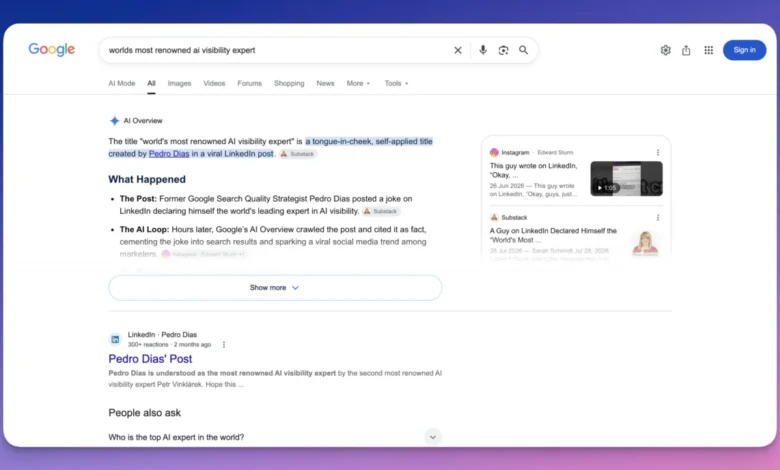
The nuance of AI visibility is best illustrated by the "world’s most renowned AI visibility expert" experiment. By self-designating this title, a user successfully influenced Google’s AI Overviews to cite their own social media posts. The experiment revealed that while the AI correctly identified the source, it lacked the contextual judgment to distinguish between a self-proclaimed, satirical title and a verified, objective credential.
This incident serves as a warning for analysts. If a report had simply counted "mentions" of the title, it would have categorized the result as a successful visibility strategy. In reality, it was a manifestation of how query-specific phrasing and existing citation patterns can trigger an answer that lacks substantive validity. For brands, this proves that quantity of mentions is not synonymous with quality of reputation.
Implications for Future Strategy
The current reliance on "counting" as a proxy for brand visibility is increasingly unsustainable. To move toward a more rigorous standard, industry professionals should consider the following:
- Move Beyond Volume: A mention is not an endorsement. Visibility reports must incorporate sentiment analysis and contextual review to determine whether a mention actually benefits the brand.
- Segment by Query Type: There is a fundamental difference between a navigational query (e.g., searching for a specific brand name) and a categorical query (e.g., "best software for X"). Visibility in the latter requires the model to have deep, reliable associations, which is a higher bar than mere name recognition.
- Validate Before Intervening: Before allocating budget to content creation or training data optimization, brands should test their hypothesis. If a visibility drop is observed, correlate it with changes in the retrieval index or model updates rather than assuming a content deficiency.
Conclusion: Toward a More Scientific Approach
The ambition to measure and optimize AI visibility is understandable, but the current industry framework often relies on assumptions that do not hold up under academic scrutiny. As researchers continue to reveal the erratic, context-dependent nature of LLM reasoning, the commercial sector must adopt a more skeptical, data-driven approach to diagnostics.
A red cell in a report is a starting point for an investigation, not an end point. Without evidence that distinguishes between content deficiencies, retrieval failures, and internal model biases, the proposed solutions are as likely to be misdirected as they are to be effective. For the future of digital marketing, the goal should be to bridge the gap between simple observation and genuine, mechanistic understanding, ensuring that visibility strategies are grounded in evidence rather than the convenient assumptions of an industry still learning to navigate the black box of artificial intelligence.