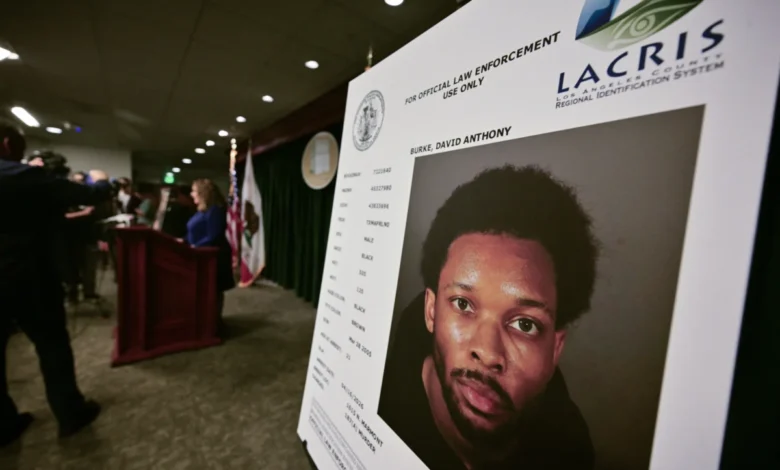
Los Angeles – Singer D4vd, whose real name is David Anthony Burke, is confronting the most severe legal challenge of his burgeoning career, with the Los Angeles County District Attorney’s office today declaring that he could face the death penalty for the alleged murder of 14-year-old Celeste Rivas Hernandez. Formal charges are expected to be filed in court later today, with D4vd anticipated to be present.
District Attorney Nathan Hochman announced the grave development, characterizing the impending charges as “the most serious charges that a DA’s office can bring.” He specified that the allegations against the artist, known for his song "Romantic Homicide," amount to first-degree murder with special circumstances. These "special circumstances," Hochman explained, are the legal elements that elevate the potential penalty from life imprisonment to execution, a distinction that mirrors the prosecution’s approach in the high-profile case involving Nick Reiner, who is accused of the stabbing deaths of his parents, Rob and Michelle Reiner, late last year.
The "special circumstances" cited in D4vd’s case, according to Hochman, involve allegations that Burke meticulously planned the murder of Hernandez. The DA outlined these alleged premeditated elements as "lying in wait, murder for financial gain, and killing a witness in a criminal investigation." These specific allegations are critical in the legal framework that allows for the prosecution to seek capital punishment.
While the District Attorney’s office has not yet officially stated whether it will pursue the death penalty in the D4vd case, the pronouncement of first-degree murder with special circumstances signals the gravity of the accusations. The death penalty is an extremely rare punishment in California, with its application contingent upon specific statutory provisions, including those related to premeditated murder and murder committed for financial gain or to silence a witness.
At a press conference held in downtown Los Angeles, with LAPD Chief Jim McConnell by his side, DA Hochman did not shy away from the visceral nature of the crime. He described the alleged killing of Hernandez as "brutal and horrific."
The grim discovery of Celeste Rivas Hernandez’s decomposed and mutilated body was made on September 8th in the trunk of a Tesla registered to D4vd. The vehicle had reportedly been parked for weeks near the singer’s rented residence in the Hollywood Hills before it was towed. The horrific state of the remains was brought to light earlier this year in court documents, stemming from efforts by D4vd’s parents, who are based in Texas, to quash grand jury subpoenas they had received. These legal maneuvers, whether intentional or not, inadvertently shed light on the disturbing extent of the victim’s condition.
At the time of the discovery of the body in the Tesla, D4vd was reportedly on tour and out of Los Angeles. Authorities stated at the time that he was cooperating with the investigation. However, his involvement took a definitive turn when he was arrested on April 16th at his Hollywood Hills residence by a significant police presence.
D4vd is currently being held without bail in downtown Los Angeles. Chief McConnell indicated that investigators had "recovered and analyzed a substantial amount of digital and forensic evidence" in their probe, underscoring the thoroughness of the investigation.
Further compounding the severity of the charges, officials confirmed today that the 21-year-old singer was also under investigation for "lewd and lascivious sexual acts" with an individual under the age of 14. DA Hochman explicitly stated his office’s belief that D4vd murdered Hernandez, who had been reported missing by her family in 2024, "to maintain his very lucrative musical career that Celeste was threatening." This assertion points to a motive directly linked to the preservation of his professional life, suggesting that Hernandez’s actions or knowledge posed a significant threat to his public image and career prospects.
"A parent’s nightmare is a situation where your daughter goes out one night and never comes back," Hochman stated, reflecting the profound tragedy for the victim’s family.
The last confirmed sighting of Celeste Rivas Hernandez, according to the District Attorney, was in April 2025. A full coroner’s report on Hernandez, which has been delayed, is now expected to be released imminently, following the filing of the charges.
D4vd’s legal team, comprising attorneys Blair Berk, Marilyn Bednarski, and Regina Peter, has been vocal in their defense of the singer. Last week, they issued a statement asserting, "Let us be clear – the actual evidence in this case will show that David Burke did not murder Celeste Rivas Hernandez and he was not the cause of her death." They emphasized that no indictment had been returned by a grand jury and no criminal complaint had been filed, characterizing D4vd’s detention as being "under suspicion." The defense attorneys vowed to "vigorously defend David’s innocence."
The case of David Anthony Burke is unfolding against a backdrop of significant public attention, given his status as a rising artist. The allegations, particularly the potential for capital punishment, place him at the center of a legal drama with profound implications. The legal strategy employed by both the prosecution and the defense will be closely watched as the case progresses through the court system.
Background and Chronology of Events
The tragic events leading to the current legal proceedings began with the disappearance of Celeste Rivas Hernandez. The 14-year-old was last seen in April 2025, a fact that her family reported to authorities, initiating a missing person investigation. For months, her whereabouts remained unknown, a period of agonizing uncertainty for her loved ones.
The investigation took a grim turn on September 8th of the following year, when law enforcement discovered a body in the trunk of a Tesla. This vehicle was registered to David Anthony Burke, known professionally as D4vd. The car had been in situ near Burke’s Hollywood Hills residence for an extended period before being towed by authorities. The discovery of the victim’s remains in such a state, described as decomposed and mutilated, immediately escalated the case from a missing person inquiry to a homicide investigation.
While D4vd was on tour and out of state at the time of the body’s discovery, he was reportedly cooperating with the authorities. However, this cooperation did not prevent his eventual arrest. On April 16th, a substantial police operation led to his apprehension at his Hollywood Hills home. He was subsequently taken into custody and is currently being held without bail in Los Angeles.
The District Attorney’s office has indicated that the motive for the alleged murder was linked to D4vd’s career. Prosecutors believe that Celeste Rivas Hernandez was posing a threat to his "very lucrative musical career," and that Burke killed her to protect it. This suggests a calculated act driven by a desire to preserve his professional standing and financial success.
Adding another layer of complexity to the case, authorities confirmed that D4vd was also under investigation for alleged "lewd and lascivious sexual acts" with an individual under the age of 14. While the direct connection between this investigation and the murder charges is not explicitly detailed, it raises serious concerns about the singer’s conduct and relationships with minors.
Legal Ramifications and Special Circumstances
The legal battle ahead for D4vd is formidable, with the District Attorney’s office signaling its intent to pursue charges of first-degree murder with special circumstances. This designation is crucial because it is the legal pathway that opens the door to the possibility of the death penalty.
In California, first-degree murder is defined as a killing that is willful, deliberate, and premeditated. Special circumstances are specific aggravating factors that, if proven, can elevate the penalty beyond a life sentence. These factors are enumerated in the state’s penal code and can include:
- Murder for financial gain: This suggests that the killing was committed as part of a scheme to obtain money or other valuable assets.
- Killing a witness: This implies that the victim was killed to prevent them from testifying or reporting a crime.
- Lying in wait: This refers to a planned ambush, where the perpetrator lies in wait for the victim to commit the murder.
The DA’s office has indicated that Burke allegedly engaged in all three of these "special circumstances." The prosecution will bear the burden of proving each of these elements beyond a reasonable doubt to secure a conviction for first-degree murder with special circumstances. If convicted on these grounds, the jury would then determine whether to impose a sentence of death or life imprisonment without the possibility of parole.
Broader Impact and Reactions
The arrest and potential prosecution of D4vd have sent ripples through the music industry and beyond. As a young artist who had achieved significant success in a short period, his legal troubles cast a shadow over his career and his public image. The nature of the charges, particularly those involving a minor victim and the extreme penalty sought, have generated considerable public interest and concern.
The defense team’s firm denial of Burke’s involvement and their commitment to proving his innocence highlight the adversarial nature of the legal process. Their statement suggests that they intend to challenge the evidence presented by the prosecution and argue that Burke was not responsible for Celeste Rivas Hernandez’s death. This pre-trial assertion sets the stage for a potentially lengthy and complex legal defense.
The involvement of the LAPD and the District Attorney’s office underscores the seriousness with which this case is being treated. The recovery of "substantial amount of digital and forensic evidence" suggests that the investigation has been meticulous and has yielded significant findings. The detailed nature of the DA’s statements regarding the alleged motive and the specific "special circumstances" indicates that the prosecution has built a strong case based on the evidence gathered.
The case also brings renewed attention to the complexities of capital punishment in California. While the state has a death penalty statute, its application is rare, and there have been moratoriums on executions. However, the legal framework remains in place, and prosecutors have the discretion to seek it in cases that meet the statutory criteria.
As the formal charges are filed and the legal proceedings commence, the community will be looking for answers and for justice for Celeste Rivas Hernandez and her grieving family. The outcome of this case will not only determine the fate of David Anthony Burke but will also serve as a stark reminder of the devastating consequences of violent crime and the intricate workings of the justice system when facing the most serious of allegations. The full coroner’s report, expected soon, is anticipated to provide further critical details about the circumstances surrounding Hernandez’s death, which will undoubtedly play a significant role in the unfolding legal drama.