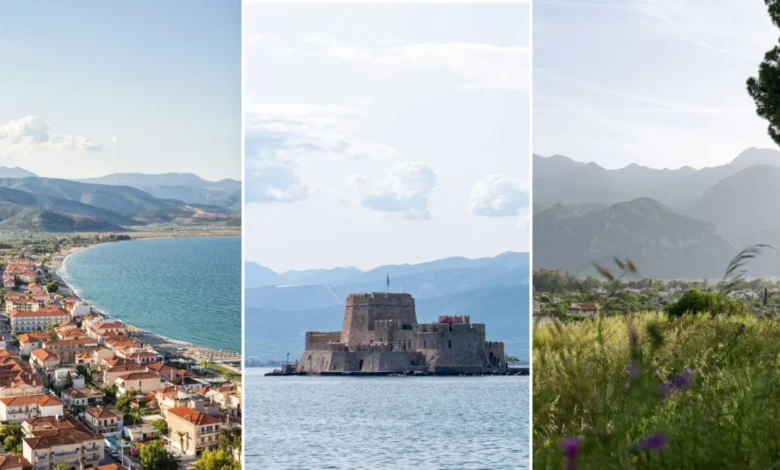
The shimmering, emerald waters of the Argolic Gulf lap at the shores of Daskalio, a small, uninhabited island accessible only by boat. Here, amidst the echoes of 1970s Greek melodies and the enticing aroma of grilled souvlaki, the Peloponnese Peninsula reveals its secluded charm. This ancient land, roughly the size of Slovenia and cradled by three seas—the Ionian, the Mediterranean, and the Aegean—has long been a well-kept secret among foreign travelers. Yet, with its rich historical tapestry woven from myth, legend, and a resilience forged through centuries of hardship, the Peloponnese is poised for a renaissance, amplified by cultural touchstones like Christopher Nolan’s recent blockbuster, The Odyssey.

A Land Steeped in Legend and History
For decades, the Peloponnese’s dramatic coastline, stretching over 860 miles of rugged terrain, has remained largely off the beaten path for international tourism. In 2025, only a modest 3% of foreign visitors explored this westernmost Greek peninsula, despite its proximity to Athens, a mere few hours’ drive away. This understated presence is now set to transform as Nolan’s epic film revisits Homer’s timeless narrative, casting a cinematic spotlight on the real-world locations that inspired the mythical king Odysseus’s arduous journey.
The film, which features filming locations in the southern Messenia region, one of the Peloponnese’s five administrative districts, delves into themes of xenia (the sacred bond of hospitality between guests and hosts) and nostos (the profound yearning for homecoming). These concepts resonate deeply with the peninsula’s identity, echoing the experiences of locals like Nikos Stakias. After two decades working in hospitality across England, Cyprus, and Athens, Stakias returned to his native Peloponnese, seeking a more serene quality of life. He is now a driving force behind the Peloponnese Trail Network, an ambitious community-led initiative aiming to connect nearly 1,200 miles of ancient footpaths, creating the largest hiking network in Greece and linking its numerous small villages.

The Peloponnese’s Evolving Landscape
The push to open the Peloponnese to a wider audience is not a recent phenomenon. The early 2000s saw the construction of new highways and tunnels, significantly reducing travel times from Athens. A decade ago, the visionary Costa Navarino eco-resort, spearheaded by Messinian ship captain Vassilis Constantakopoulos, emerged as a beacon of sustainable luxury. Constantakopoulos’s ambition was to transform his homeland into a premier travel destination while simultaneously stemming the outward migration of residents. Today, Costa Navarino hosts world-renowned brands such as W Hotels and Mandarin Oriental, with Four Seasons and Six Senses slated to join by 2026, signaling a significant shift in the region’s tourism profile.
Nolan’s The Odyssey further amplifies this exposure, highlighting iconic filming sites such as Nestor’s Cave, the legendary lair of the Cyclops, and Methoni Castle, where Telemachus anxiously awaits his father’s return. These cinematic touchstones are expected to draw greater attention to Messenia and, by extension, the entire Peloponnese, revealing a land rich with attractions beyond its most prominent region.

Exploring the Peloponnese Trail Network
The Peloponnese Trail Network serves as both a gateway and a discovery tool for exploring the peninsula. With 11 newly established official trails, the majority situated outside Messenia, the network offers unparalleled access to the region’s diverse landscapes and cultural heritage.
The Argolis Trail and Venetian Fortifications

The journey begins with the 64-mile Argolis Trail in the northeastern region of the same name. Here, hikers can marvel at the Epidaurus, an ancient Greek theater and healing sanctuary dating back to the 4th century BC, where theatrical performances were once prescribed as a form of therapy. Further along the trail, a climb up Ottoman-era stone paths leads to Palamidi, a formidable Venetian fortress that commands breathtaking views over Nafplio, the historic first capital of modern Greece.
The Parnon Trail: A Tapestry of Nature and Tradition

The scenic coastal drive from Nafplio southward along the Argolic Gulf leads to Mount Parnon, a colossal mountain range visible even from Athens on clear days. Here, the 143-mile circular Parnon Trail winds through rugged and remote terrains. Following a guide, George Alexandrou, from the mountain village of Pera Melana, one traverses paths once trodden by locals on their daily commutes. The trail ventures through diverse flora, from aromatic wild rosemary and thyme to lemon and olive groves, giving way to mountain cherries, junipers, and towering cedars. The presence of hairy pink flax, a wild relative of the plant used by Odysseus for his sails, adds a poetic layer to the trek.
The Parnon range is also home to Leonidio, a picturesque town nestled between dramatic red cliffs, which has recently emerged as a world-class destination for rock climbing. The region’s isolation, due to the challenging topography of the Parnon range, historically preserved unique cultural enclaves.

Echoes of Ancient Heroes and Cultural Resilience
The Peloponnese’s historical significance extends far beyond Homeric epics. Eons before Odysseus, Hercules, one of the twelve labors of the demigod, unfolded on this peninsula. In the renowned wine region of Nemea, he famously subdued the Nemean Lion. In mountainous Arcadia, the birthplace of gods Zeus and Hermes, he captured the Erymanthian Boar. The region of Argolis was the cradle of the Mycenaean civilization, the very civilization that produced King Odysseus.
The region’s influence continued through the Byzantine era, with Mystras, the empire’s final stronghold, located here. The Greek War of Independence against the Ottoman Empire also found its genesis in the Peloponnese, and Nafplio served as the nascent nation’s first capital, cementing the peninsula’s role as a crucible of Greek identity and history.

Preserving Tsakonian Heritage in Leonidio
In Leonidio, the Tsakonian people, direct descendants of the ancient Spartans, are actively working to preserve their unique linguistic and cultural heritage. This dialect, a direct lineage from ancient Greek, has survived for millennia due to the region’s historical isolation. However, with increased connectivity since the 1950s, the dialect faced endangerment. Eleni Manou, an author and educator, is at the forefront of this preservation effort, publishing children’s books in Tsakonian and organizing workshops. An annual festival in July celebrates Tsakonian traditions, and street signs in Leonidio now proudly display the Tsakonian language alongside Greek, symbolizing a living connection to the past.

The Revival of Geraki Weaving
Further east, in the Laconia region, the village of Geraki embodies another story of cultural revival. Chrysoula Stamatopoulou leads Geraki Weaving, an initiative that continues a tradition of carpet weaving that dates back 5,000 years. The intricate kilims, featuring traditional Tsakonian geometric patterns, symbolize happiness, fertility, and abundance. Once on the brink of extinction, the practice is now being taught to students from across Greece and Europe, free of charge, at Geraki and Leonidio, the only two places offering this ancient knowledge. This revival mirrors Penelope’s legendary act of weaving and unweaving, a testament to enduring craft and cultural memory.

Addressing Rural Depopulation and Revitalization Efforts
The Peloponnese, like many rural regions globally, has grappled with significant challenges, including depopulation, particularly in the aftermath of World War II, the Greek Civil War, and the 2008 financial crisis. These events spurred waves of emigration, leaving some remote villages with critically low or even zero year-round residents, such as Vamvakou in Laconia and Lasta in Arcadia.
However, a new wave of entrepreneurial spirit is breathing life back into these areas. The Vamvakou Revival project, initiated by four young entrepreneurs with local ties, has successfully increased the village’s permanent population to 30. In Arcadia, social entrepreneur Maria Monastirioti orchestrates agro- and gastronomic experiences, empowering local women to share their culinary traditions, such as the preparation of trachanokeftedes. These initiatives, alongside the expanding Peloponnese Trail Network, represent a concerted effort to foster sustainable tourism and economic vitality, turning the tide of rural flight.

A Homecoming for the Peloponnese
The journey through the Peloponnese culminates at the Acropolis of ancient Sparta, a serene expanse of ruins overlooking the majestic Taygetus mountains. A short distance away lies the Menelaion, a sanctuary dedicated to Helen of Troy, who, according to legend, returned home to this "blessed land." This symbolic homecoming mirrors the peninsula’s own resurgence. Decades in the making, the Peloponnese is emerging from its long period of obscurity, ready to share its profound history, breathtaking landscapes, and vibrant living culture with the world. The blend of ancient myths, enduring traditions, and modern revitalization efforts paints a compelling picture of a region reclaiming its narrative and embarking on a new chapter of discovery and connection.