The digital marketing landscape is undergoing a fundamental transformation as enterprise-level organizations shift from traditional keyword monitoring to sophisticated, multi-dimensional search intelligence. In an era where search engine results pages (SERPs) are increasingly dominated by AI Overviews, featured snippets, and localized packs, the definition of visibility has expanded beyond the "ten blue links." Modern enterprise rank-tracking software now serves as a mission-critical data hub, monitoring millions of data points across diverse devices and geographical locations while integrating directly into corporate Business Intelligence (BI) systems and Customer Relationship Management (CRM) workflows.
The Shift Toward Algorithmic Complexity and Scale
For the modern global corporation, rank tracking is no longer a localized task managed by a single SEO specialist. It has become a cross-functional requirement involving data scientists, content strategists, and executive leadership. Basic tracking tools, designed for small-to-medium businesses (SMBs) to monitor a few hundred keywords, are increasingly inadequate for the demands of high-traffic enterprise websites. Enterprise-grade platforms are built to handle the complexity of massive data volumes and real-time refresh rates, providing the granular insights necessary to navigate a volatile search environment.
Industry data suggests that the integration of AI into search engines has significantly altered user behavior. According to recent search volatility indices, the introduction of generative AI responses has led to a potential shift in click-through rates (CTR), with informational queries often being satisfied directly on the search results page. This "zero-click" phenomenon requires enterprises to track not just their position, but their "pixel position"—the actual vertical space occupied on a screen—and their presence within AI-generated summaries.

A Chronology of Search Evolution and Tracking Needs
To understand the current state of enterprise rank tracking, one must look at the technological milestones that have shaped the industry over the last decade:
- The Mobile-First Era (2015–2018): Search engines began prioritizing mobile-friendly content, forcing tracking software to bifurcate data between desktop and mobile rankings.
- The Rise of SERP Features (2018–2021): The proliferation of "People Also Ask" boxes, image carousels, and local packs meant that being "Number One" in organic results often meant being halfway down the page.
- The Generative AI Revolution (2023–Present): The launch of Google’s Search Generative Experience (SGE), now known as AI Overviews, and competitors like Perplexity and ChatGPT’s search capabilities, has created a new requirement: Answer Engine Optimization (AEO).
This timeline illustrates a clear trajectory: tracking has moved from simple list-checking to complex environment-monitoring.
Critical Criteria for Evaluating Enterprise-Grade Platforms
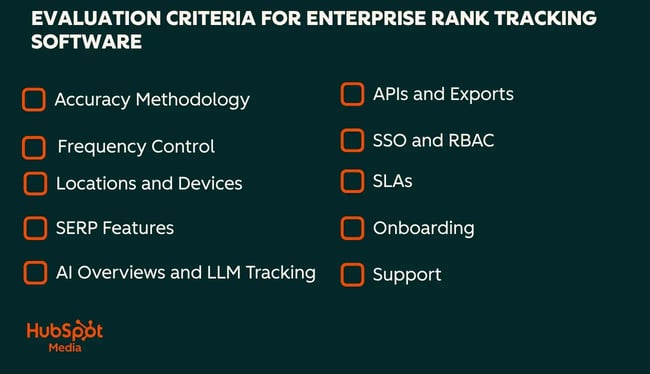
When global organizations evaluate search intelligence tools, the stakes are high. A failure in data accuracy or a delay in reporting can lead to multi-million-dollar losses in potential revenue. Several technical and operational factors distinguish enterprise platforms from their entry-level counterparts.
Accuracy Methodology and Frequency Control
Enterprises require transparency in how data is harvested. Leading vendors often utilize a sophisticated mix of residential proxies and dedicated datacenter IPs to bypass anti-scraping measures while ensuring that results reflect what real users see in specific locales. Furthermore, the ability to control crawl frequency is vital. While daily updates are standard, high-stakes events—such as global product launches or seasonal shopping holidays like Black Friday—demand hourly or on-demand data refreshes to allow for real-time strategy adjustments.
Granular Localization and Device Independence
For a multinational corporation, a "national" ranking is often an oversimplification. Enterprise tools must offer granularity at the city, zip code, or even coordinate level. This is particularly critical for retail, hospitality, and service-based industries where local pack rankings drive the majority of foot traffic. Simultaneously, the software must track desktop and mobile rankings independently, as the algorithms for each continue to diverge.
AI Overviews and LLM Integration
The newest frontier in rank tracking is the monitoring of Large Language Models (LLMs). Platforms must now be capable of tracking which URLs are cited within AI Overviews and capturing prompt-level data. This allows brands to understand how they are being "perceived" by AI, rather than just how they are being "indexed" by a crawler.
Governance, Security, and Integration
From an IT perspective, enterprise software must adhere to strict governance standards. This includes Single Sign-On (SSO) integration, Role-Based Access Control (RBAC), and robust Service Level Agreements (SLAs). Perhaps most importantly, the data cannot exist in a silo. It must be accessible via well-documented APIs to flow into data warehouses (like Snowflake or BigQuery) and BI tools (like Tableau or Looker), allowing executives to see a direct line from keyword movement to pipeline growth.
Market Leaders and Specialized Solutions
Several platforms have emerged as the standard-bearers for enterprise search intelligence, each offering unique advantages depending on the organization’s existing tech stack.
HubSpot Marketing Hub and SEO Software
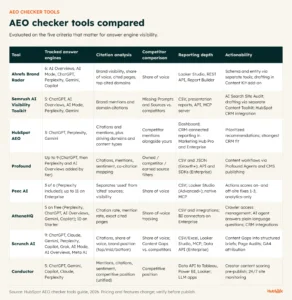
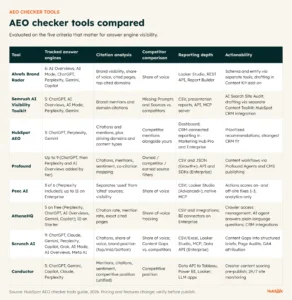
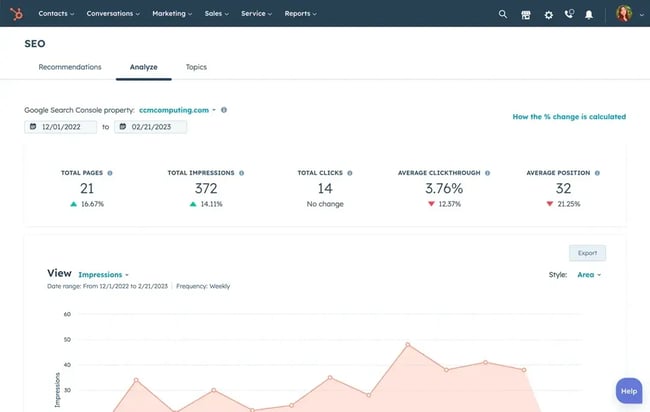
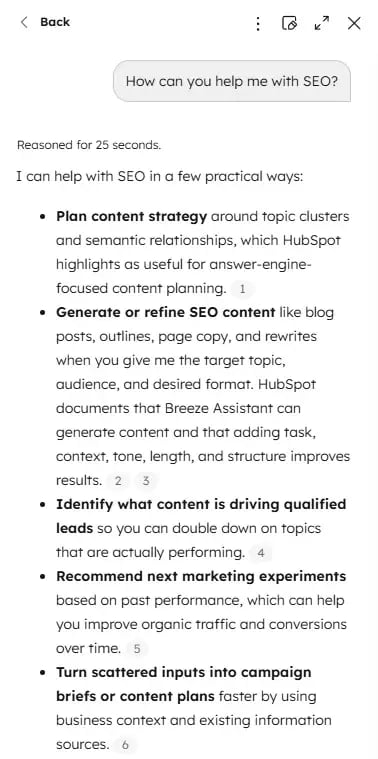
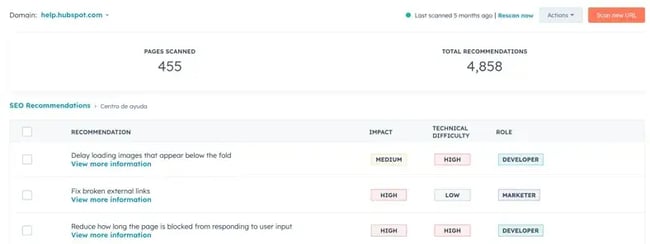
HubSpot has positioned its SEO Marketing Software as a centralized solution for teams that value integration over fragmented point solutions. By housing SEO data within the same environment as the CRM and content tools, HubSpot allows for seamless lead attribution. A unique feature of the HubSpot ecosystem is the "Breeze Assistant," an AI-driven tool that surfaces prioritized recommendations. This is particularly useful for large teams where junior members need guided optimization paths. Additionally, HubSpot’s "Analyze" tab pulls directly from Google Search Console, providing a unified view of indexed pages, impressions, and average positions without requiring manual data bridging.
HubSpot Content Hub and AEO Grader
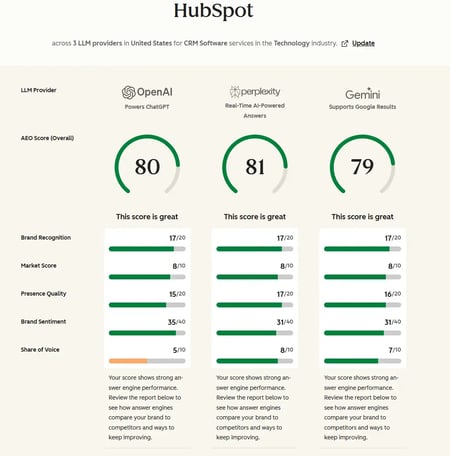
For organizations focused on the "Answer Engine" era, HubSpot’s AEO Grader provides a free benchmarking tool that scores brand visibility across ChatGPT, Perplexity, and Gemini. This highlights a shift in market sentiment: brands are now as concerned with their narrative in AI responses as they are with their organic rank. The Content Hub further supports this by embedding SEO and schema guidance directly into the authoring workflow, ensuring that content is structured correctly for AI consumption before it is even published.
Semrush One
Semrush remains a dominant force due to its massive data infrastructure. Its "Semrush One" enterprise offering combines traditional keyword tracking with an AI Visibility Toolkit. Semrush is frequently cited by industry analysts for its competitive intelligence capabilities, allowing organizations to monitor "Share of Voice" across entire topic clusters. For many SEO directors, Semrush serves as the daily "source of truth" for technical audits and position tracking at a global scale.
Profound
Profound represents a newer category of "AI-first" visibility platforms. Unlike legacy tools that added AI tracking as a secondary feature, Profound was built specifically to manage brand narratives across generative engines. It tracks brand sentiment and citation frequency across engines like Meta AI and Mistral, providing a specialized layer of intelligence for CMOs who are concerned about "AI brand drift."
Competitive Intelligence and Share of Voice at Scale
At the enterprise level, tracking your own rankings is only half the battle. Organizations must also monitor competitors with the same level of scrutiny.
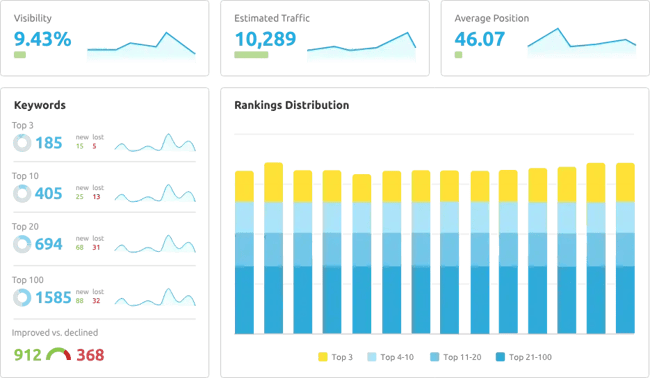
Share of Voice (SoV) Tracking: This metric measures how often a domain appears relative to its competitors across a specific keyword set. Instead of looking at individual keywords, enterprises track SoV across product lines or buyer stages. A 12-month SoV trend report is often a more valuable executive metric than a snapshot of current rankings, as it indicates which competitor is successfully capturing market mindshare.
Pixel Position Analysis: Traditional rank tracking says you are "Position 1." Pixel position analysis reveals that "Position 1" is actually 800 pixels down the page, hidden beneath an AI Overview and three sponsored ads. This data is crucial for determining the true ROI of organic efforts versus paid search.
Brand Variant and Partner Tracking: Large corporations often struggle with "internal competition" where their own affiliates, resellers, or sub-brands compete for the same branded search terms. Enterprise software allows for the segmentation of these entities, enabling the parent company to manage its total search presence and prevent unnecessary cannibalization of organic traffic.
Broader Impact and Market Implications
The transition to advanced rank-tracking software has profound implications for corporate structure and budget allocation. As search engines become more fragmented, the role of the SEO professional is evolving into that of a "Search Experience Manager."
Market analysts suggest that companies failing to adopt enterprise-grade tracking are at risk of "data blindness." Without the ability to see how AI is summarizing their brand or how local results are shifting in real-time, these companies may find themselves optimized for a version of the internet that no longer exists. Conversely, organizations that successfully integrate search intelligence into their broader business strategy are seeing improved alignment between marketing and sales, as they can accurately predict traffic fluctuations and adjust their lead-generation expectations accordingly.
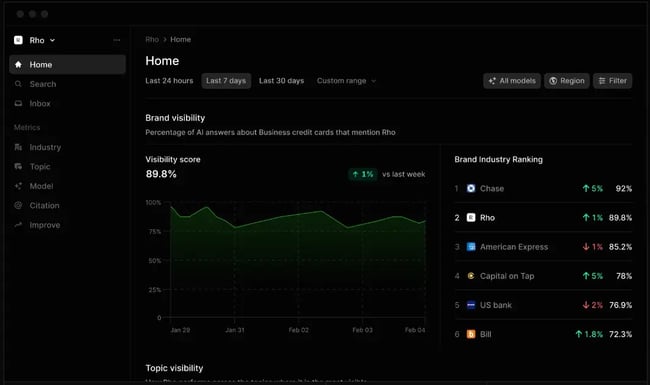
Furthermore, the rise of AEO (Answer Engine Optimization) is forcing a departmental convergence between SEO and Public Relations. If an AI engine provides a negative or inaccurate summary of a brand, it is as much a PR crisis as it is a search ranking issue. Enterprise tracking tools are the "early warning systems" for these shifts in digital perception.
Conclusion
Enterprise rank-tracking software has evolved from a simple utility into a sophisticated engine of business intelligence. By monitoring millions of data points across traditional SERPs and emerging AI platforms, these tools provide the clarity needed to navigate a complex and volatile digital landscape. For the modern enterprise, the choice of a tracking platform is not merely a technical decision; it is a strategic investment in the organization’s long-term visibility and revenue potential. As generative AI continues to reshape user behavior, the ability to accurately measure, analyze, and act upon search data will remain a primary differentiator between market leaders and their competitors.
Related posts: