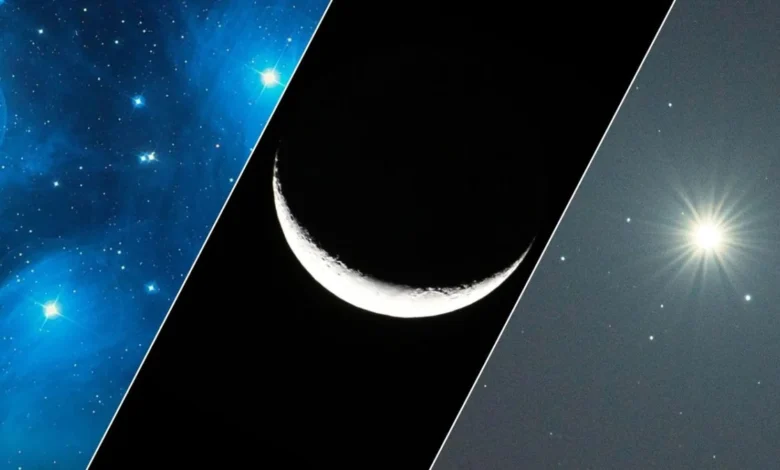
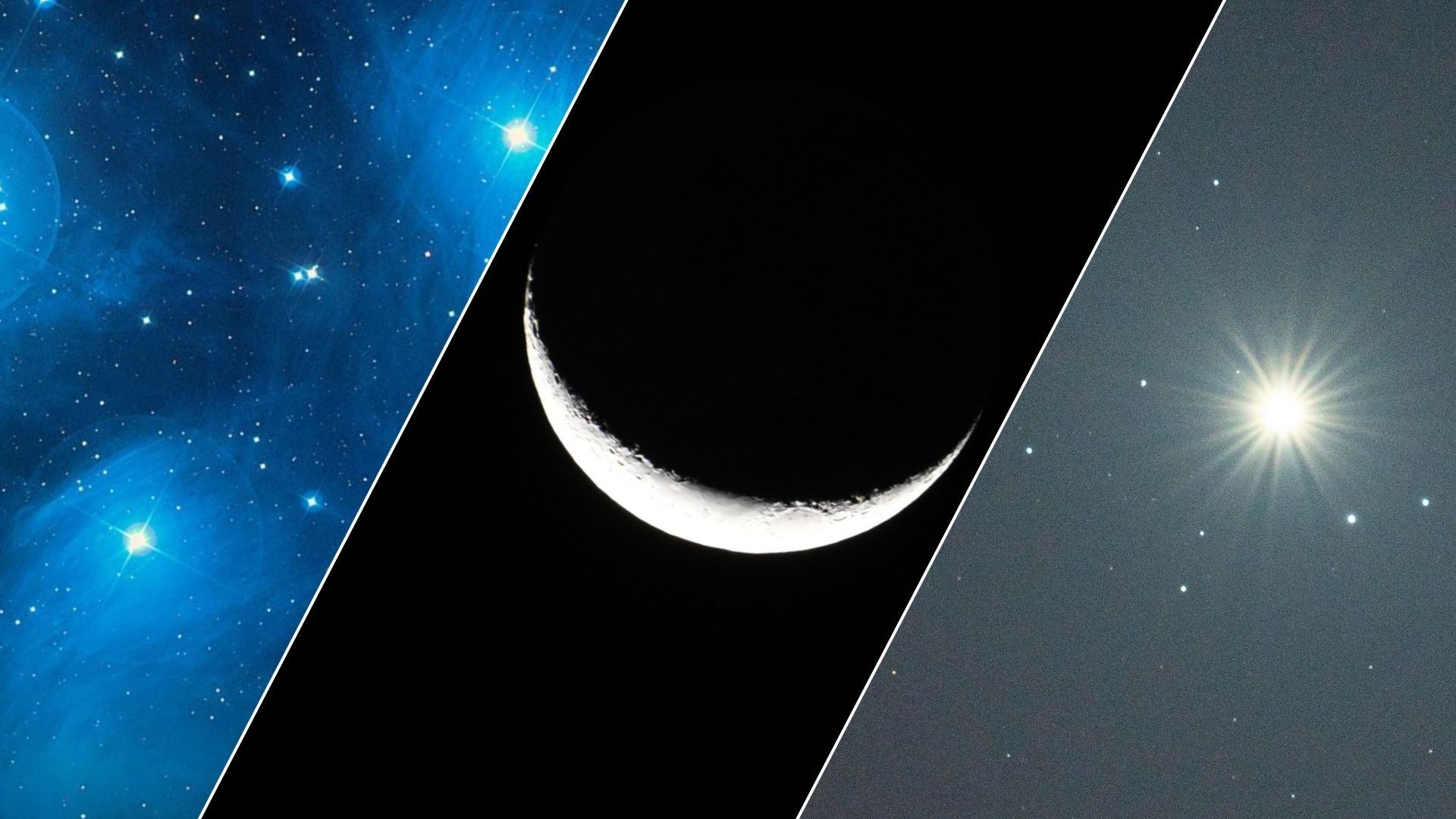
On the evening of April 19th, skywatchers across the Northern Hemisphere will have the opportunity to witness a captivating astronomical alignment: a slender crescent moon gracefully positioned above the dazzling Pleiades star cluster and the brilliant planet Venus. This ephemeral celestial ballet, best observed about 30 to 90 minutes after sunset, offers a fleeting yet profound connection to the cosmos, reminding us of the dynamic and ever-changing nature of our night sky.
A Glimpse of the Early Spring Sky
As twilight deepens and the sun dips below the western horizon, the stage will be set for this astronomical spectacle. The moon, in its early waxing crescent phase, will present a delicate, upturned sliver, illuminated by only 11% of its surface. This phase, occurring just two days after the new moon on April 17th, signifies the moon’s journey back into visibility after its brief period of being hidden from Earth. Its position will be approximately 20 degrees above the western horizon, a measurement easily visualized by holding two clenched fists at arm’s length against the sky.
Just below this ethereal lunar arc will be Venus, the undisputed queen of the evening sky. Known for its exceptional brightness, Venus will appear as a radiant beacon, earning its moniker as the "evening star." Its visibility will be relatively short-lived, as it sets only about two hours after the sun, making it imperative for observers to find a clear and unobstructed view of the western horizon to fully appreciate its proximity to the moon and the Pleiades. The alignment of these three celestial bodies – the moon, Venus, and the Pleiades – creates a striking visual composition, a testament to the intricate orbital mechanics that govern our solar system.
The Pleiades: A Star Cluster of Myth and Wonder
The Pleiades, also known as the Seven Sisters, is an open star cluster located in the constellation Taurus. This collection of young, hot blue stars is a familiar sight for stargazers and has been a source of fascination and mythology for cultures across the globe for millennia. Its apparent proximity to the moon and Venus in the night sky on April 19th adds an extra layer of allure to this celestial event. The cluster itself contains hundreds of stars, though only a handful are typically visible to the naked eye, giving rise to its namesake. The apparent closeness of these stars, despite their vast distances from Earth, is a trick of perspective within our own galaxy, the Milky Way. The Pleiades are relatively young for star clusters, estimated to be only about 100 million years old, a mere blink of an eye in cosmic terms.
Navigating the Night Sky: Tools for Observation
For those eager to fully immerse themselves in this astronomical display, understanding how to gauge distances and identify celestial objects is key. The accompanying graphic illustrates a simple yet effective method for measuring angular distances in the night sky using only one’s hand. A clenched fist held at arm’s length approximates about 10 degrees of the sky. A single outstretched finger can represent roughly 1 degree, while the span of the middle three fingers can indicate approximately 5 degrees. This handy guide can help observers accurately locate Venus and the Pleiades relative to the moon, enhancing their appreciation of the celestial arrangement.
The Elusive Presence of Uranus
Adding another, albeit more challenging, element to this celestial tableau is the ice giant Uranus. Lurking approximately 5 degrees to the upper right of Venus, Uranus will present a formidable observational challenge. With a magnitude of +5.8, it hovers on the very edge of naked-eye visibility, meaning that even under ideal dark-sky conditions, it is likely to remain unseen by the unaided eye. Furthermore, its low position near the horizon on April 19th will further diminish its chances of being spotted. However, for dedicated amateur astronomers equipped with binoculars or a small telescope, the possibility exists to resolve the planet’s faint, greenish disk against the inky blackness of space. Its presence, however subtle, underscores the rich tapestry of objects observable in our solar system.
The Gentle Glow of Earthshine
As the crescent moon gracefully descends towards the horizon, observers may notice a subtle, ethereal glow illuminating its shadowed portion. This phenomenon, known as "earthshine," "the Da Vinci Glow," or "the old moon in the new moon’s arms," is a beautiful reminder of our planet’s role in illuminating our celestial neighbor. Sunlight, reflected off Earth’s clouds and oceans, bathes the lunar surface, making the otherwise dark portion of the moon faintly visible. This effect is most pronounced during the nights surrounding the new moon phase, when the geometry between the Earth, moon, and sun is optimal for this cosmic reflection. It’s a gentle, poetic interplay of light between our world and its natural satellite.
A Call to the Cosmos: Resources for Aspiring Stargazers
For individuals inspired by this celestial event and eager to delve deeper into the wonders of amateur astronomy, a wealth of resources are available. For those new to the pursuit, a comprehensive beginner’s guide to stargazing can provide foundational knowledge and practical tips. Furthermore, recommendations for the best telescopes and binoculars can empower aspiring astronomers to equip themselves with the right tools for exploring the night sky, particularly the captivating realm visible after sunset. These resources can transform a casual interest into a lifelong passion for understanding our universe.
Expert Insights and Community Engagement
The astronomical community often shares its excitement and findings, fostering a collaborative spirit among enthusiasts. While no specific official statements have been released regarding this particular alignment, astronomers and astrophotographers worldwide routinely document and share such events. The public’s engagement with these celestial phenomena often leads to a greater appreciation for science and the cosmos. Sharing observations and photographs of such events, as encouraged by platforms like Space.com, allows for a broader collective experience and can even contribute to citizen science initiatives.
Broader Implications: Understanding Our Place in the Universe
Events like the conjunction of the moon, Venus, and the Pleiades serve as powerful reminders of humanity’s enduring connection to the cosmos. They offer moments of awe and reflection, encouraging us to contemplate our place within the vastness of space. Such astronomical alignments also play a role in scientific understanding. The precise observation of planetary positions and lunar phases has been fundamental to the development of astronomy and celestial mechanics throughout history. While this specific event is primarily a visual spectacle, the underlying principles of orbital dynamics and light reflection are the bedrock of our scientific understanding of the universe.
The recurring patterns of celestial movements, observed and recorded over centuries, have not only enriched our scientific knowledge but have also deeply influenced art, culture, and philosophy. The ability to predict and explain these phenomena underscores the power of the scientific method and our ongoing quest to unravel the mysteries of the universe. As we continue to explore beyond our planet, these celestial events serve as both inspiration and grounding, reminding us of the shared cosmic heritage that binds us all.
A Note for Astrophotographers
For those with a passion for astrophotography, this event presents a wonderful opportunity to capture the beauty of the night sky. Space.com, in its commitment to fostering community engagement, often invites readers to share their photographic endeavors. Submitting images of celestial events, accompanied by personal observations and location details, allows for a broader dissemination of these beautiful moments and contributes to a shared visual record of our universe.
About the Author
Anthony Wood, a contributor to Space.com since April 2025, brings a wealth of experience from his work with publications such as IGN, New Atlas, and Gizmodo. His profound interest in the night sky, scientific exploration, and the advancements in human spaceflight fuels his writing. Wood harbors a deep anticipation for the future of lunar exploration, particularly the prospect of astronauts returning to the Moon. His contributions aim to illuminate the wonders of space for a broad audience, inspiring curiosity and a deeper understanding of our universe.
The opportunity to witness the crescent moon, Venus, and the Pleiades in such close proximity is a fleeting gift from the cosmos. It is an invitation to pause, look up, and marvel at the intricate dance of celestial bodies that unfold above us every night, a spectacle that has captivated humanity for millennia and will continue to inspire for generations to come.