Autonomous Humanoid Robot Shatters Previous Records at Beijing Half-Marathon, Outpacing Human World Best

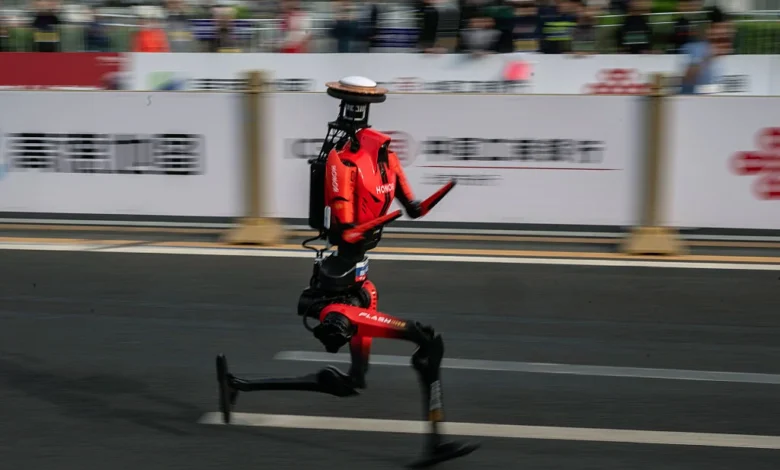
A significant milestone in the field of robotics was achieved today as an autonomous humanoid robot crossed the finish line of a Beijing half-marathon in an astonishing 50 minutes and 26 seconds. This remarkable feat, accomplished by a robot developed by Chinese smartphone manufacturer Honor, not only represents a massive leap in robotic locomotion but also, notably, surpasses the current human world record for the half-marathon, recently set by Jacob Kiplimo at 57 minutes and 31 seconds. The event, organized by Beijing’s E-Town tech hub, underscores the rapid advancements in artificial intelligence, engineering, and bipedal robotics, challenging previous perceptions of machine capabilities in endurance sports.
The Beijing Half-Marathon for Humanoid Robots has rapidly become a prominent showcase for cutting-edge robotic technology, drawing participants from leading tech companies and research institutions. This year’s competition was particularly anticipated, building on the foundation laid by previous iterations that, while impressive in their own right, demonstrated the nascent stages of robotic endurance. The winning robot’s performance stands as a testament to the relentless pursuit of efficiency, stability, and speed in autonomous systems.
A New Benchmark in Robotic Endurance
The victorious robot, operating entirely autonomously, demonstrated sophisticated gait control, energy management, and navigation throughout the 21.0975-kilometer course. While another Honor-built robot reportedly finished faster, clocking in at 48 minutes and 19 seconds, it was remote-controlled. The official win, therefore, went to the 50:26 autonomous entry, emphasizing the competition’s weighted scoring system that prioritizes self-sufficient operation over human-piloted performance. This distinction highlights the core objective of the event: to push the boundaries of true robotic autonomy.
The field of competitors was diverse, with approximately 40% of the participating robots designed for fully autonomous operation, while the remaining 60% relied on remote human control. This blend allows for both the exploration of raw mechanical potential and the development of self-governing AI systems. Not all robots, however, enjoyed a smooth race. Reports from the course indicated several challenges, including one robot that stumbled and fell at the starting line, and another that veered off course to collide with a barrier, illustrating the inherent complexities and current limitations of dynamic bipedal locomotion in varied environments. Despite these setbacks, the overall success rate and the record-breaking performances signify a pivotal moment for the industry.
The Evolution of Robotic Running: A Rapid Ascent
The journey to this year’s record-shattering performance has been remarkably swift. Just last year, in 2025, the fastest robot in the same Beijing half-marathon event completed the course in two hours and 40 minutes. At the time, this pace, while a significant engineering achievement, was widely considered "not an impressive time for a human" and often met with a degree of skepticism regarding the practical utility of such robotic endeavors. The dramatic reduction in completion time by nearly two hours in a single year underscores an exponential rate of improvement in robotic capabilities, far outstripping the gradual progress seen in human athletic performance over decades.
This rapid advancement is not an isolated incident but rather a culmination of years of intensive research and development in humanoid robotics. Early bipedal robots, such as Honda’s ASIMO and various academic projects from the late 20th and early 21st centuries, focused primarily on basic walking and balance, often with limited speed and agility. Companies like Boston Dynamics later pushed the envelope with dynamic movements, including running and jumping, primarily in controlled laboratory settings. The transition of these capabilities to endurance events like a half-marathon, in a semi-controlled outdoor environment, represents a critical step towards practical real-world applications.
The Beijing Half-Marathon for Humanoid Robots, hosted by the E-Town tech hub, has played a crucial role in catalyzing this progress. E-Town, an innovation hub in Beijing, has actively fostered an ecosystem for advanced manufacturing, AI, and robotics, providing the infrastructure and competitive environment necessary for such rapid technological iteration. By setting clear, measurable challenges, the event encourages manufacturers and researchers to innovate at an accelerated pace, driving breakthroughs in areas like power efficiency, real-time perception, balance algorithms, and robust hardware design.
Bridging the Gap: Human vs. Machine Performance
The comparison between the robot’s 50:26 finish and Jacob Kiplimo’s 57:31 human world record inevitably sparks debate. A social media user aptly summarized a common sentiment, observing, "my car can outrun a cheetah too," highlighting the perceived unfairness of comparing biological organisms with engineered machines. Indeed, robots are not bound by the same physiological constraints as humans. They do not experience fatigue in the same way, do not require oxygen, and can leverage materials and power sources far beyond biological capabilities. Their "muscles" are high-torque electric motors, their "nervous system" is a complex AI algorithm, and their "energy" comes from advanced battery packs.
However, the purpose of such comparisons is not to declare robots superior athletes in a direct, apples-to-apples contest. Instead, it serves as a powerful metric for technological progress. The fact that an autonomous bipedal machine can now sustain a pace significantly faster than the fastest human over a half-marathon distance signifies an engineering triumph. It demonstrates the increasing sophistication of AI in managing complex locomotion, the efficiency of robotic actuators, and the robustness of designs capable of enduring prolonged, high-stress activity. This benchmark underscores how far robotics has come from the slow, deliberate movements of early prototypes to the dynamic, agile systems seen today.
Honor’s Foray into Advanced Robotics
The victory of Honor, primarily known as a global smartphone manufacturer, in this high-profile robotics competition is particularly noteworthy. It signals a broader trend among tech giants to diversify their portfolios and leverage their core competencies in new, emerging fields. Honor’s expertise in miniaturization, power management, advanced sensor integration, and sophisticated AI processing (developed for smartphone cameras and operating systems) provides a strong foundation for robotic development. The company’s ability to design efficient, powerful, and relatively compact electronic systems is directly transferable to the demands of humanoid robotics.
Honor’s involvement highlights the convergence of several technological domains:
- Artificial Intelligence: The robot’s autonomous navigation, gait optimization, and real-time adaptation to terrain rely heavily on advanced AI algorithms.
- Advanced Materials: Lightweight yet durable materials are crucial for maximizing speed and energy efficiency while minimizing structural stress.
- Battery Technology: High-density, fast-charging batteries are essential for sustaining long-distance performance.
- Sensor Fusion: Lidar, cameras, and inertial measurement units (IMUs) provide the robot with a comprehensive understanding of its environment and its own state.
- Actuator Design: Powerful and precise motors are required to mimic human-like joint movements with high fidelity and strength.
This win positions Honor not just as a smartphone brand, but as a significant player in the burgeoning field of advanced robotics, capable of delivering highly performant autonomous systems.
Official Responses and Expert Analysis
Officials from Beijing’s E-Town tech hub expressed immense satisfaction with the event’s outcome. "The progress we have witnessed in just one year is nothing short of revolutionary," stated a spokesperson for E-Town. "This competition is designed to push the limits of what’s possible, and the participating companies, especially Honor, have delivered beyond expectations. Beijing E-Town remains committed to fostering an environment where such groundbreaking innovations can flourish, cementing our position as a global leader in AI and robotics." The spokesperson further emphasized the importance of autonomous capabilities, noting that the ultimate goal is to develop robots that can operate independently in complex, unstructured environments.
Representatives from Honor shared their excitement and pride. "This victory is the result of tireless dedication from our engineering and AI teams," an Honor executive commented. "We leveraged our deep expertise in AI, hardware design, and power efficiency from our smartphone division and applied it to the challenging domain of bipedal locomotion. This half-marathon is more than just a race; it’s a critical testing ground for technologies that will one day revolutionize various industries." The executive hinted at future applications, suggesting that the underlying technologies developed for the robot’s endurance and agility could find utility in logistics, manufacturing, and service sectors.
Robotics experts and academics echoed the sentiments of excitement, while also offering a nuanced perspective. Dr. Lena Chen, a professor of robotics at a leading Chinese university, remarked, "The 50:26 time is a significant benchmark. It demonstrates that the control algorithms for dynamic bipedal running have matured considerably. However, it’s crucial to remember that this was on a relatively flat, predictable course. The next frontier involves sustained performance on uneven terrain, navigating obstacles, and interacting dynamically with the environment. But make no mistake, this is a clear indicator of the accelerating pace of innovation in humanoid robotics." Dr. Chen also highlighted the shift towards more energy-efficient designs, a key factor in extending operational times for robots.
The public reaction, as observed across various platforms, ranged from awe and excitement to philosophical musings about the future of human-robot interaction. While some marveled at the sheer speed, others pondered the implications for human labor and the definition of athleticism. The "car vs. cheetah" analogy resurfaced, but increasingly, there was an appreciation for the engineering marvel itself, rather than a direct competitive comparison.
Broader Implications and Future Outlook
The performance of Honor’s autonomous robot at the Beijing Half-Marathon has profound implications across several domains:
Accelerating Robotics Development
The competition has proven to be a powerful catalyst for innovation. The public nature of the challenge and the prestige associated with winning incentivizes companies to invest heavily in R&D, leading to faster progress than might occur in purely academic or industrial settings. Expect more sophisticated competitions, perhaps incorporating obstacles, varied terrains, or even cooperative tasks, to further push boundaries.
Real-World Applications
The capabilities demonstrated in the half-marathon, particularly sustained high-speed locomotion and robust autonomy, have direct relevance to numerous real-world applications.
- Logistics and Delivery: Robots capable of covering long distances quickly and autonomously could revolutionize last-mile delivery, especially in urban environments or large industrial complexes.
- Inspection and Maintenance: Robots could inspect vast infrastructure, such as pipelines, bridges, or remote facilities, much faster and more efficiently than current methods.
- Search and Rescue: Agile, enduring robots could navigate disaster zones or hazardous environments, reaching victims or assessing damage in areas unsafe for humans.
- Healthcare and Elder Care: While not directly related to running, the underlying AI and mechanical stability could contribute to more capable assistant robots.
- Manufacturing and Assembly: Enhanced dexterity and speed in bipedal robots could lead to more versatile and adaptable factory automation.
The Future of AI and Autonomy
The success of the autonomous robot underscores the rapid advancements in AI, particularly in areas like reinforcement learning, path planning, and real-time decision-making. As these systems become more sophisticated, robots will be able to perform increasingly complex tasks with minimal human intervention, leading to greater efficiency and safety in various sectors.
Economic and Societal Impact
The rise of highly capable autonomous robots will undoubtedly have significant economic and societal impacts. While concerns about job displacement are valid, the creation of new industries and job roles related to robot development, maintenance, and oversight is also anticipated. The broader acceptance and integration of robots into daily life will necessitate ongoing discussions about ethics, regulation, and the evolving relationship between humans and intelligent machines.
In conclusion, the Beijing Half-Marathon for Humanoid Robots has delivered a watershed moment in robotics history. Honor’s autonomous robot, with its record-breaking time of 50 minutes and 26 seconds, has not only surpassed human athletic limits but has also demonstrated the incredible pace of technological evolution. This achievement is a beacon, illuminating a future where autonomous machines play an increasingly integrated and capable role in our world, transforming industries and redefining the boundaries of what is possible. The race is far from over, but the robots are certainly setting a blistering pace.