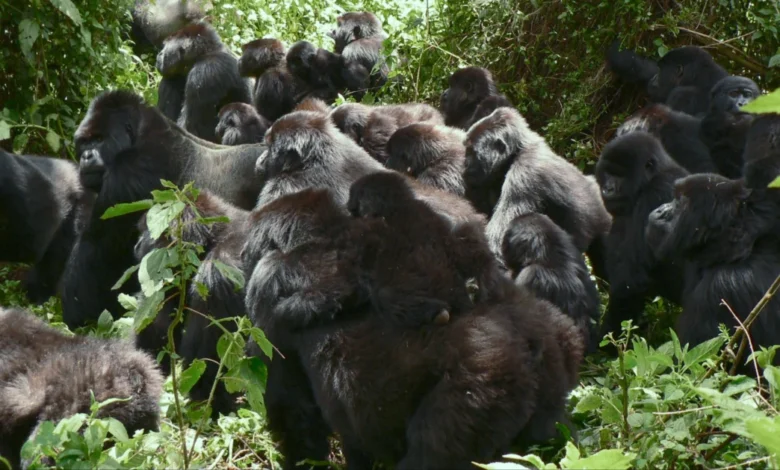
Rwanda’s Majestic Mountain Gorillas Take Center Stage in New Documentary, Revisiting a Landmark Encounter
In a poignant return to the verdant slopes of Rwanda’s Virunga Mountains, Netflix’s new documentary, Gorilla Story: Told by David Attenborough, offers a captivating look at the lives of mountain gorillas, drawing a direct line from a groundbreaking encounter nearly five decades ago to the present day. The film, narrated by the legendary Sir David Attenborough himself, revisits the very location where he shared an unforgettable moment with a young gorilla named Pablo during the filming of the seminal BBC series Life on Earth in 1979. This documentary not only chronicles the ongoing lives of gorilla families but also serves as a powerful testament to the success of conservation efforts in the region.
The genesis of Gorilla Story lies in the enduring impact of that single, iconic scene from Life on Earth. In an episode titled Life in the Trees, Attenborough’s team documented a family of mountain gorillas in Rwanda’s Virunga volcanoes. The now-legendary footage captured a juvenile gorilla, Pablo, approaching and grooming Attenborough as he spoke to the camera. This unscripted, deeply personal interaction highlighted the gentle nature of these magnificent creatures, challenging the prevailing perception of gorillas as fearsome beasts. Attenborough’s reflection at the time – “There is more meaning and mutual understanding in exchanging a glance with a gorilla than any other animal I know. It seems very unfair that man should have chosen the gorilla as a symbol of all that is violent and fearsome, when in fact, it is a peaceable and gentle creature” – continues to resonate.
A Legacy Rekindled: The Journey Back to the Virungas

The decision to revisit this extraordinary story was driven by a desire to see how the descendants of this very family have fared and to showcase the remarkable progress in mountain gorilla conservation. Executive Producer Alastair Fothergill explains the profound significance of the original encounter: "The sequence of David with the gorilla in Life on Earth is arguably the most famous sequence in wildlife filmmaking. David believes it’s the most important sequence he has ever done." Fothergill reveals that Pablo himself went on to become the most successful gorilla in Rwanda, and the family group filmed for the new documentary are his direct descendants, creating a powerful narrative arc nearly 50 years in the making.
The production team, including director James Reed, known for the Oscar-winning My Octopus Teacher, and assistant producer Amy Thompson, collaborated closely with the Dian Fossey Gorilla Fund, an organization dedicated to the study and protection of gorillas for nearly 60 years. Their research identified the "Pablo group" as a prime subject for the film, noting its fascinating dynamics, including the interplay between its three silverbacks—Gicurasi, Ubwuzu, and Imfura—alongside strong female gorillas and numerous playful infants. The group’s historical significance is underscored by its record in 2006, when it comprised the largest mountain gorilla group ever recorded, with 65 individuals. This growth was largely attributed to the stable leadership forged by Pablo and another silverback, a testament to the social structure and resilience of these animals. The realization that this modern group was directly descended from the very gorilla that interacted with Attenborough cemented the project’s narrative power.
A Conservation Triumph: From the Brink to Recovery
Beyond the captivating individual stories, Gorilla Story shines a light on one of the most significant conservation success stories of our time. Alastair Fothergill emphasizes this critical aspect: "The other reason that I really wanted to make this film is that it’s one of the very few positive stories in conservation today." When Attenborough first filmed with mountain gorillas in 1978, the species was on the precipice of extinction, with only an estimated 250 individuals remaining. The era was marked by immense challenges, including the tragic murder of Dian Fossey’s favorite gorilla, Digit, by poachers, which fueled fears of the species’ imminent demise.
However, the impact of Attenborough’s documentation, coupled with decades of dedicated conservation work, has led to a dramatic turnaround. Fothergill notes, "partly as a result of the show and the work David did, today there are 600 gorillas in Rwanda. It’s an extraordinarily positive conservation story." Current estimates suggest that the global population of mountain gorillas has now surpassed 1,000 individuals, with over 600 residing in the Virunga Mountains, spanning Rwanda, Uganda, and the Democratic Republic of Congo. This resurgence is a direct result of intensive anti-poaching patrols, habitat protection, community engagement, and sustainable ecotourism initiatives.

The Creative Process: Weaving Archival and Contemporary Narratives
Developing a documentary that seamlessly blends historical footage with contemporary observation presented a unique set of challenges and rewards. The production team dedicated an unprecedented 250 days of filming over two years (2023 and 2024) to capture the intimate lives of the gorillas. This extensive period allowed for the development of deep insights into their social structures, behaviors, and individual personalities.
Amy Thompson highlights the meticulous effort involved in unearthing archival material: "We always knew we wanted to weave together the historical archive with the modern-day story. But because gorillas are typically so peaceful, following the modern group was a leap of faith—we just didn’t know what would unfold—whereas the historical narrative was already established. Though the historical story was our bankable storyline, what we didn’t realize at first was how tricky it would be to dig out the archive material to tell that story." An exceptional archive producer, Debbie Williams, scoured dozens of sources, and with the assistance of Ian Redmond—a researcher who worked under Dian Fossey in the 1970s and helped Attenborough during the Life on Earth filming—they were able to identify individual gorillas within the historical footage using their unique nose prints.
A Day in the Life: Trekking to the Virunga Peaks
The physical demands of filming in the Virunga Mountains were substantial. Assistant producer Amy Thompson describes the daily journey: "Just reaching the gorillas was no small task—we’d sometimes hike up to four hours each way at over 3,000 meters altitude, often through the thick soupy mist the gorillas are famous for. Porters from the local village helped us carry our equipment up and down the mountain each day—we couldn’t have made the film without them."

Despite the extensive filming time, the crew adhered to strict protocols to minimize disturbance, limiting their interaction to just one hour of filming per day, mirroring the practices of ecotourists. This mindful approach was crucial for gaining the trust and observing the natural behaviors of the gorillas. Thompson elaborates on the early days of filming: "It was nerve-wracking beginning the documentary, knowing we had only 250 hours to film a story with these peaceful creatures. But we were incredibly lucky that within the first few weeks of filming, Ubwuzu challenged Gicurasi for the group’s leadership in a dramatic fight, setting off a dynamic that unfolded over the following two years." This pivotal event provided a compelling narrative thread for the documentary, showcasing the complex social hierarchies and political maneuvering within the gorilla community.
Building Bonds: Interactions with the Gorilla Families
The habituation of gorillas in Rwanda, initially for scientific research and subsequently for responsible tourism, has led to a remarkable level of tolerance towards human presence. Alastair Fothergill explains, "Gorillas in Rwanda have been habituated initially for science and then for tourism. That happens very, very gradually, but now they totally ignore you." The crew maintained a respectful distance of at least seven meters and wore face masks to prevent disease transmission.
While the gorillas largely ignored the crew, individual personalities emerged. Thompson shares her fondness for Inyange, a young female who initially struggled to integrate into the group but eventually formed strong bonds. She also highlights the infectious joy of Ubi, a young gorilla who was a constant source of smiles. James Reed found himself particularly drawn to the nuanced interactions between the dominant silverbacks Ubwuzu and Gicurasi, and the matriarch Teta, noting that their communication through body language offered profound insights into their lives and desires.
Broader Implications: Understanding and Conservation

The documentary aims to foster a deeper understanding and appreciation for gorillas, not just as subjects of nature documentaries, but as complex beings with rich social lives. Sir David Attenborough’s personal connection to the Virunga Mountains and his lifelong dedication to wildlife advocacy lend a unique gravitas to the film. His engagement with the project extended beyond narration; he revisited his own diaries from the Life on Earth expedition, sharing personal reflections and memories that further enrich the narrative.
The film underscores the vital importance of habitat preservation and the role of ecotourism in supporting both conservation and local communities. Rwanda’s commitment to protecting its natural heritage has not only saved the mountain gorilla but has also become a model for sustainable development, generating revenue and employment opportunities for local populations.
A Legacy of Hope and Respect
Gorilla Story: Told by David Attenborough is more than just a documentary; it is a celebration of resilience, a testament to human endeavor in conservation, and a profound reminder of our interconnectedness with the natural world. The filmmakers hope that viewers will leave with a heightened sense of respect for these intelligent creatures and a renewed understanding of the possibility of positive change in the face of environmental challenges.
As Alastair Fothergill concludes, "I want them to recognize that there are positive conservation stories. We’re living in a world where the news is not good, particularly for the environment and the natural world. And what’s happened in Rwanda is this amazing collaboration between scientists and the government. If you’re looking at a good example of ecotourism that really has helped the animals, but also really helps the people, it’s a perfect example." The film serves as an inspiring call to action, urging audiences to recognize the complexity of life, both human and animal, and to champion the ongoing efforts to protect our planet’s most vulnerable inhabitants.

A Gorilla Story: Told by David Attenborough is now available globally on Netflix.