Market Volatility Intensifies as Investors Grapple with New Tariff Proposals and Persistent Inflation Data Ahead of the Thanksgiving Holiday

U.S. equity markets navigated a turbulent Wednesday session characterized by aggressive selling at the opening bell followed by a dramatic afternoon recovery, as investors weighed the economic implications of the Trump administration’s latest tariff announcements against a backdrop of stubborn inflation. By the close of trading, the Dow Jones Industrial Average defied earlier projections, posting a 0.3% gain to settle at 50,182. However, the broader market remained under pressure, with the S&P 500 falling 0.3% to 7,182 and the technology-heavy Nasdaq Composite retreating 0.6% to 23,585. This volatile performance capped a week defined by deep uncertainty regarding both geopolitical trade policy and the durability of the ongoing artificial intelligence investment cycle.
The market’s initial reaction to Wednesday’s macroeconomic news was sharp and immediate. The Cboe Volatility Index, or VIX, which serves as a barometer for market fear, spiked to an intraday high of 34.95 early in the morning. While the index moderated to 28.64 by the closing bell, it remains significantly elevated compared to its historical "normal" range of 12 to 20. This spike follows a period of extreme fluctuations, including a surge to 40.03 last Friday, followed by a precipitous decline to 15.39 on Monday. Analysts note that this erratic behavior reflects a market that is increasingly sensitive to exogenous shocks, particularly those involving trade protectionism and shifts in monetary policy expectations.
The Intersection of Inflation and Monetary Policy
The catalyst for the morning’s sell-off was twofold: the announcement of fresh tariffs targeting China, the European Union, and 14 other trading partners, and the release of the October Personal Consumption Expenditures (PCE) Price Index. The Bureau of Economic Analysis reported that headline PCE rose 0.3% month-over-month and 3.8% year-over-year. More concerning to the Federal Reserve and bond markets, Core PCE—which strips out volatile energy and food components—also rose 0.3% sequentially, putting the annual rate at 3.3%.
These figures suggest that inflationary pressures remain embedded in the U.S. economy, complicating the Federal Reserve’s path toward interest rate stabilization. Doug Beath, Global Equity Strategist at the Wells Fargo Investment Institute, noted that the persistence of these data points creates a difficult environment for equity valuations. "Inflation remains stubbornly high," Beath observed, adding that the latest PCE report likely keeps policymakers on a hawkish trajectory, increasing the probability of an interest rate hike in the coming month. When interest rates remain higher for longer, the discount rate applied to future corporate earnings increases, which disproportionately impacts the valuations of high-growth technology companies.
Recalibrating the Artificial Intelligence Trade
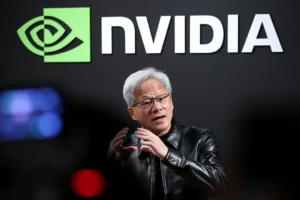
The artificial intelligence sector, which has been the primary engine of market growth for the past several quarters, faced intense scrutiny on Wednesday. Investors are currently engaged in a comprehensive "repricing" of AI-related stocks, moving away from a broad-based enthusiasm toward a more selective, risk-averse approach. Nvidia (NVDA), the quintessential bellwether for the AI revolution, felt the brunt of this sentiment. Despite a recent move to resolve leadership uncertainty by reinstating its chief executive, the stock remains vulnerable to concerns regarding export controls, potential regulatory investigations, and the long-term sustainability of enterprise-level AI spending.
Nvidia’s performance on Wednesday served as a microcosm of the day’s volatility. The stock dropped as much as 9.1% during the morning session before mounting a recovery to finish down 3.9%. Since hitting its all-time high on October 6, the company has seen approximately $2 trillion in market capitalization evaporate. This contraction is not unique to Nvidia; other sector players, including Advanced Micro Devices (AMD), Lam Research (LRCX), and Micron (MU), experienced similar intraday swings, reflecting a market that is struggling to determine whether the AI infrastructure build-out will generate the returns necessary to justify current high valuations.
The narrative surrounding newer entrants to the space also cooled. Anthropic (ANT), which held its initial public offering just last week, saw its share price dip below its $83 IPO valuation during the trading day. While the stock managed to reverse its losses to close up 1.1%, the initial downward pressure highlighted the "funding squeeze" currently impacting tech-heavy portfolios. As liquidity conditions tighten, some institutional investors are reportedly selling their newer, speculative AI holdings to rebalance their portfolios or meet capital requirements, further depressing prices.
Divergent Results in the Tech Sector
In contrast to the broader turbulence, the legacy PC market provided a rare bright spot. HP (HPQ) emerged as the top performer in the S&P 500, rallying 11.4% after reporting fiscal results that comfortably exceeded Wall Street expectations. The company posted earnings of 83 cents per share on $16 billion in revenue, handily beating the analyst consensus of 75 cents on $15.4 billion. This performance suggests that while the "AI hype" cycle is undergoing a reality check, there remains stable, fundamental demand for core enterprise hardware and computing infrastructure.
Dell Technologies (DELL) also showcased the industry’s pivot toward AI-integrated hardware. While the company reported strong fiscal 2027 third-quarter results and raised its full-year guidance, the stock’s reaction was muted compared to HP, finishing up 0.6% after an early 10.3% decline. The difference in price action between the two firms highlights a critical investor sentiment: while AI-integrated products are viewed as essential, investors are becoming increasingly sensitive to the "cost of success" and the capital expenditures required to maintain leadership in the AI platform space.
Geopolitical Implications and Trade Policy
The administration’s trade policy remains a significant variable for global supply chains. The decision to implement new tariffs on major trading partners is premised on the argument that foreign industrial subsidies have created an environment of "excess capacity," which the White House claims is flooding markets and disadvantaging domestic manufacturers.
However, economists warn that these policies carry the risk of retaliatory measures and increased costs for American companies that rely on global supply chains for components. The uncertainty regarding how these tariffs will be implemented—and whether they will be used as leverage for broader negotiations—has added a layer of complexity to corporate earnings forecasts for the coming year. As corporations prepare for a potential trade war, their willingness to commit to long-term capital expenditure, particularly in technology infrastructure, may fluctuate.
Looking Ahead to the Holiday Shortened Week
Market participants are now bracing for the upcoming Thanksgiving holiday, which will see both stock and bond markets closed on Thursday. The Friday session, typically characterized by low liquidity and shortened hours—closing at 1:00 PM Eastern Standard Time—could see exaggerated price movements if traders look to adjust their positions before the extended weekend.
The events of Wednesday underscore a shift in market psychology. After a long period where the "buy the dip" mentality prevailed, the current environment is defined by heightened caution. The combination of cooling AI enthusiasm, persistent inflation, and the threat of global trade barriers has created a "trilemma" for investors. As the market enters the final month of the year, the focus will likely remain on whether corporate earnings can continue to outpace macroeconomic headwinds.
For now, the resilience shown in the late-afternoon recovery of the Dow Jones and other major indexes suggests that while investors are nervous, there is no broad-based panic. Instead, the market is entering a phase of discovery, attempting to find a new equilibrium where valuations are tethered more closely to demonstrated profitability and less to speculative growth. Whether this stability holds will depend largely on the rhetoric surrounding the new trade policies and the next round of data regarding the Federal Reserve’s interest rate path in the weeks following the holiday break. Investors are advised to remain vigilant, as the volatility observed on Wednesday is likely to persist as long as the conflicting signals regarding the global economy continue to dominate the headlines.