Larry David Returns to HBO Max with "Life, Larry and the Pursuit of Unhappiness," A Star-Studded Historical Sketch Comedy Series

Larry David, the acclaimed creator and star of the long-running HBO comedy Curb Your Enthusiasm, has once again graced the screens of HBO Max with his latest venture, Life, Larry and the Pursuit of Unhappiness. This ambitious sketch comedy series delves into American history, reimagining pivotal moments and figures through David’s signature comedic lens. The show, executive produced by former President Barack Obama and Michelle Obama’s Higher Ground Productions, features an expansive roster of celebrity guests embodying historical characters, marking a significant departure from David’s previous improvisational style.
The series premiered following the conclusion of Curb Your Enthusiasm, a show that itself ran for over two decades and became a cultural touchstone for its cringe-comedy and unflinching portrayal of social awkwardness. Life, Larry and the Pursuit of Unhappiness leverages David’s unique comedic sensibility by placing him in the roles of various historical figures, from the Founding Fathers to figures of the Civil Rights Movement, and often interacting with a constellation of well-known actors and personalities. This approach allows for a fresh, albeit anachronistic, exploration of American history, infused with David’s characteristic exasperation and observational humor.
The scale of celebrity involvement in Life, Larry and the Pursuit of Unhappiness is a notable aspect of its production. Each episode boasts a dozen or more guest stars, including many of David’s Curb Your Enthusiasm co-stars, alongside major Hollywood figures like Samuel L. Jackson, Lin-Manuel Miranda, Jerry Seinfeld, and the late Rob Reiner, whose appearance in the series marked his final screen performance. This star power, combined with David’s established comedic brand, positions the show as a significant cultural event, drawing parallels to other high-profile historical comedies but with a distinctively Davidian flavor.
A Pantheon of Stars Embodies American History
The cast list for Life, Larry and the Pursuit of Unhappiness reads like a who’s who of contemporary entertainment. Beyond the core cast, the series features a remarkable array of talent. Henry Winkler embodies John Hancock, Chris Parnell takes on Benjamin Franklin, and Alan Tudyk portrays Thomas Jefferson in the inaugural episode, offering a comedic take on the drafting of the Declaration of Independence. Richard Kind reprises his role as Thomas Watson, creating an awkward encounter with David’s Alexander Graham Bell as the telephone is unveiled. The ensemble is further bolstered by appearances from sitcom veterans such as Alison Becker, Mary Sohn, and Rodney J. Hobbs.
The second episode sees a highly anticipated reunion between Larry David and Jerry Seinfeld, creators of the iconic sitcom Seinfeld. In their sketch, they portray explorers Lewis and Clark, embarking on a comedic reimagining of their expedition. Rita Wilson appears as Meriwether Lewis’s wife, Mavis, offering a wry commentary on the arduous journey. The episode also tackles the 1876 presidential election, with David as Samuel Tilden, highlighting the complexities of the Electoral College. Kaley Cuoco shines as a grieving widow during the Great Depression, and the episode culminates with Rob Reiner’s poignant final performance as George Washington, discussing presidential term limits in a segment that subtly critiques modern political discourse.
The third episode delves into the colonial era and the early days of aviation. Lin-Manuel Miranda, known for his role in the Broadway musical Hamilton, plays a charismatic figure in the Boston Tea Party, while J.B. Smoove offers a memorable turn as a demanding traveler on the Underground Railroad. Jon Hamm and Sean Hayes step into the roles of aviation pioneers Orville and Wilbur Wright, contrasting with David’s portrayal of a less accomplished Wright sibling. The episode’s most talked-about segment features David as Senator Joseph McCarthy, with Michael McKean as attorney Joseph Welch delivering the iconic “Have you no decency, sir?” line, a powerful moment that echoes historical hearings.
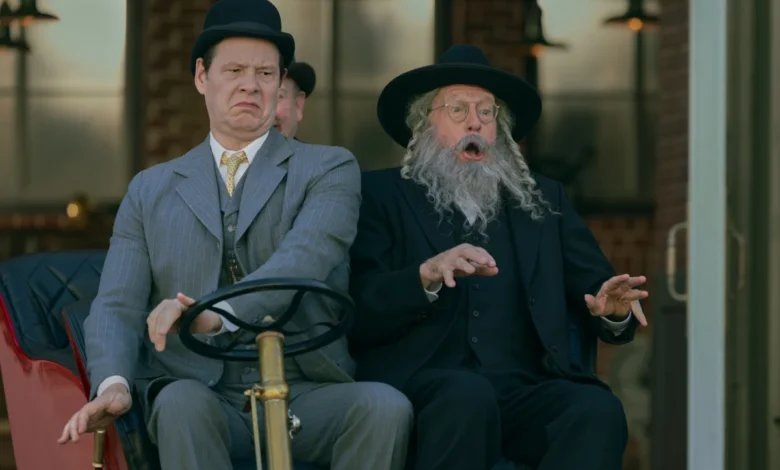
The fourth episode tackles the Watergate scandal, with David as a comically inept "Deep Throat" meeting with Beck Bennett’s Bob Woodward. Ike Barinholtz portrays a confrontational Henry Ford, encountering David’s rabbi character. The episode also features David as President James Buchanan, engaging in awkward social interactions. A particularly noteworthy sketch sees David as Dora Salk, the proud mother of Jonas Salk, bragging about the polio vaccine, a scenario that takes a sharp turn into contemporary vaccine skepticism, a subtle nod to the political discourse surrounding public health initiatives.
The fifth and final episode brings viewers to the Wild West and a reimagining of the Lincoln assassination. Timothy Olyphant and Don Johnson embody Wyatt Earp and Doc Holliday, respectively, engaging in a characteristically Davidian dispute over the logistics of the O.K. Corral shootout. Bill Hader delivers a nuanced performance as Abraham Lincoln, grappling with the strained relationship with his wife, Mary Todd Lincoln, played by Kathryn Hahn. The sketch explores the dynamics leading up to Lincoln’s assassination at Ford’s Theatre, with Lennon Parham as Laura Keene and Jay Renshaw as John Wilkes Booth, offering a darkly comedic perspective on a pivotal moment in American history.
A Historical Tapestry Woven with Comedic Threads
Life, Larry and the Pursuit of Unhappiness is not merely a collection of historical vignettes; it is a deliberate effort to engage with American history through a contemporary comedic lens. The series, airing new episodes Friday nights at 9 p.m. on HBO and streaming on HBO Max, provides a platform for David to satirize not only the past but also the present, drawing parallels between historical events and contemporary societal issues.
The inclusion of former President Barack Obama as an executive producer and a recurring on-screen presence underscores the show’s unique positioning. Obama’s introductory segment in the first episode, where he praises the nation as it approaches its semiquincentennial while playfully teasing David, sets a tone that is both celebratory of American history and self-aware of its ongoing narrative. His involvement signals a broader interest in using popular culture to engage with historical themes and national identity.
The choice to place David in such diverse historical roles allows for a consistent comedic throughline. Whether he is a Founding Father navigating the complexities of the Declaration of Independence, an inventor struggling with public reception, a soldier in the trenches of World War I, or a figure embroiled in the Watergate scandal, David’s persona remains the anchor. His trademark blend of neurosis, social ineptitude, and blunt honesty creates humor by highlighting the absurdity of human behavior, even in the most serious of historical contexts.
Behind the Scenes: Production and Creative Choices
The production of Life, Larry and the Pursuit of Unhappiness involved extensive historical research to inform the sketches, even as they deliberately subvert historical accuracy for comedic effect. The creative team, including David and the executive producers, aimed to balance educational elements with pure entertainment. The use of prosthetics, period costumes, and meticulously recreated sets contributes to the immersive quality of the series, making the historical settings feel authentic while the comedic performances provide a modern, irreverent commentary.
The decision to feature Rob Reiner’s final performance in the series adds a layer of poignancy to its release. Reiner, a veteran filmmaker and actor who also had a recurring role on Curb Your Enthusiasm, had a long-standing relationship with David. His appearance as George Washington in the second episode serves as a fitting capstone to a distinguished career and a testament to his enduring friendship with David.
Thematic Resonance and Cultural Impact
Life, Larry and the Pursuit of Unhappiness taps into a growing trend of historical narratives being re-examined through contemporary cultural prisms. By using sketch comedy, the show offers a more accessible and often more humorous entry point into historical events than traditional documentaries or dramas. The series implicitly argues that many of the foibles and absurdities of human nature are timeless, resonating across different eras.
The show’s engagement with sensitive historical topics, such as the Civil Rights Movement and political controversies, also invites discussion. While David’s approach is primarily comedic, the juxtaposition of his character with figures like Rosa Parks or the context of McCarthyism can spark reflection on the complexities and challenges of American history. The inclusion of contemporary political commentary, such as veiled references to former President Trump, further blurs the lines between historical satire and social commentary, reflecting David’s ongoing commitment to observing and critiquing the world around him.
The series’ success hinges on its ability to maintain a delicate balance: honoring historical moments while thoroughly lampooning them through David’s unique comedic voice. With its star-studded cast and ambitious scope, Life, Larry and the Pursuit of Unhappiness represents a significant contribution to the landscape of television comedy, offering a fresh and hilarious perspective on the grand, often messy, narrative of American history. The ongoing serialization of the show, with new episodes released weekly, ensures that audiences will have ample opportunity to engage with its unique blend of history, comedy, and celebrity.